
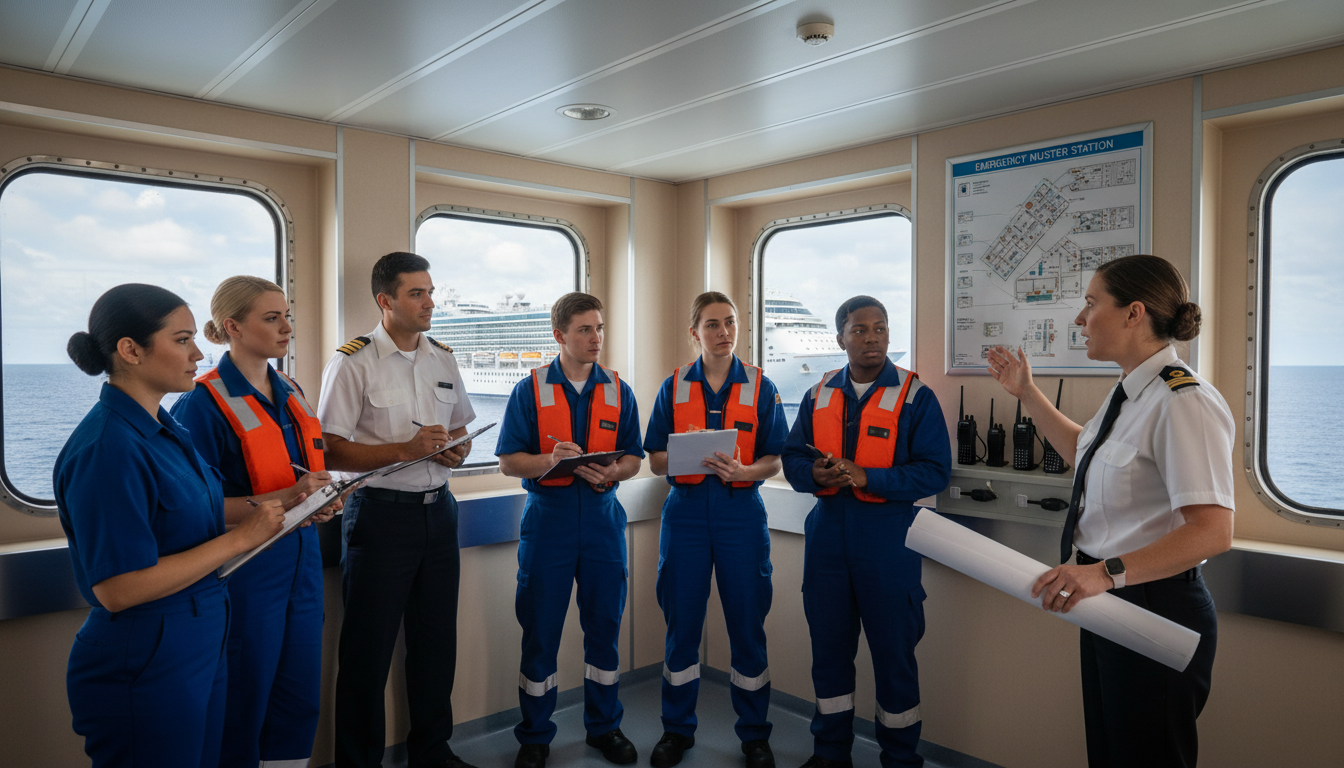
Cruise ship crisis management training is about making sound decisions when information is incomplete, passengers need reassurance and several departments must act together. This guide explains what supervisors should practise, how STCW passenger-ship responsibilities differ and how to transfer course learning into shipboard performance.
Why cruise supervisors need crisis management competence
Passenger ship emergencies place unusual demands on supervisors. They may need to interpret information, coordinate personnel, support passengers and report rapidly to the emergency organization. The applicable STCW passenger-ship requirements distinguish crisis management and human behaviour from crowd management. A supervisor should first check whether their role carries a designated responsibility for passenger safety in an emergency. The company training matrix and muster list matter more than a generic job title. Completing a course is one component of readiness; vessel familiarization, exercises, clear reporting arrangements and the ability to work within the emergency plan are equally important.
Crisis management is not the same as crowd management
Crowd management concerns personnel assigned to assist passengers, including orderly movement and communication. Crisis management and human behaviour addresses a different level of emergency responsibility, including managing responses and understanding human reactions. The two competencies should not be treated as interchangeable. For example, a crew member directing passengers to an assigned station has a different task from a supervisor coordinating a team and managing conflicting information. Compare Panama Crisis Management and Human Behaviour with Panama Crowd Management according to the employer’s role requirements.
Define roles before an emergency begins
A supervisor should be able to explain their emergency assignment, whom they report to, who reports to them and which decisions they are authorized to make. Ambiguity can produce duplicated work or leave important tasks unattended. During familiarization, use the actual vessel’s emergency organization rather than a hypothetical chart. Ask supervisors to identify their reporting point, approved communication methods and escalation route when a problem falls outside their authority. An effective exercise checks whether responsibilities remain clear when a team member is unavailable. Avoid publishing sensitive details of a ship-specific emergency plan in open training materials.
Scenario: two departments report conflicting information
Imagine a supervisor receives one report suggesting that a passenger area has been cleared and another saying assistance is still needed there. Acting on the first message alone could create a dangerous assumption. The supervisor should follow the vessel’s reporting and verification process, identify the source and timing of each report, and escalate uncertainty to the authorized decision-maker. In a roundtable, ask participants what information is missing, which questions they would ask and how they would prevent an unverified claim from becoming an official instruction. The objective is disciplined information management, not improvising emergency tactics.
Decision-making when the picture is incomplete
Real emergencies rarely deliver perfect information. Supervisors need to distinguish observations from assumptions and know when to escalate rather than delay. Training should use time-pressured decisions that stay within the company’s procedures. A good facilitator asks what the supervisor knows, what remains uncertain, who has authority and what must be communicated next. Learners should explain their reasoning and compare it with the ship’s approved process. A course that only tests definitions may miss this essential skill. The purpose of scenario work is to develop judgment while respecting the established command structure.
Understand human behaviour under stress
Passengers and crew may react differently to alarms, disruption or uncertainty. Some ask repeated questions; others hesitate, seek relatives or follow the behaviour of people around them. Training should encourage supervisors to recognize these possibilities without stereotyping or diagnosing individuals. Clear instructions, respectful language and visible coordination can support understanding. In a scenario, ask how a team would respond when several passengers seek contradictory information. The supervisor should keep messages consistent with authorized announcements and arrange support through the emergency organization. Human behaviour knowledge is useful only when translated into appropriate actions.
Communicate across departments
A passenger-ship emergency may involve deck, technical, hotel, medical and security personnel. Supervisors should know how information flows between their team and the broader emergency organization. Practise short reports that distinguish location, observation, action already taken and support requested. Use closed-loop communication where appropriate: the recipient repeats critical information so misunderstandings can be corrected. In multilingual teams, avoid idioms and unnecessary jargon. If two departments use different terms for the same place or event, resolve the ambiguity during drills rather than discovering it under pressure.
Avoid conflicting passenger messages
A reassuring tone is valuable, but reassurance must not turn into speculation. Supervisors should ensure personnel use approved announcements and directions and do not promise outcomes they cannot verify. A practical discussion might begin with a passenger asking whether an area is safe when the team has no confirmed answer. Learners can practise acknowledging the question, explaining what information is available and following the authorized reporting channel. Effective communication does not mean giving an immediate answer to every question. It means protecting accuracy while helping passengers understand the next approved step.
Delegation and workload management
Under pressure, supervisors can become bottlenecks if they attempt to handle every issue personally. Training should explore how to allocate tasks within assigned authority, confirm understanding and maintain oversight. Delegation requires clarity about what is expected and when an update is needed. It does not mean bypassing the ship’s emergency command arrangements. In a tabletop exercise, give a team several simultaneous reports and ask the supervisor to identify priorities and communication needs. The debrief should examine whether important information was lost or tasks were assigned without confirmation.
Scenario: a supervisor must hand over responsibility
Consider a supervisor who is reassigned during a prolonged exercise. The replacement needs a reliable picture of completed actions, unresolved concerns and reporting obligations. An unstructured handover can cause duplicated work or missed requests. Ask learners to practise a concise handover using a fictional situation. The receiving supervisor should repeat the key unresolved issues and confirm the appropriate communication channel. The exercise demonstrates that crisis management includes continuity, not only the first minutes of an incident. The precise handover method must follow the vessel’s emergency procedures.
Train with tabletop discussions and realistic drills
Tabletop exercises let supervisors explore decisions without placing passengers or operations at risk. Start with a clear objective, such as verifying reports or managing cross-department communication. Provide an initial situation and introduce one realistic complication. Ask each participant to explain their role and next communication step. Then compare responses with approved procedures. Practical drills and formal assessments remain necessary where required; a discussion does not replace them. Use the results to identify weaknesses in knowledge, familiarization or team coordination and assign specific follow-up actions.
A 25-minute supervisor roundtable
Spend five minutes reviewing the emergency organization and the learning objective. Present a fictional passenger-area incident and give groups six minutes to identify verified facts, assumptions and reporting priorities. Introduce a conflicting message and allow another five minutes for revised decisions. Use six minutes to compare answers with the vessel’s approved process. Finish with three minutes for individual reflections and assigned follow-up. A facilitator should avoid rewarding the loudest participant; ask quieter supervisors to explain their reasoning. Document training gaps and refer operational changes through the appropriate company process.
Debrief behaviour, not only attendance
After a drill, a useful debrief asks what the team expected, what actually happened and why differences arose. Review the clarity of reports, role allocation, escalation and communication with passengers. Separate individual learning needs from problems caused by unclear procedures or equipment limitations. Avoid a blame-focused atmosphere that discourages honest reporting. Record observations, corrective actions, responsible owners and review dates. A completed attendance sheet shows participation, not whether the team can perform reliably. Supervisors should receive feedback they can apply during the next exercise.
Choose training by duty and issuing approval
Marine Pro Academy offers Panama-approved Crisis Management and Human Behaviour and a Liberia course option. Compare the relevant STCW competence, approval, assessment arrangements and employer recognition before enrolling. If a supervisor also has passenger-assistance duties, examine whether Liberia Crowd Management is separately required. A more expensive course or a bundle is not automatically the right qualification. The assigned role and accepted evidence should determine the purchase.
What crewing and training teams should record
Keep the person’s assigned position, passenger-ship duties, required competence, issuing approval, verification evidence and completion details in the training matrix. Record ship-specific familiarization and drills separately. When someone changes ship, department or emergency responsibility, review their requirements rather than carrying forward assumptions from a previous assignment. If certificate recognition is unclear, ask the employer or relevant administration before the joining deadline. A clear audit trail supports readiness and reduces last-minute disputes over whether the correct course was completed.
Frequently asked questions
Does every cruise supervisor need crisis management training? Requirements depend on the assigned emergency responsibilities and applicable passenger-ship rules. Is crowd management a substitute? No; the competencies address different responsibilities. Can an online course replace shipboard drills? Not where familiarization, drills or practical assessment are required. What should supervisors practise? Role clarity, verified reporting, decision-making, communication and debriefing. How should I select a course? Confirm the employer’s matrix, flag recognition, delivery method and certificate verification before paying.
Final supervisor readiness checklist
Confirm the muster assignment and the applicable STCW competence. Verify that the certificate issuer and delivery arrangements are accepted for the intended vessel. Learn the actual emergency organization and reporting routes during joining familiarization. Practise concise reports, escalation of uncertain information and respectful passenger communication. Participate in required drills and review feedback with your team. Record unresolved gaps and their owners. Effective crisis management training helps supervisors make coordinated decisions; it should never encourage them to improvise outside their authority.
Leave a Reply