
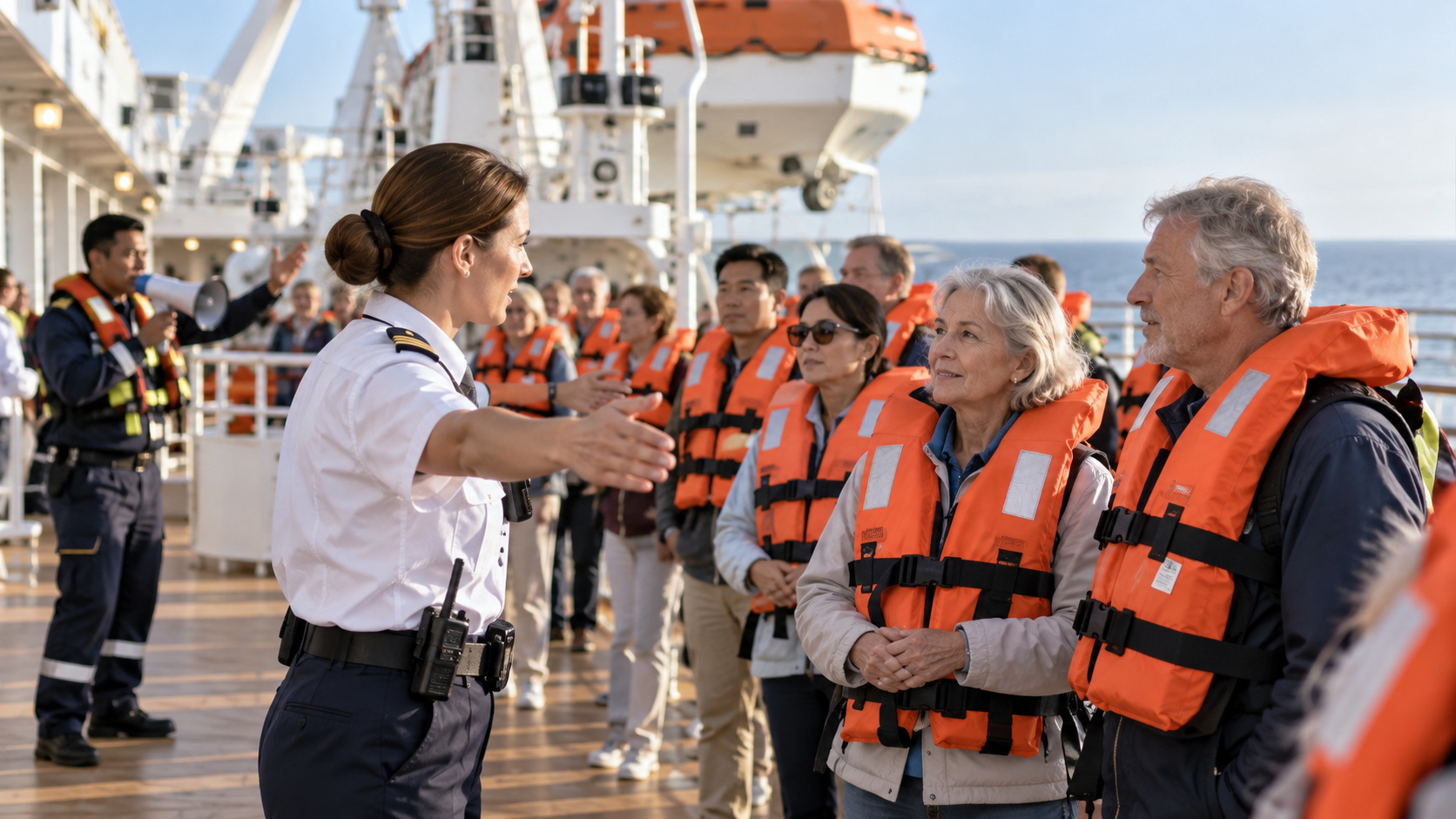
Effective passenger ship crowd management training prepares designated crew to assist passengers, communicate calmly and follow the vessel’s emergency organization. This practical guide covers STCW passenger-ship responsibilities, realistic onboard scenarios, training selection, certificate checks and a short supervisor discussion exercise.
What passenger ship crowd management training covers
Passenger ship crowd management training prepares personnel who are designated on muster lists to assist passengers in emergency situations. It focuses on directing people, communicating instructions, understanding shipboard arrangements and supporting orderly movement. The relevant STCW passenger-ship training provisions distinguish crowd management from other competencies, including crisis management and human behaviour. Training needs depend on duties and vessel type, not simply whether a person works in a hotel or marine department. The first step is to check the actual muster assignment and the company’s training matrix. A course completion record does not replace the ship-specific familiarization, drills or practical competence required for the role.
Who should complete crowd management training?
On passenger ships, personnel designated on muster lists to assist passengers in emergencies are the central audience for crowd management training. Depending on the operator, this may include guest services, housekeeping, restaurant, entertainment or deck personnel with passenger-assistance assignments. Not every employee has identical duties, and training should not be selected solely by department title. Crewing managers should examine the position, muster-list responsibility and applicable flag-state requirements. If a crew member changes assignments during a contract, review their training before assigning new responsibilities. Keep the evidence in the crew training matrix so supervisors can verify it before an exercise or inspection.
Crowd management versus crisis management
These topics are connected but not interchangeable. Crowd management emphasizes assisting passengers, communicating directions and helping people move safely under the ship’s emergency arrangements. Crisis management and human behaviour training addresses a different set of responsibilities for personnel designated to manage or take responsibility for passenger safety in emergencies. A person who holds one certificate should not automatically assume that it satisfies the other requirement. Compare Panama Crowd Management with Panama Crisis Management and Human Behaviour according to the role, approved course scope and employer acceptance.
Understand the muster list before the emergency
The muster list identifies emergency responsibilities and reporting arrangements. Training should help each participant understand their own assignment, the designated reporting point and the boundaries of their authority. A restaurant employee who assists passengers may have a very different task from an officer directing an emergency team. The ship’s emergency plan determines the applicable route, communications and contingency arrangements. During familiarization, ask crew to locate their station, explain who they report to and describe how they would request assistance. Do not rely on a generic diagram from an online lesson when the actual vessel layout and arrangements may differ.
Scenario: an unfamiliar passenger asks for directions
Imagine an alarm has sounded and a passenger in a public area asks a crew member which way to go. The crew member has a designated passenger-assistance duty but is unsure whether the usual route is available. The correct response is not to improvise a shortcut. They should follow the current shipboard instructions, communicate clearly, and obtain clarification through the designated chain of command if the route is uncertain. In a training discussion, ask learners what information they can safely give, whom they should contact and how they would avoid contradicting official announcements. The scenario tests judgment and communication without inventing a universal evacuation procedure.
Give short, understandable instructions
During an emergency, long explanations can confuse people, especially when there is noise, stress or a language barrier. Crew should practise concise statements, calm tone and simple confirmation questions. Use approved terminology and directions consistent with the ship’s emergency organization. Avoid idioms or casual language that could be misunderstood. In a roundtable, have one participant explain an assigned instruction and another repeat what they understood. If the message changes as it passes between people, discuss how to correct the misunderstanding. Training should reinforce that crew must not announce unverified information or give conflicting directions.
Supporting passengers with different needs
Passenger populations include children, older travellers, people with reduced mobility and guests who may not understand the primary language of announcements. Crowd management training should consider how designated personnel recognize a need for assistance and communicate it through approved arrangements. Crew should understand what support they are trained and authorized to provide, and when specialist assistance is required. Do not promise that one generic technique suits every person or vessel. A useful scenario involves a family separated during an exercise or a passenger who cannot use the expected route. Ask participants how they would seek help while maintaining their assigned responsibilities.
Recognize anxiety without escalating it
Passengers may react to unfamiliar alarms with uncertainty, frustration or fear. A crew member’s body language and wording can affect whether instructions are understood. Training can explore how to remain calm, avoid speculation and provide consistent information without minimizing genuine concerns. The goal is not to diagnose passenger behaviour. It is to support safe communication and follow the emergency organization. Practise responding to a passenger who asks the same question repeatedly or challenges an instruction. Supervisors should give feedback on clarity, respect and whether the response stays within the crew member’s authority.
How hotel departments contribute
Hotel and hospitality crew may have frequent passenger contact, so their communication skills are important. However, a customer-service role does not automatically authorize someone to direct an emergency response. The muster list and approved procedures define their duties. Training managers can connect crowd management learning to realistic settings such as dining rooms, corridors and entertainment venues. Discuss how a crew member can identify a concern, maintain a clear communication channel and assist passengers as assigned. Include situations where the employee must stop routine service and report to an emergency station. The ship’s instructions always take priority over normal hospitality routines.
Coordinate with the ship’s emergency organization
Crowd management is a team activity. Individual actions must align with announcements, muster arrangements and the instructions of authorized personnel. A crew member who notices a blocked area, an unexpected crowd movement or a passenger needing help should know the correct reporting route. Training can use a simulated handover: one participant observes a problem, another receives the report and a supervisor checks whether the message contains the location, concern and requested support. Avoid sharing sensitive ship-specific operational details in public training material. The practical objective is accurate communication and disciplined coordination.
Prepare new joiners with vessel-specific familiarization
An approved course introduces competence, but a newly joined crew member still needs to learn the particular vessel. Relevant familiarization may include the assigned station, reporting arrangements, signage, communication equipment and approved routes. The scope depends on the vessel and duties. A supervisor can ask the person to demonstrate where they report and describe what they would do if their normal contact is unavailable. Document completion according to company procedures. If someone cannot explain their assignment, schedule follow-up instruction before treating them as ready for the role. Familiarization is a practical safeguard, not an administrative formality.
A 20-minute roundtable for supervisors
Start with a three-minute review of the assigned passenger-assistance role. Present a fictional situation involving a confused passenger and a changed route, then give small groups five minutes to discuss how they would respond. Use another five minutes to compare answers against the vessel’s approved procedures. Spend four minutes practising short passenger instructions and closed-loop reporting. Finish by asking each participant to name one area where they need clarification. This exercise reinforces learning but does not substitute for a required drill or approved assessment. Record attendance, observed gaps and follow-up actions under the company training process.
What an effective course assessment looks like
Knowledge questions can check terminology and responsibilities, but scenario questions better reveal whether learners can apply principles. For example, ask what a designated crew member should do when a passenger requests information that has not been confirmed. Feedback should explain why unauthorized improvisation is risky and why communication channels matter. Formal training and assessment must meet the applicable approved arrangements. Onboard supervisors can supplement this with observation during familiarization and drills. A completed quiz is useful evidence of learning, but should not be represented as universal proof that a crew member is ready for every emergency duty.
Choosing the correct issuing approval
Before enrolling, verify the course’s applicable STCW scope, approval or recognition, assessment method and acceptance by the intended employer or flag administration. Marine Pro Academy lists Panama-approved Crowd Management and Liberia Crowd Management. These are options to compare, not evidence that every certificate is accepted universally. Ask the employer which issuing arrangement is required. Check how the certificate can be verified and whether any additional practical training or ship-specific familiarization applies to the assignment.
Build a useful training record
A training record should identify the crew member, position, relevant muster assignment, course completed, issuing body and verification status. Record vessel familiarization and drills separately from portable course certificates. When a crew member transfers between ships, do not assume that familiarity with one layout or emergency organization transfers automatically. A crewing team should be able to explain why the course was required and how it aligns with the assigned role. If a certificate’s acceptance is uncertain, resolve that before the joining deadline. Clear records help supervisors, auditors and crew avoid last-minute confusion.
Common mistakes before joining a passenger ship
A frequent mistake is buying a course because the title sounds relevant without checking the assigned muster duty. Another is confusing crowd management with crisis management and human behaviour. Other problems include relying on an unverified certificate, overlooking assessment requirements and assuming an online lesson replaces ship-specific familiarization. Crew should also avoid waiting until travel arrangements are finalized to ask whether a certificate is accepted. Compare the Liberia Crisis Management course only when the role calls for that separate competence. Purchasing the wrong qualification wastes time and money.
Frequently asked questions
Does every cruise ship employee need crowd management training? Requirements depend on passenger-ship duties, including muster-list assignments, and applicable rules. Is crowd management the same as crisis management? No; they address different responsibilities. Can online learning replace a shipboard drill? Not where a drill, familiarization or practical assessment is required. Which certificate should I buy? Confirm the employer’s training matrix, issuing approval and intended role first. How can supervisors reinforce training? Use realistic scenarios, concise communication practice and feedback from approved drills.
Final pre-joining checklist
Confirm your assigned passenger-assistance duties and the applicable STCW competence. Check course approval, employer recognition and assessment arrangements before paying. Keep a verifiable certificate and share it with the crewing team in advance. On joining, learn the ship’s muster organization, reporting point and communication expectations. Ask for clarification if a route, station or responsibility is uncertain. Participate in required familiarization and drills, and act on feedback. Effective passenger ship crowd management is not about memorizing a few directions: it is about helping people through coordinated, clear and role-appropriate action.
Leave a Reply