
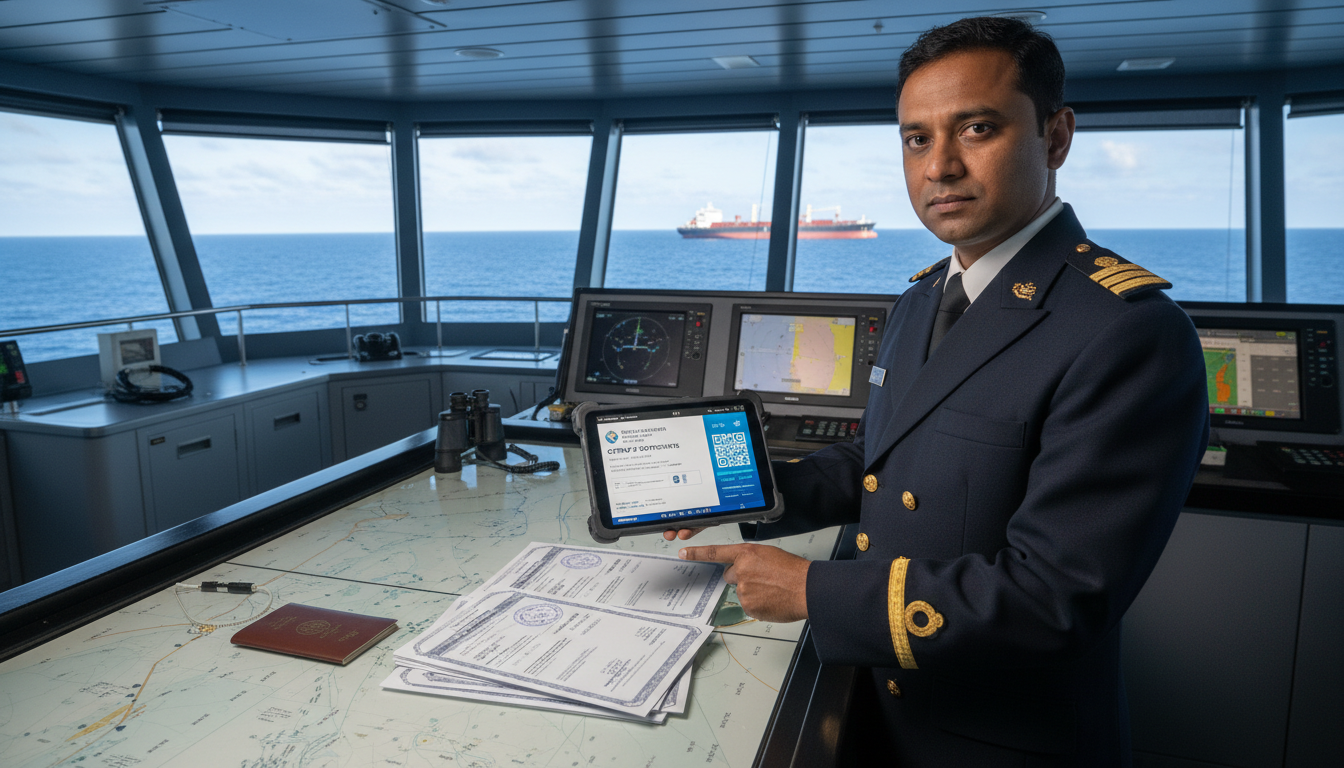
STCW certificate verification should be part of every seafarer’s pre-joining routine. A maritime certificate can look completely normal and still create a problem when a crewing department tries to verify it.
That is why STCW certificate verification should be part of every seafarer’s pre-joining routine.
Before a vessel accepts you for service, an employer may need to confirm that your training is genuine, current, appropriate for your role and issued under the correct approval arrangement.
Verification is therefore about more than checking the expiry date. It means confirming that the certificate can be linked to the training provider, issuing organization and approval pathway it claims to represent.
Why STCW Certificate Verification Matters
Maritime employers depend on certificates to demonstrate that crew have completed required training.
Those documents may be checked during:
- recruitment
- pre-joining compliance reviews
- flag-state applications
- endorsement processing
- audits
- inspections
- internal company verification
If a certificate cannot be verified, the employer may need additional evidence before accepting it. That can delay joining instructions, travel booking, flag-state paperwork, Seaman Book applications or assignment to a particular position.
The safest approach is to identify verification issues while you are still at home rather than after you have started travelling.
Start With the Exact Certificate
Before contacting anyone, check the document itself.
Confirm that it contains the expected information, such as:
- full name
- course title
- STCW reference where applicable
- certificate number
- issue date
- issuing organization
- approval information where relevant
- signatures or authentication details
- verification instructions if provided
Your name should match your passport and other maritime documents. Small differences can create unnecessary questions, so resolve discrepancies before the joining process becomes urgent.
Approval and Verification Are Different
A certificate may be verifiable without being suitable for every maritime purpose. Likewise, a course can carry legitimate authority approval while still needing to be checked against your specific vessel or employment requirement.
This is why seafarers should understand the difference between verification, approval, recognition and acceptance. Marine Pro Academy explains these distinctions in more detail in Approved vs Recognized Maritime Certificates.
A certificate can pass an authenticity check and still be unsuitable for the intended flag or role.
Check Which Administration Approved the Course
For statutory maritime training, approval information matters.
Before joining, ask:
- Which administration approved the course?
- Does that approval apply to this exact course?
- Does it cover the delivery format used?
- Is the approval relevant to my intended assignment?
- Does my employer require a specific flag-state pathway?
Marine Pro Academy offers STCW courses across different certification pathways. Where a course has specific Panama, Liberia or another authority approval, the relevant product page should identify that status.
Do not rely on broad wording such as “internationally approved” or “accepted worldwide.” Specific approval information is more useful than general marketing claims.
Verify Before You Buy, Not Only After
Certificate verification should begin before enrollment.
Before purchasing a course, check whether the provider explains:
- who issues the certificate
- which administration approves it where applicable
- how the certificate can be verified
- what assessment is required
- whether practical training is involved
- who the course is intended for
This reduces the risk of completing training that does not solve your actual requirement.
For example, a seafarer preparing for a Panama-related assignment may need a specific Panama-approved pathway. Marine Pro Academy provides a dedicated Panama-approved STCW course category for applicable training.
Online Certificates Need the Same Checks
An online certificate should not be judged simply because it was delivered digitally.
The important questions are:
- Was online delivery permitted for the course?
- Who issued the certificate?
- What approval applies?
- How was the learner assessed?
- Can the document be authenticated?
- Does the employer accept it for the intended purpose?
Marine Pro Academy’s guide to Online Certificate Validity for Seafarers explains why online delivery and certificate acceptance need to be considered separately.
How STCW Certificate Verification Works
Where a certificate provides a verification method, use it.
This may include:
- certificate number
- QR code
- provider verification portal
- email verification
- database search
- direct confirmation from the issuing body
Marine Pro Academy provides a dedicated Certificate Verification service for applicable certificates issued through its training system.
When checking a certificate, compare the verification result with the document itself. The learner name, certificate number, course, issue date and issuing entity should correspond.
Do Not Edit Certificate Files Yourself
A spelling error or formatting problem should be corrected by the issuing provider.
Do not modify a PDF certificate yourself. Editing names, dates, numbers, logos, signatures or approval information can make a genuine certificate appear suspicious.
If your document contains an error, request an official correction or reissue and keep the original delivery record where possible.
Check Expiry and Verification Together
A certificate can be genuine but expired. That is why authenticity and validity need to be reviewed separately.
Before joining, check:
- Is the certificate genuine?
- Is it still current?
- Does it remain valid for the expected contract?
- Does the employer accept it for the role?
Marine Pro Academy’s guide to Certificate Renewal Timing for Seafarers explains how to review documents before expiry becomes urgent.
Check the Whole STCW File
Verification should not focus on one document while ignoring the rest.
Depending on your role, review training such as:
- Personal Survival Techniques
- Fire Prevention and Fire Fighting
- Elementary First Aid
- Personal Safety and Social Responsibilities
- Security Awareness
- Designated Security Duties
- Crowd Management
- Crisis Management
- Ship Security Officer
- other role-specific training
For crew who need several related certificates, Marine Pro Academy’s STCW course bundles can simplify training across compatible pathways. Verify that the bundle matches your actual requirements before enrolling.
Security Training Requires the Right Level
Security certificates are a common area of confusion. Not every seafarer requires the same level of security training.
Personnel without designated security duties may need Security Awareness. Personnel with assigned security responsibilities may require Designated Security Duties. Some officers may require Ship Security Officer training depending on their role.
For Panama-related requirements, Marine Pro Academy offers a Panama-approved Security Awareness + Designated Security Duties Bundle.
Verification Becomes Important for Endorsements
Flag-state endorsement applications can require verification of the underlying professional certificates.
An authority may need to confirm the Certificate of Competency, Certificate of Proficiency, issuing administration, certificate validity and professional capacity.
Marine Pro Academy provides Panama Endorsement support for eligible endorsement applications. Final verification and issuance remain with the Panama Maritime Authority and other relevant issuing bodies.
Seaman Book Applications Can Also Depend on Training Documents
A Seaman Book application can require supporting maritime documentation, depending on the issuing administration and application type.
Marine Pro Academy provides Seaman Book application support for selected administrations. Submitting clear and verifiable documents from the beginning helps reduce avoidable follow-up.
What Employers Should Check
Crewing departments should use a consistent verification process:
- Receive the certificate
- Check name and document details
- Confirm expiry
- Confirm approval status where required
- Verify authenticity
- Confirm suitability for the assigned role
- Record the result in the crew file
For larger operations, the process should form part of the company’s crew-compliance system rather than relying on individual email threads. Marine Pro Academy’s B2B Maritime Solutions support maritime companies with coordinated crew training and documentation workflows.
Warning Signs That Need More Checking
A certificate deserves further review if:
- the issuing organization cannot be identified
- the certificate number cannot be checked
- approval claims are vague
- the course title does not match the requirement
- important information is missing
- the document appears edited
- names differ significantly from the passport
- dates appear inconsistent
- the provider cannot explain how authenticity is confirmed
A warning sign does not automatically mean fraud. It means the document requires clarification.
Keep an Organized Digital Certificate Folder
Create a secure digital folder containing current versions of your documents and use clear filenames. This makes it easier to respond quickly when a recruiter asks for records.
A Pre-Joining Verification Checklist
Identity
- Does my name match across documents?
- Is my passport current?
Training
- Are the correct STCW courses completed?
- Are certificates still valid?
- Is the approval pathway appropriate?
Verification
- Can each important certificate be authenticated?
- Do certificate numbers and names match?
Employment
- Does the employer accept the certificates?
- Are any additional company courses required?
Documentation
- Is my Seaman Book current?
- Are endorsements valid?
- Is my medical current?
Why STCW Certificate Verification Protects Your Joining Date
STCW certificate verification may feel like an administrative detail, but it is an important part of deployment readiness.
A genuine certificate that cannot be located quickly, a valid course from the wrong approval pathway or a document carrying inconsistent information can all slow down an otherwise straightforward joining process.
Marine Pro Academy supports seafarers with STCW training, Certificate Verification, Seaman Book services and Panama Endorsement support.
The goal is simple: when your employer checks your documents, the answer should be clear, fast and easy to verify.
Leave a Reply