
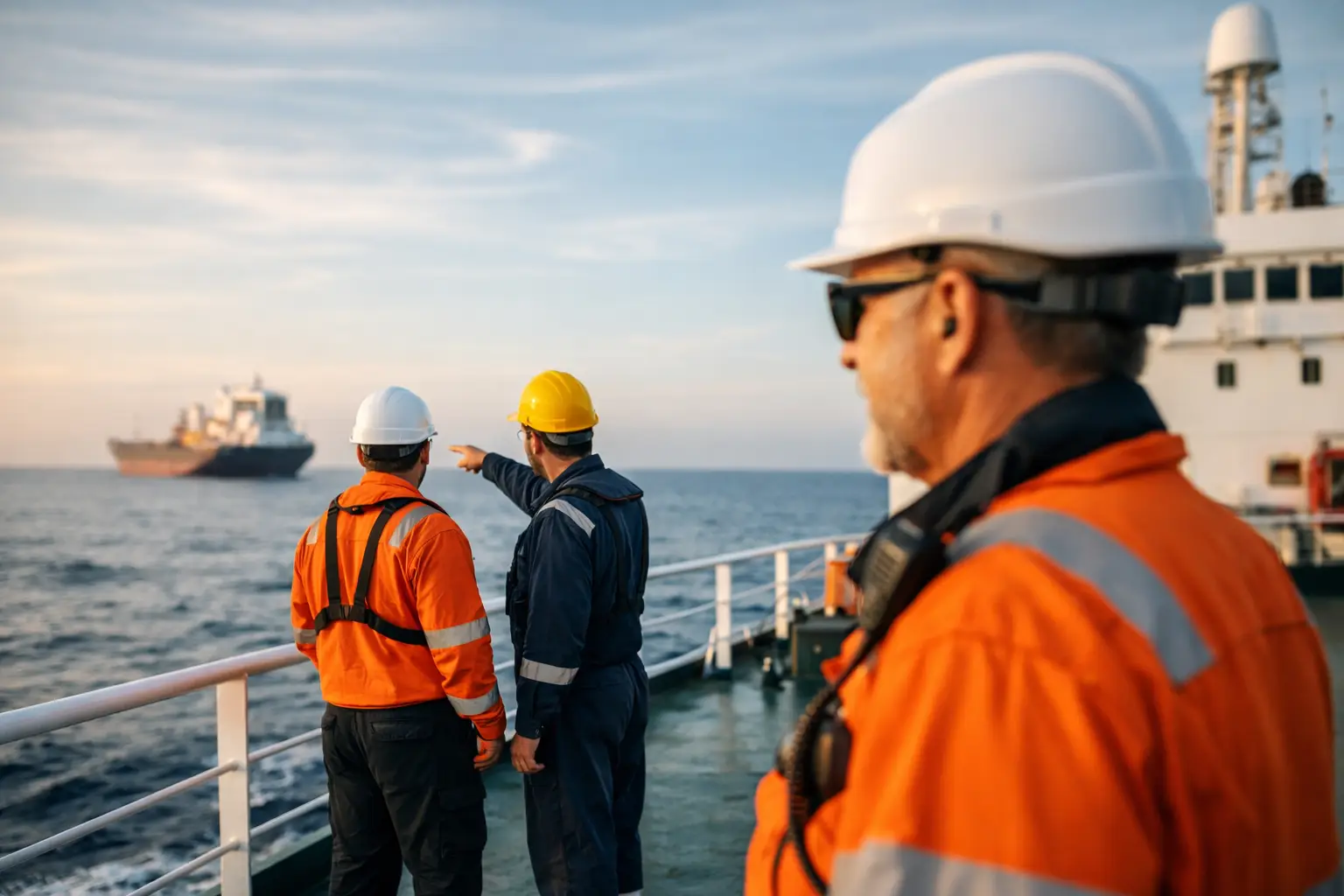
A near miss rarely starts with a major failure. More often, it begins with something small – a rushed handover, a missed toolbox talk, an assumption that someone else checked the permit, or a crew member who noticed a hazard but stayed quiet. That is where safety leadership and safety awareness matter most onboard. They shape what happens before an incident, not just how people react after one.
At sea, technical competence is essential, but it is not enough on its own. A vessel can have compliant procedures, approved equipment, and trained crew, yet still operate unsafely if leadership is weak or awareness fades during routine work. Maritime safety depends on consistent behaviors under pressure, during fatigue, and across multicultural crews working in changing conditions.
What safety leadership and safety awareness mean onboard
Safety leadership is not limited to the master or senior officers. It is the practical ability to influence safe decisions, reinforce standards, and act early when conditions change. Onboard, that can mean a chief officer stopping a cargo task because the risk has shifted, an engineer challenging an unsafe shortcut in the engine room, or an able seaman speaking up about a slip hazard before anyone gets hurt.
Safety awareness is the crew’s ability to recognize hazards, understand risk, and stay alert to how fast normal operations can become unsafe. It includes situational awareness, but it also goes further. A safety-aware crew member does not just see a hazard. They connect it to consequences, controls, and the job being done at that moment.
The two are closely linked. Leadership sets the standard for what is acceptable. Awareness determines whether crew can identify and respond to risk in time. If leadership is strong but awareness is weak, hazards go unnoticed. If awareness is high but leadership is poor, people may see problems but hesitate to act.
Why safety leadership and safety awareness affect compliance
Maritime compliance is often treated as a paperwork issue. In practice, it is a behavior issue just as much as a documentation issue. Procedures, drills, permits to work, risk assessments, and reporting systems only work when people apply them correctly and consistently.
This is where safety leadership and safety awareness have direct operational value. They reduce the gap between what the manual says and what happens on deck, on the bridge, or in the engine room. That gap is where incidents, deficiencies, and avoidable delays tend to develop.
For seafarers, this matters beyond the immediate safety outcome. A weak safety culture can affect inspections, contract continuity, and employability. Companies want crew who follow procedures, communicate clearly, and contribute to a safer working environment. Good safety performance supports readiness for joining, smooth vessel operations, and confidence during audits and flag-state requirements.
What strong safety leadership looks like in real operations
Strong safety leadership onboard is usually visible in small decisions, not speeches. It shows up in how work is planned, how concerns are handled, and whether standards stay consistent when the vessel is busy.
A strong safety leader makes expectations clear before the job starts. They verify understanding, not just attendance. They ask whether conditions have changed, whether the controls are still valid, and whether the team has the right equipment and enough time. This is especially important during enclosed space entry, mooring operations, hot work, lifting activities, and any task where routine can create overconfidence.
Just as important, effective leaders make reporting safe. If crew believe that speaking up will lead to blame, silence becomes normal. If they know concerns will be heard and acted on, reporting becomes part of daily operations. That shift can prevent repeat incidents and strengthen trust across ranks.
There is also a balance to manage. Leadership should be firm on standards without becoming so rigid that crew stop sharing concerns. A command style may work in an emergency, but during routine operations, crews perform better when expectations are clear and communication remains open.
Building safety awareness under real shipboard pressure
Safety awareness is easy to discuss in training. It is harder to maintain during long watches, port turnarounds, fatigue, weather changes, and tight operational schedules. That is why awareness must be built into the work itself.
Pre-job briefings are one of the simplest examples. When done properly, they do more than repeat the checklist. They focus attention on the specific hazards of that task, in that location, with that team, under those conditions. The difference matters. A generic briefing creates compliance on paper. A focused briefing improves actual awareness.
Handover quality also plays a major role. Poor handovers reduce awareness quickly, especially when the oncoming watch assumes conditions are stable. Clear updates on equipment status, ongoing permits, environmental conditions, traffic, maintenance activities, and unresolved hazards help preserve continuity and reduce mistakes.
Drills matter too, but realism matters more. If drills become predictable and rushed, they stop improving awareness. When scenarios reflect likely onboard risks and include communication, decision-making, and role clarity, they sharpen both confidence and response quality.
Where crews often lose awareness
Loss of awareness usually does not come from lack of knowledge. It comes from familiarity, fatigue, distraction, and production pressure. Jobs that have been done many times can feel safe even when the risk remains high. That is when shortcuts appear.
Multinational crews face an added challenge. Even when everyone is competent, differences in language, communication style, and risk perception can affect how hazards are understood. Leaders need to check comprehension directly, not assume that silence means clarity.
Digital tools can help, but they are not a substitute for judgment. Online training, virtual simulation, and mobile access to procedures support readiness, especially for seafarers managing certification and compliance between contracts. But onboard awareness still depends on crews applying that knowledge in live conditions. The benefit of digital training is speed, accessibility, and consistency. The trade-off is that shipboard reinforcement remains essential.
How to strengthen safety leadership and safety awareness
Improvement does not always require a major new system. In many cases, it starts by tightening daily routines and making safety visible in decisions, not just documents.
Leaders should begin with clarity. Every job needs a shared understanding of the task, the hazards, the controls, and the stop-work threshold. Ambiguity is a safety risk.
Next comes consistency. If procedures are enforced only during inspections or formal visits, crews notice that quickly. Standards need to hold during normal operations, busy turnarounds, and inconvenient moments.
Feedback is equally important. Near-miss reports, unsafe condition observations, and post-task reviews should lead to visible action. When crews see that reporting changes something, awareness becomes more active and more honest.
Training should also match operational reality. Seafarers benefit most from instruction that is practical, compliant, and available without unnecessary delay. For globally mobile crews, access matters. A digital-first platform like Marine Pro Academy supports this by helping seafarers complete required training, stay aligned with international standards, and keep progress moving between contracts.
The role of every rank onboard
Safety leadership is not rank-exclusive. Senior officers shape the culture, but every crew member influences whether that culture works in practice. Junior crew often see frontline hazards first. Ratings often notice changes in equipment condition, housekeeping, and task flow before anyone else. Cadets develop habits early, and those habits tend to stay.
That means safety awareness should be treated as an active responsibility at every level. Speak up when conditions change. Ask when instructions are unclear. Recheck when a task feels rushed. Pause when a control no longer fits the actual job. Those actions are not delays. They are part of professional seamanship.
For maritime employers, this is one of the clearest markers of a dependable crew member. Certifications prove qualification. Safe decisions prove operational readiness.
Why this matters for long-term career progress
A strong safety record supports more than accident prevention. It affects reputation, trust, and future opportunity. Seafarers who show sound judgment, procedural discipline, and strong communication are easier to place, easier to promote, and more valuable onboard.
That is especially true in sectors where vessel operations are complex and timelines are tight. Cruise, merchant, offshore, and yacht environments all demand technical skill, but they also depend on people who can maintain standards when pressure rises. Safety leadership and safety awareness are part of that professional value.
The best crews are not the ones who never face risk. They are the ones who recognize it early, communicate clearly, and act before a small issue becomes an incident. At sea, that mindset protects lives, supports compliance, and strengthens careers one decision at a time.

Leave a Reply