
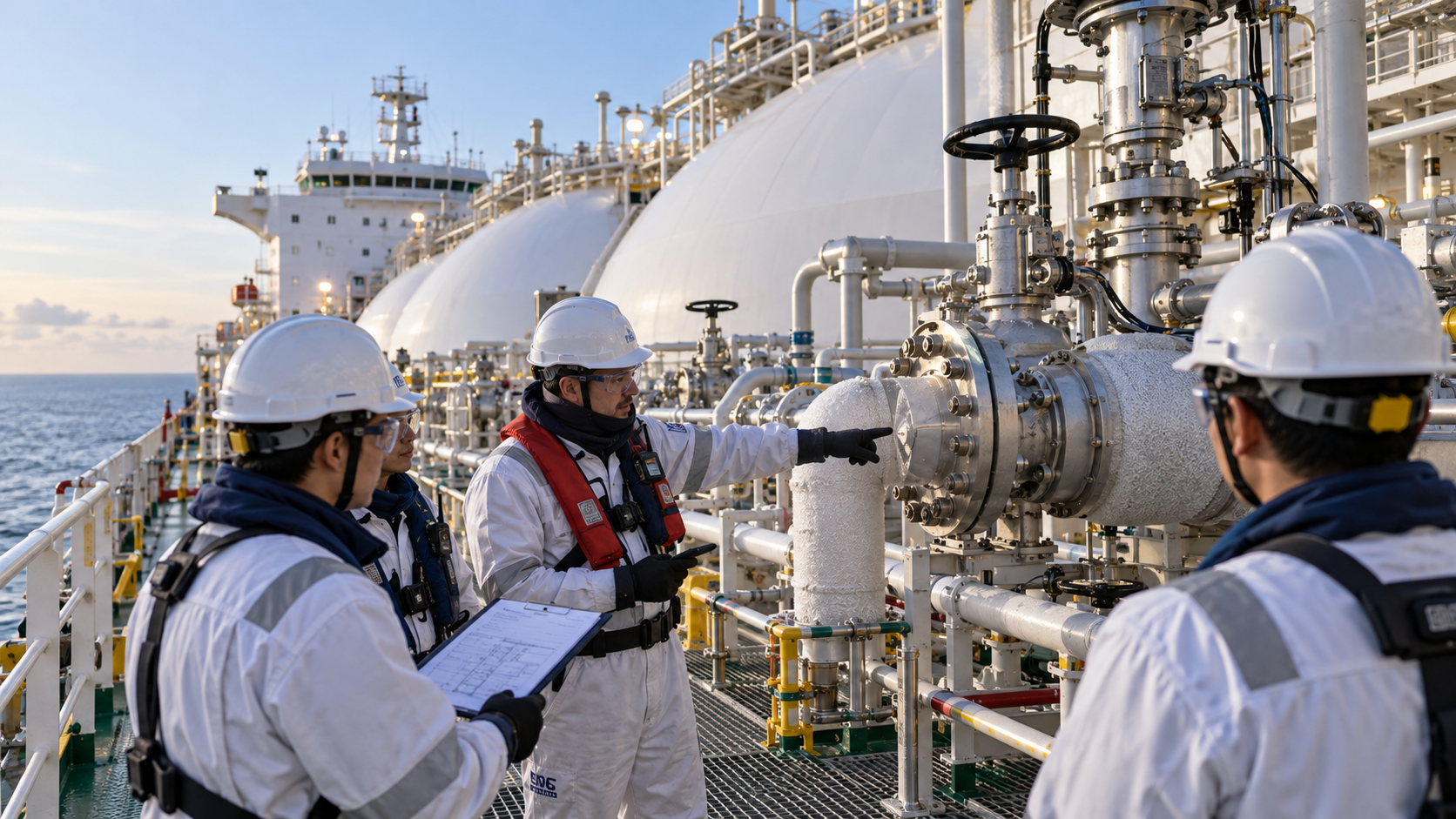
LNG cargo handling awareness helps new personnel understand why liquefied natural gas operations require disciplined procedures, clear communication and respect for cryogenic hazards. LNG carriers and terminals handle cargo at extremely low temperatures, so even experienced maritime professionals need role-specific familiarization before working around cargo systems.
Awareness training is not a substitute for the competency, tanker endorsement or supervised practical experience required for a particular role. It provides a foundation so personnel can understand the equipment, terminology and hazards they will encounter.
Why LNG Cargo Operations Are Different
LNG is stored and transferred at cryogenic temperatures. Equipment, valves, piping, pumps and safety systems are designed specifically for those conditions. Personnel must understand that ordinary assumptions from conventional fuel or general cargo operations may not apply.
Core Hazards New Personnel Should Recognize
- Extreme cold and cryogenic exposure.
- Rapid vaporization if LNG is released.
- Flammable gas mixtures.
- Pressure changes within cargo systems.
- Oxygen-deficient atmospheres in certain situations.
- Static electricity and ignition control.
- Specialized personal protective equipment requirements.
Awareness training should help learners recognize these hazards without encouraging them to perform tasks outside their authorization.
Understand the Cargo System Before Touching Equipment
LNG cargo systems can include tanks, manifolds, compressors, vaporizers, pumps, valves, emergency shutdown arrangements and gas-detection systems. New personnel should understand the purpose of the main components before they are expected to support cargo operations.
A useful training approach is to follow the cargo flow from tank to manifold and explain where monitoring, isolation and emergency controls fit into the process.
Cargo Pumps Are Central to LNG Transfer
LNG cargo pumps are specialized equipment designed to operate under cryogenic conditions. Understanding their purpose and limitations helps deck and engineering personnel interpret operations more effectively.
Marine Pro Academy offers a dedicated LNG Cargo Pumps course for maritime professionals involved in LNG operations.
Why Communication Matters During Transfer
Cargo operations involve coordination between vessel and terminal personnel. Misunderstood instructions can have serious consequences. Standard phraseology, clear responsibility and positive confirmation are essential during preparation, transfer, shutdown and emergency response.
Emergency Shutdown Awareness
Personnel working around LNG operations should know that emergency shutdown systems are designed to stop or isolate cargo transfer when defined unsafe conditions occur. Awareness training should explain the purpose of these systems and the importance of following vessel-specific procedures.
Personal Protective Equipment Is Role-Specific
Cryogenic gloves, face protection, protective clothing and other equipment may be required depending on the task. Crew should follow the vessel’s procedures and risk assessment rather than copying PPE choices from another ship.
Gas Detection and Atmosphere Awareness
Gas detection is fundamental around LNG systems. Crew should understand alarms, restricted areas and the need to follow instructions when abnormal readings occur. Entry into enclosed or potentially hazardous spaces requires separate procedures and authorization.
New Personnel Need Familiarization as Well as Training
An online awareness course can introduce concepts, but every vessel has its own layout, equipment and procedures. Before participating in cargo operations, personnel need appropriate onboard familiarization and supervision.
Who Benefits From LNG Cargo Handling Awareness?
- Deck officers and ratings joining LNG vessels.
- Engine personnel supporting cargo-related systems.
- Cadets preparing for LNG assignments.
- Terminal personnel who need vessel-side context.
- Supervisors who manage staff around cargo operations.
How to Choose an LNG E-Learning Course
Look for a course that clearly states its learning objectives, intended audience, duration, assessment method and certificate type. Avoid vague claims that an awareness course alone qualifies someone for every LNG duty.
Marine Pro Academy’s Maritime E-learning catalogue includes specialist technical courses that can support continuing professional development.
Scenario: Small Leak During Preparation
A new crew member notices frost forming around a connection before transfer begins. The correct response is not to investigate independently. The person should stop, maintain a safe position and report the observation through the ship’s established chain of command.
Scenario-based questions like this help learners connect theory to behaviour.
Scenario: Abnormal Pump Performance
During transfer, a team notices unexpected pump performance. An awareness-trained crew member should understand that cargo pump behaviour is monitored carefully and that abnormal indications must be escalated according to procedure rather than “worked around.”
Link Awareness Training to the Crew Training Matrix
Companies should record LNG awareness separately from formal tanker qualifications, familiarization and task-specific authorization. Marine Pro Academy’s Crew Training Matrix for Maritime Companies explains how to structure role-based records.
A Pre-Assignment LNG Awareness Checklist
- Understand the vessel type and cargo system.
- Confirm required statutory and company training.
- Complete assigned awareness learning.
- Review PPE and emergency arrangements.
- Complete vessel-specific familiarization.
- Know reporting lines during cargo operations.
- Never perform an unfamiliar task without authorization.
Use Awareness Training as the Starting Point
LNG cargo handling awareness gives new personnel a safer starting point by explaining the equipment, hazards and behaviours expected around cryogenic cargo operations. It should be combined with the correct statutory qualifications, company procedures and supervised onboard familiarization.
Explore Marine Pro Academy’s LNG Cargo Pumps course, specialist maritime e-learning and wider course catalogue for additional professional-development options.
LNG Cargo Handling: From Awareness to Operational Readiness
Awareness training should help new personnel arrive onboard with the right questions. They should know which parts of the cargo system they need to identify, which alarms they must understand and which procedures require direct supervision. This reduces the amount of purely introductory explanation needed during vessel familiarization.
However, awareness does not authorize a crew member to operate cargo equipment independently. Company procedures, role-specific qualifications, tanker endorsements where applicable and supervised experience remain essential.
Questions New LNG Personnel Should Ask Onboard
- Where are the cargo control stations and emergency shutdown controls?
- Which alarms require immediate escalation?
- Which PPE applies to each cargo task?
- How are manifold areas controlled during transfer?
- Who is authorized to operate cargo valves and pumps?
- What are the vessel’s specific gas-detection and emergency procedures?
LNG Training for Companies
Fleet operators can use theory-based e-learning before embarkation and then complete vessel-specific familiarization onboard. Marine Pro Academy’s B2B Maritime Solutions can support companies that need consistent pre-joining learning across several vessels or crew groups.
Frequently Asked Questions
Does an LNG awareness course qualify me to operate cargo systems?
No. Awareness training supports understanding but should not be treated as a substitute for required certification, company authorization or supervised practical competence.
Is LNG training useful before a first LNG assignment?
Yes. It can make onboard familiarization more effective by introducing cargo terminology, system purpose and key hazards before embarkation.
Leave a Reply