
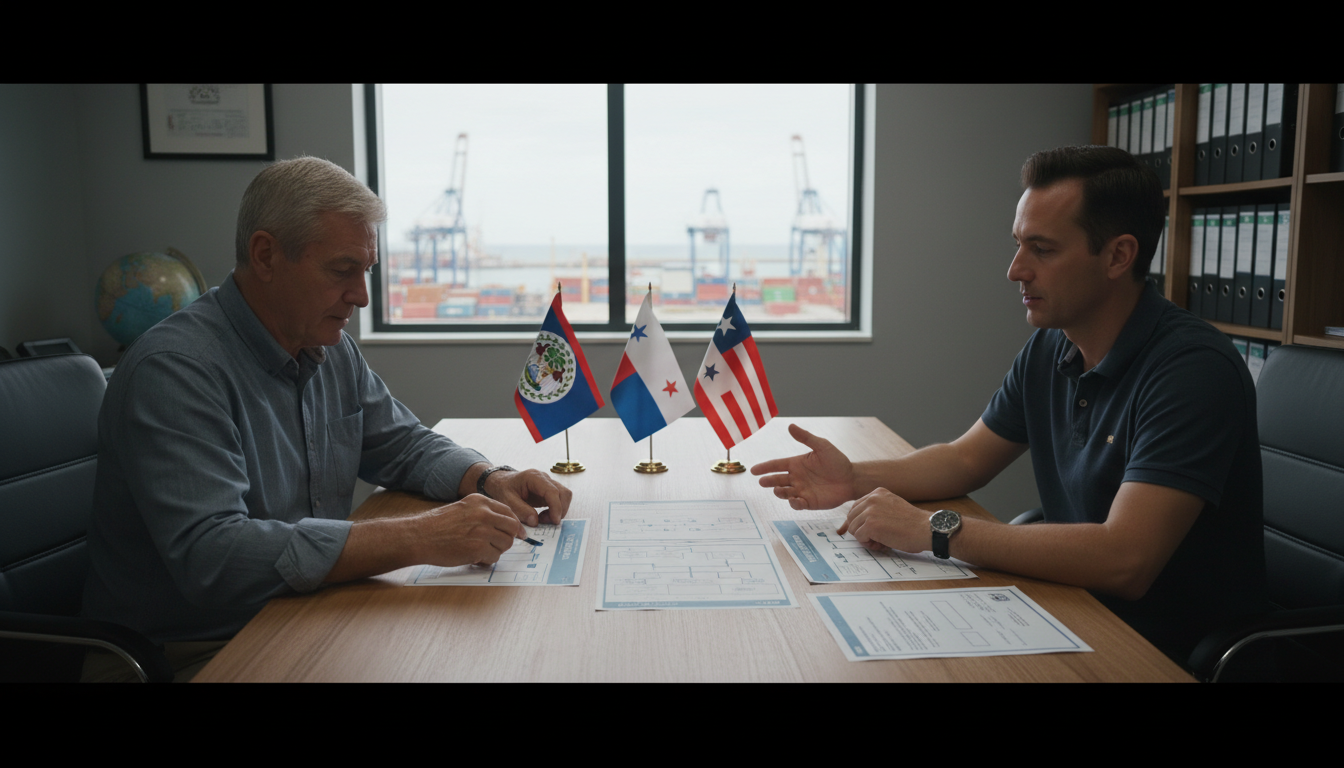
Seafarers frequently ask whether Belize, Panama or Liberia STCW certificates are “better.” That question cannot be answered by flag name alone. The decisive factors are the actual approved programme, the issuing body, competence assessed, documentation format, and whether the next employer or administration accepts it..
There is no universal best flag for every seafarer
Seafarers frequently ask whether Belize, Panama or Liberia STCW certificates are “better.” That question cannot be answered by flag name alone. The decisive factors are the actual approved programme, the issuing body, competence assessed, documentation format, and whether the next employer or administration accepts it.
Compare approval, not marketing language
For each option, request the provider’s approval details and confirm they apply to the named training course. A centre can hold an approval for one programme without automatically being approved for another. For instance, Security Awareness and designated security tasks are distinct learning outcomes; they should not be treated as a single certificate merely because both sit within STCW security requirements.
Look beyond online convenience
Distance-learning delivery can reduce travel for theoretical study, but requirements for practical demonstrations, examinations and identity verification may still apply. Ask exactly what must be done in person, where that assessment occurs and who certifies successful completion. This is particularly important for personal survival and firefighting competencies.
Choose for your next assignment
Your employment contract, vessel flag, recruiter and onboard compliance team may each have documentary requirements. Ask them to confirm an intended certificate before payment, particularly if you are applying for endorsements or a seaman’s book. Marine Pro Academy’s Belize Basic Safety Training bundle and Belize Security Awareness training provide useful starting points for checking course scope.
A practical comparison checklist
Record the course name and STCW table, approved provider, issuing administration, practical assessment method, total cost, processing expectations and verification process. The strongest decision is a documented match to your actual job requirement, rather than assuming that one administration’s approval provides universal acceptance.
Explore Marine Pro Academy training
Explore the Belize-approved Basic Safety Training courses and review the specific certificate requirements before booking. Course approval, assessment and acceptance should always be checked for the individual application.
Compare the exact STCW competence
Begin with the precise requirement: for example, STCW A-VI/1-1 is not interchangeable with A-VI/6-1 just because both belong to a wider safety or security programme. Review the complete course title and identify whether it relates to survival, firefighting, first aid, personal responsibilities or security tasks. Match that requirement to the training product and certificate expected on completion. A useful comparison spreadsheet should include the course reference, issuer, approved modality, assessment process and the document requested by the employer. This prevents a cheaper but unsuitable course from delaying deployment.
Assess online learning and practical elements
Online delivery is especially attractive to seafarers between contracts or working irregular hours. Yet the delivery of theoretical instruction must be distinguished from the demonstration of practical competence wherever required. Check how the provider handles practical assessment, learner identification and evidence of competence. An asynchronous course should disclose what happens after the online modules are finished. Do not assume that passing a web-based knowledge test automatically completes every practical STCW requirement. Request written guidance for any learning outcome that depends on physical demonstration or supervised assessment.
Prices, timing and total cost
The advertised course price is only one part of the decision. Consider additional fees, payment currency, any physical assessment component, certificate delivery, support response times and possible costs of resolving a mismatch. An apparently inexpensive certificate becomes costly if the crewing office rejects it just before joining. Compare the total required training pathway rather than isolated course prices. If you need more than one subject, consider an appropriate bundle, but verify the individual modules and issuing arrangements before payment.
Decision example: a crew member with a fixed joining date
Imagine a crew member whose employer asks for Security Awareness and PSSR, with certificates accepted only from specified training centres. The correct process begins with the employer’s list, then checks each product against that list. The learner confirms identity requirements, assessments and delivery. If a provider cannot substantiate the acceptance pathway, the learner should not purchase simply to meet a deadline. This approach may feel slower than clicking the first offer, but it is designed to reduce last-minute certificate problems.
Keep an auditable training record
Retain course descriptions or confirmation of approval scope, completion receipts, certificates and communication resolving any unusual acceptance questions. Record renewal instructions as they appear on the issued document or in the employer’s policy. If you later change vessels or employers, recheck acceptance rather than treating one past approval as permanent evidence for every future job. In a regulated training environment, clear records often matter as much as the course purchase itself.
A simple comparison template for purchasers
When comparing offers, make a table with the required competence, product title, approving administration, issuing training centre, assessment mode, evidence of practical competence, certificate delivery format and employer acceptance. Add the total price and expected process time only after those essential checks. This makes the comparison auditable and limits impulse purchases based on flags or marketing labels. If one provider cannot answer a critical question, mark it unresolved rather than assuming the answer is favourable. A responsible comparison should protect the learner’s ability to join a vessel, not just identify a low upfront cost.
How to approach your company’s crewing department
A short, precise question is often more useful than asking whether a country’s certificates are generally recognized. Send the specific course name, competence reference, issuing organization and proposed certificate format. Ask whether that exact document would satisfy the training requirement for your assigned vessel and position. Where the company has an approved-centre list, request the current version. Save the response and check whether conditions apply, such as an additional practical module. This is particularly important when switching from a cruise ship to another vessel type or changing flag states between contracts.
Frequently asked comparison questions
Is Panama always better than Belize or Liberia? No universal ranking determines acceptance; the course and employer requirements matter. Does a lower price mean weaker training? Not necessarily, but verify the assessment and issuer. Are digital certificates automatically accepted? Their acceptance depends on the receiving organization’s rules and the ability to verify authenticity. Do the same STCW code references guarantee identical delivery arrangements? No. Is every course advertised online fully completed remotely? Not necessarily, especially where practical competence must be demonstrated. Always examine the specific course documentation.
Making the final decision confidently
Prioritize evidence over claims: what training do you need, what does the proposed certificate actually demonstrate, and who will confirm acceptance? Once those questions are answered, evaluate convenience, support and price. If multiple courses are required, a bundle such as Belize Basic Safety Training may reduce enrolment complexity. However, keep the comparison at subject level; bundles should never obscure the identity of the individual competencies.
What matters most: Belize, Panama and Liberia certification routes
Compare the particular course approval and issuing centre rather than assuming that one flag is universally preferable. Match each competence code, instructional mode and practical assessment requirement to the crew member’s job checklist. Ask the receiving employer to confirm acceptance of that specific certificate. Online availability, a low price and a familiar flag name are convenient attributes, but none independently establishes suitability for deployment.
A realistic maritime example: Belize, Panama and Liberia certification routes
A seafarer moving between cruise operators may discover that an earlier employer accepted a certificate while a new company asks for additional validation. Rather than repurchasing all courses, the candidate presents the precise certificate titles, issuers and references for assessment. The crewing office identifies any genuinely missing evidence. That sequence avoids both unnecessary expenses and last-minute document problems.
Questions before purchasing: Belize, Panama and Liberia certification routes
Does one administration always provide better certificates? No; the specific approved programme and receiving requirement determine suitability. Does a lower price necessarily imply inferior training? No, but assessment quality and approval must be checked. Are digital certificates automatically recognized? No; validation and receiving policies matter. Can a bundle be compared directly with an individual course? Only after listing constituent subjects and required assessments.
A practical checklist: Belize, Panama and Liberia certification routes
Build a comparison worksheet containing the STCW competence, issuer, approval evidence, delivery method, practical requirements, total cost, certificate verification and employer acceptance. Prioritize meeting mandatory conditions before comparing convenience. Keep written confirmations for the next crew assignment and review those conditions if the vessel or employer changes.
Compare the Training Pathway, Not Just the Flag Name
Before choosing among Belize, Panama or Liberia, compare the exact course, delivery format, certificate issuer and intended employer requirement. Marine Pro Academy organizes Panama-approved STCW courses, a wider STCW catalogue and course bundles so seafarers can review the options side by side.
Leave a Reply