
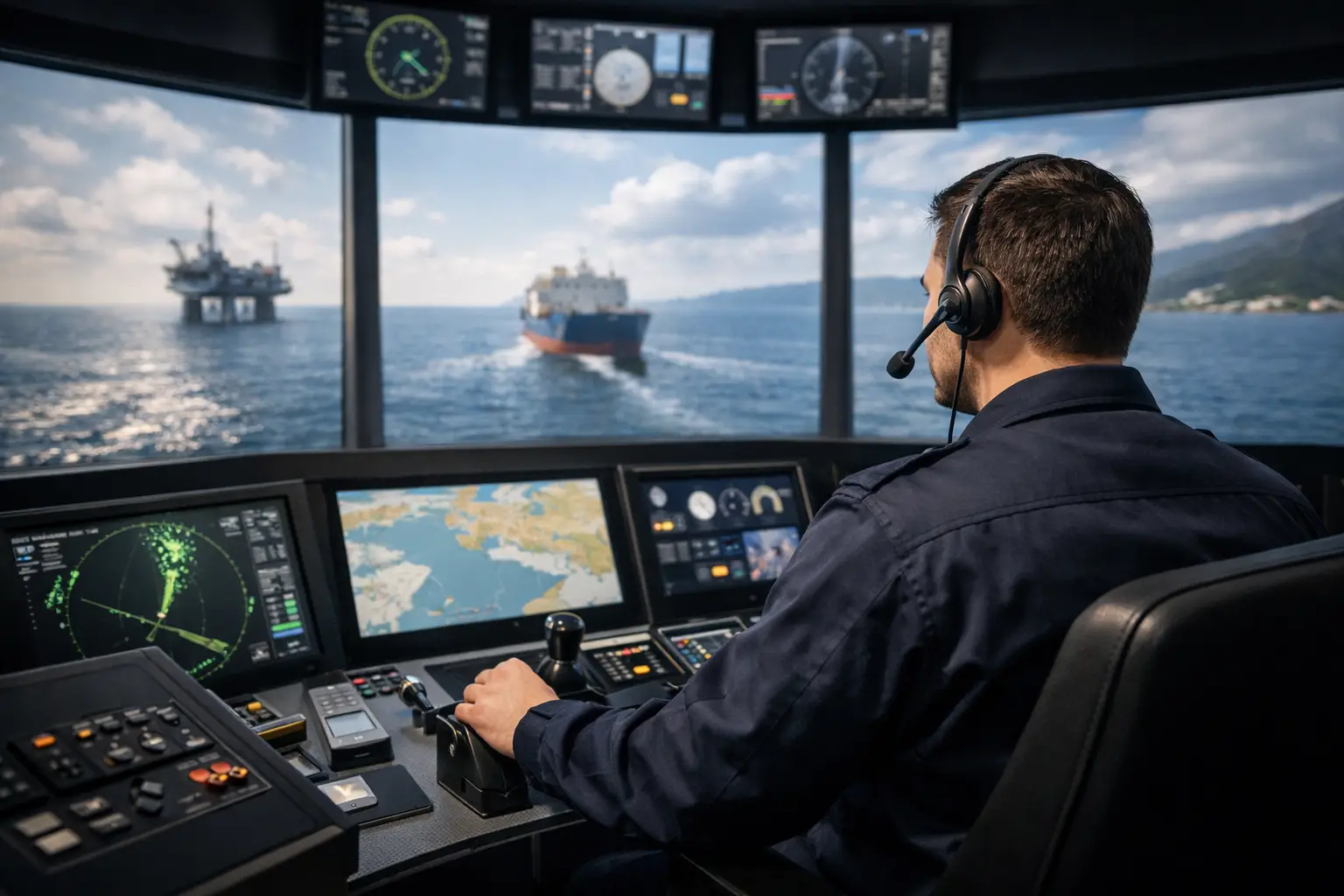
A simulator can place a trainee on a bridge minutes before a close-quarters situation, a machinery alarm, or a security incident – without putting a vessel, crew, cargo, or the marine environment at risk. Understanding how virtual maritime simulation works helps seafarers see why it is more than watching a training video. Done correctly, it is a structured way to practice decisions, procedures, and communication under realistic operational pressure.
For crew working between contracts, virtual simulation can also reduce a major barrier to readiness: the need to travel to a training center for every learning activity. It does not replace every practical requirement, and it should not be treated as a shortcut around flag-state or company rules. Its value is in giving seafarers focused, repeatable practice that supports STCW-aligned learning and assessment pathways.
How virtual maritime simulation works
Virtual maritime simulation combines a digital vessel environment with a planned training scenario. The system recreates relevant elements of shipboard operations, such as a bridge layout, controls, navigation displays, engine-room panels, alarms, weather, traffic, and communication tasks. The trainee interacts with that environment through a computer, mobile-compatible interface, headset, or dedicated simulation equipment, depending on the course design.
The experience starts with a learning objective. A course may require the trainee to identify a fire response sequence, apply collision-prevention principles, respond to an onboard emergency, or recognize a security risk. The simulator then presents conditions that make the objective meaningful. Visibility may deteriorate, traffic may increase, an alarm may activate, or a colleague may report conflicting information.
Rather than simply selecting the right answer from a screen, the trainee is asked to observe, prioritize, communicate, and act. Their choices change what happens next. A delayed response can allow a situation to escalate. A correct action can stabilize it. This cause-and-effect structure is what turns simulation into operational practice.
The digital model creates the operating environment
At the center of a simulation is a model of the operating environment. It does not need to reproduce every bolt on a vessel to be effective. It needs to accurately represent the systems, procedures, hazards, and decision points relevant to the lesson.
For bridge-focused training, that may include a vessel’s heading, speed, radar information, electronic chart data, visual targets, traffic movement, wind, current, and restricted visibility. For safety training, the model may focus on escape routes, emergency equipment, muster responsibilities, alarm signals, and the chain of communication. For engine or technical scenarios, the priority may be system status, warnings, isolation procedures, and fault recognition.
The level of detail depends on the competency being trained. A cadet learning the sequence for an emergency response may need clear guidance and controlled conditions. An experienced officer practicing decision-making may need multiple variables, time pressure, and incomplete information. More realism is not automatically better if it distracts from the required skill.
Scenarios introduce pressure without operational risk
A good scenario has a clear purpose, a defined starting point, and realistic consequences. It may begin with a routine watch, then introduce an evolving risk: an approaching vessel, equipment failure, person-overboard report, fire alarm, or sudden weather change.
The system can vary the circumstances from one attempt to the next. This prevents trainees from memorizing a fixed sequence. For example, a navigational risk can develop at a different bearing, speed, or visibility level. An emergency can occur in another section of the vessel. The expected principles remain consistent, but the trainee must interpret the situation rather than repeat a script.
This repeatability is particularly useful for skills that are rarely used but must be performed correctly when needed. Emergency procedures cannot depend on someone remembering a slide presentation from months earlier. Simulation gives crew an opportunity to rehearse the order of actions, confirm their role, and recognize where hesitation occurs.
What the trainee does during a virtual simulation
Virtual simulation is active learning. The trainee may inspect instruments, acknowledge alarms, select equipment, report to a supervisor, choose a route, issue instructions, or make decisions within a timed sequence. Some programs include branching paths, where each action affects the next event. Others guide the learner through a required procedure before asking them to complete it independently.
Communication matters as much as technical knowledge. Shipboard operations rely on clear reporting, closed-loop communication, escalation, and shared situational awareness. A well-designed simulation can require the trainee to choose the correct message, report critical details, and notify the appropriate person at the right stage. These are practical behaviors that support safer onboard performance.
For individual online learners, the simulation may focus on personal actions and recognition of correct procedures. In team-based settings, multiple participants may take different roles and coordinate their response. Both formats have value. The right choice depends on the course outcome, the vessel role, and whether the competency requires group coordination.
Assessment, feedback, and records
Simulation becomes valuable training only when performance is measured against defined criteria. The platform records key actions, timing, decisions, and completion status. Depending on the program, it may track whether the trainee followed the correct sequence, identified hazards, used the right controls, or responded within an acceptable timeframe.
Feedback should be specific. “Incorrect” is not enough for a seafarer who needs to improve before joining a vessel. Useful feedback identifies what was missed, why it matters operationally, and what action should have been taken. The trainee can then review the standard, repeat the scenario, and demonstrate improvement.
Assessment design must match the approval and certification requirements of the course. Some maritime competencies can be supported through online learning and virtual simulation, while others may require supervised practical demonstration, approved equipment, or in-person assessment. This is not a limitation of the learner. It is a compliance requirement that protects the credibility of the certificate and the safety standard behind it.
Before enrolling, check the course approval status, the flag-state pathway it supports, the assessment method, and any practical components required for final certification. A compliant program states these requirements clearly instead of creating surprises after course completion.
Where virtual simulation delivers the strongest value
Virtual simulation is especially effective when a trainee needs to understand a process before performing it in a live environment. It can prepare crew for safety and security responsibilities, emergency decision-making, bridge resource awareness, familiarization tasks, and equipment-related procedures.
It also supports refresher learning. A seafarer may know the theory but want to rebuild confidence before returning to sea. Completing a scenario again can reveal gaps that reading a manual will not show, such as slow prioritization, missed communication steps, or uncertainty under pressure.
Its practical advantage is access. Seafarers can study around travel, port calls, and contract schedules rather than losing days to unnecessary logistics. Marine Pro Academy uses digital learning and virtual simulation to help make training pathways more accessible while maintaining a clear focus on approved, IMO-compliant requirements.
Still, virtual training has trade-offs. Screen-based interaction cannot fully reproduce vessel motion, physical equipment handling, fatigue, noise, or the interpersonal demands of a live emergency. The best approach is not virtual versus practical training. It is using each method for what it does best: virtual simulation for repeatable decision practice and preparation, and approved practical instruction where hands-on demonstration is required.
How to get more from a simulation course
Treat the scenario as a professional exercise, not a task to complete as quickly as possible. Start with a stable internet connection and a quiet setting where you can concentrate. Review the course instructions before entering the scenario, especially the learning objective and performance criteria.
During the exercise, follow the same discipline expected onboard. Check information before acting, prioritize immediate risks, communicate clearly, and do not guess through an alarm or procedure. If the platform allows a repeat attempt, use it. The second run is where many learners move from recognizing the right answer to applying it in the right order.
Afterward, review the feedback while the scenario is still fresh. If you missed a step, connect it to the actual onboard consequence. That habit makes the learning more durable and helps you arrive for your next assignment better prepared to act, not just to pass an assessment.
Virtual maritime simulation works best when it respects real operations: clear standards, realistic decisions, measured performance, and honest limits. Used that way, it gives seafarers valuable practice time before the moment when the correct response truly matters.
Leave a Reply