
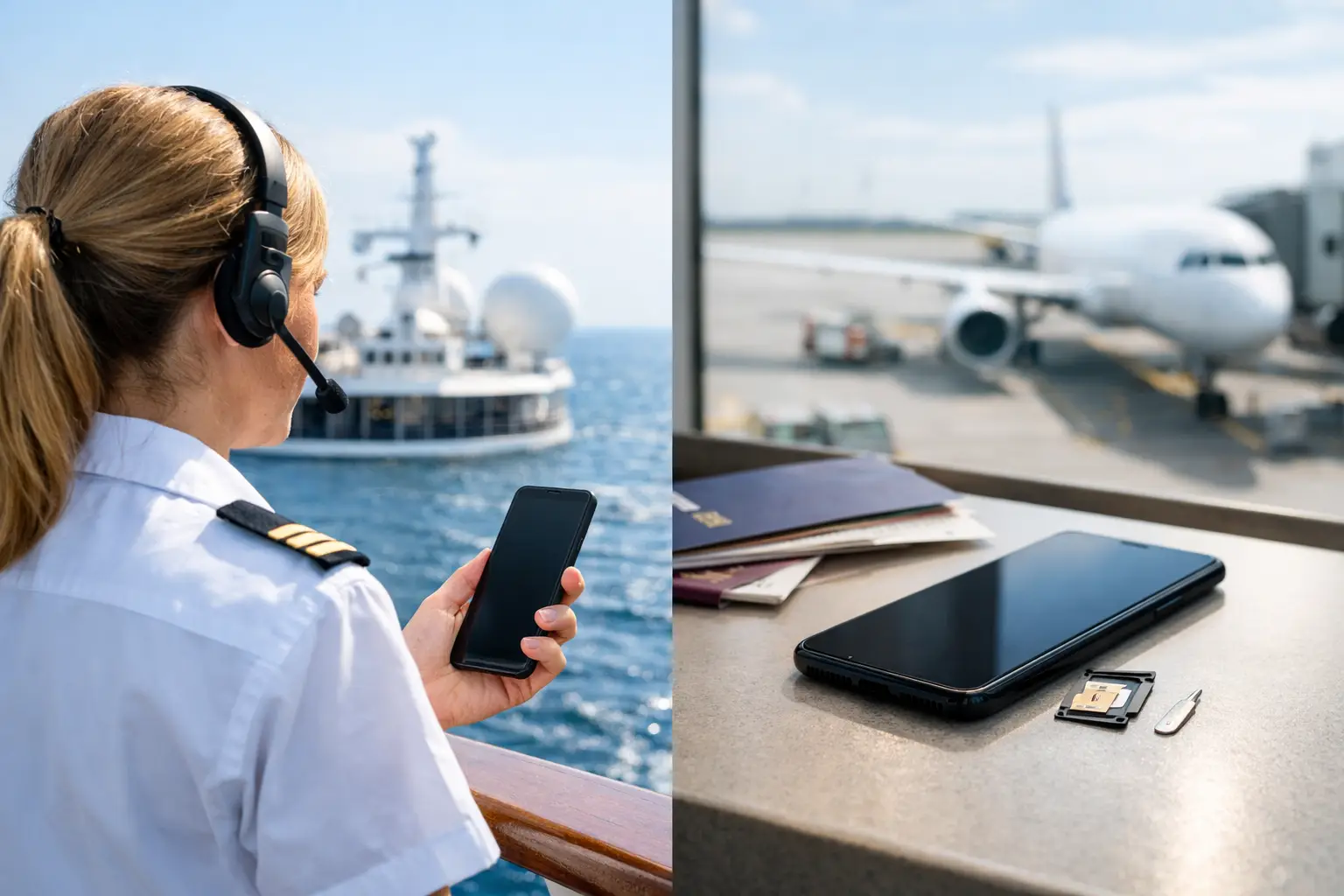
A delayed flight, a new port, a document deadline, and a family message can all arrive in the same hour. In the crew eSIM vs airport SIM decision, the better option is usually the one that gets a seafarer online before the next administrative task becomes a problem. That means looking beyond the advertised data allowance and considering activation, country coverage, device compatibility, and what happens when a contract crosses several borders.
For crew traveling between vessels, airports, hotels, crew houses, and ports, connectivity is operational. It supports check-in instructions, employer communication, training access, digital certificates, banking, maps, and contact with home. A low sticker price is useful, but only if the SIM works where and when it is needed.
Crew eSIM vs Airport SIM: The Practical Difference
An airport SIM is a physical prepaid SIM card purchased at an airport kiosk, convenience store, or mobile operator counter. It is often marketed to tourists and can be active quickly if the counter is open, the required identification is accepted, and the phone is unlocked.
A crew eSIM is a digital SIM profile installed on an eSIM-compatible phone. It can normally be purchased and activated before departure or while connected to Wi-Fi during transit. Instead of replacing a physical card, the seafarer adds a mobile plan through a QR code or an in-app activation process.
The difference matters because crew movement is rarely limited to one holiday destination. A contract may involve travel through a hub airport, joining a vessel in another country, port calls across a region, and a flight home through a third country. An eSIM designed for international use can reduce the need to buy, register, remove, and replace physical SIM cards at each stage.
That does not make airport SIMs useless. In a single-country stay, especially when a seafarer needs a local number for several weeks or months, a local physical SIM may provide stronger value or larger data allowances. The right choice depends on the itinerary and the type of access required.
Where Airport SIMs Can Create Delays
Airport SIMs solve an immediate problem: a traveler has landed and needs data. But the convenience can be less reliable than it appears from the arrival hall.
First, airport counters operate on local hours. A crew member arriving after a flight delay or during an overnight connection may find the kiosk closed. Lines can also be long when multiple international flights arrive together, which is not ideal when transport, joining instructions, or hotel details are time-sensitive.
Second, airport plans are often sold at a premium. They may include a simple setup and a recognizable local network, but travelers can pay more per gigabyte than they would through a digital plan or a local operator store away from the airport. Some packages also expire quickly, leaving unused data behind after a short port stay.
Third, registration requirements vary by country. Many destinations require passport verification, local address details, or other identity checks before a SIM can be activated. This is a normal regulatory process, but it can add friction for crew in transit who need data immediately.
There is also the physical-card issue. If a phone has one SIM slot, installing an airport SIM means removing the home SIM. That can interrupt access to a primary number, including SMS verification codes used for banking, email, payroll, and account security. A lost home SIM can become a much larger problem than the original need for travel data.
Why a Crew eSIM Fits Multi-Country Travel
A crew eSIM is most useful when the priority is speed and continuity. It can be installed before leaving home, while on reliable Wi-Fi, and kept ready for activation upon arrival. That gives a seafarer one less task to manage after landing.
Most modern dual-SIM phones allow the eSIM to handle mobile data while the physical home SIM remains installed for calls and verification messages. Settings differ by device, and roaming charges must be reviewed carefully, but this arrangement can keep critical services available without swapping cards.
Regional and global eSIM plans can also match the reality of maritime travel. A single plan may cover several countries in a region, reducing the need to buy a new SIM during every port call or transit stop. For crew who fly through major hubs and join ships abroad, this can save time and avoid repeated registration processes.
The practical advantage is not that an eSIM guarantees service everywhere. Mobile coverage still depends on the destination, the local partner network, terrain, building access, and the plan’s terms. At sea, standard travel eSIMs generally do not provide offshore connectivity once the vessel is outside terrestrial network range. Crew should not confuse a land-based eSIM with satellite service or a ship’s onboard Wi-Fi package.
Instead, think of an eSIM as a reliable bridge: it keeps you connected in airports, hotels, terminals, crew accommodation, and ports where local cellular coverage is available.
Compare the Details That Affect Your Contract
Before purchasing either option, check the coverage map and read the plan conditions. “Global” does not always mean every country, and “unlimited” may include fair-use limits, speed reductions, or restrictions on hotspot use. If you need to attend online training, upload documents, or join a video call with crewing personnel, data speed and hotspot permissions matter as much as the total allowance.
Check whether the plan is data-only. Many eSIM plans do not provide a local phone number, which is usually fine for WhatsApp, email, crew portals, and online learning platforms. However, if a local number is required for a specific bank, delivery service, government portal, or long-term accommodation arrangement, a local airport or carrier SIM may be the better fit.
Device readiness matters too. An eSIM must be supported by the handset, and some devices purchased in certain markets have different eSIM capabilities. Before travel, confirm that the phone is unlocked, updated, and compatible with eSIM activation. Save the activation instructions securely, and install the profile while you still have dependable Wi-Fi.
For both options, protect your data allowance. Turn off automatic app updates, cloud backups, and video autoplay when using mobile data. Download charts, crew travel documents, training materials, and entertainment before leaving Wi-Fi. A small data plan can last far longer when the phone is configured for travel.
A Simple Decision Rule for Seafarers
Choose an airport SIM when you will remain in one country for an extended period, need a local number, and have time to complete registration with a local operator. It can be a sensible lower-cost choice for longer stays ashore.
Choose a crew eSIM when you need data immediately, are moving through multiple countries, want to keep your home SIM in place, or need a backup connection before joining a vessel. It is particularly useful for short turnarounds, last-minute assignments, and travel days when a closed kiosk or paperwork delay is not acceptable.
Many experienced crew use both strategically. They keep a regional eSIM active for travel and early arrival, then add a local SIM only if the assignment becomes long enough to justify it. This approach costs a little more upfront, but it reduces the risk of being unreachable during the most time-sensitive part of a rotation.
Prepare Connectivity Before You Sign Off
Do not wait until boarding begins to test a new plan. Install the eSIM, confirm the destination is covered, and keep the plan details, customer support information, and a backup Wi-Fi option available. If you are carrying a physical airport SIM, make sure you have a safe place to store your home SIM and the tool needed to remove it.
Marine Pro Academy’s connectivity approach is built around this practical reality: crew need access that travels with their career, not another task waiting at the airport counter. Set up your connection before transit, keep your critical number protected, and arrive ready to handle the next instruction without delay.
Leave a Reply