
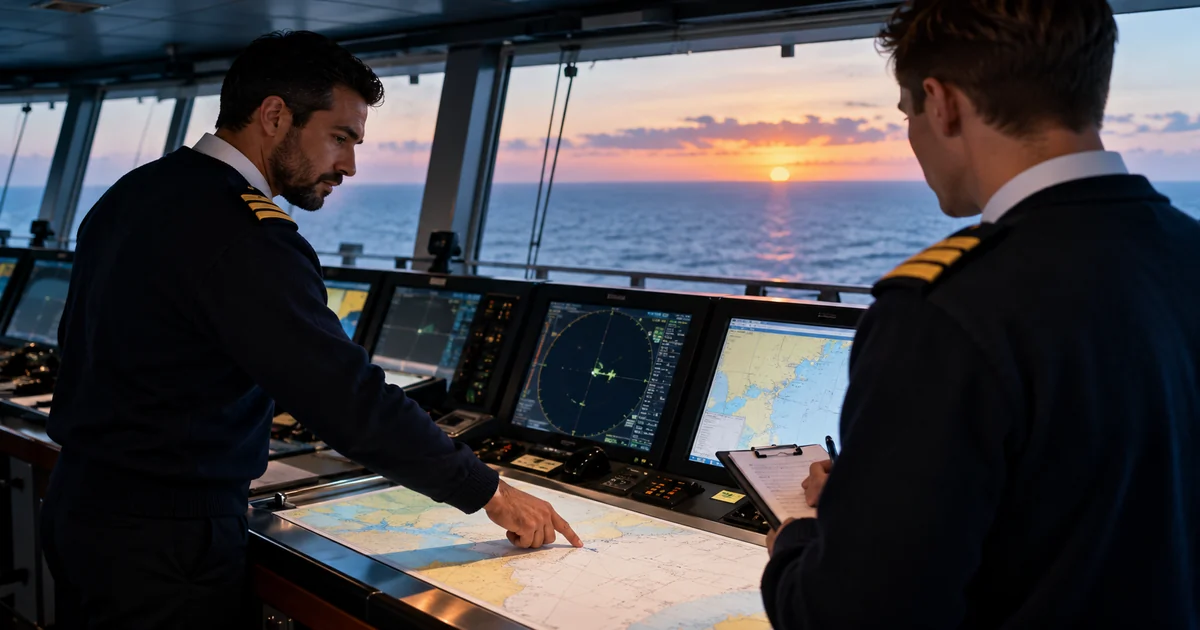
A bridge watch handover checklist should do more than confirm that one officer has arrived and another is ready to leave. It is the moment when responsibility for the ship’s navigation changes hands, often while traffic, weather, equipment status and the voyage plan are changing as well. A rushed exchange can leave the relieving officer with an incomplete picture of what matters during the next few minutes.
For deck officers, cadets and bridge teams, a good handover is a deliberate transfer of situational awareness. It brings together the vessel’s position, planned track, nearby traffic, navigational hazards, master’s orders, equipment limitations and the fitness of the relieving watch. This guide explains the questions to ask, the information to confirm and the situations in which a handover should not be rushed. It is educational guidance; the ship’s approved bridge procedures, standing orders and the master’s instructions always take precedence.
Why a bridge watch handover is a safety-critical event
The bridge does not become less busy because a watch is changing. An approaching vessel may alter course, visibility may deteriorate, a pilot may be expected or the ship may be approaching a waypoint. At precisely that moment, the officer who has been following the situation for hours is preparing to leave, while the incoming officer must build an accurate mental picture quickly.
A handover that consists only of “course steady, nothing to report” is rarely enough. Even when the passage is uneventful, the relieving officer needs to know what has been checked, what remains uncertain and what is likely to demand attention next. This is why STCW Code section A-VIII/2 addresses taking over the navigational watch and the matters that the relieving officer must personally satisfy themselves about. A checklist supports those obligations; it does not replace professional judgment.
Start with fitness for duty, not the instruments
Before discussing position or traffic, both officers should consider whether the relieving watch is capable of performing its duties. Fatigue, illness, distraction and insufficient familiarization can compromise watchkeeping. Night vision adjustment also matters when moving from a brightly lit space into a dark bridge environment. If the outgoing officer has reason to believe the relief cannot perform effectively, the issue must be escalated under the ship’s procedures rather than concealed to protect the roster.
Fitness for duty is a leadership issue as much as a personal one. A junior officer may be reluctant to admit that a difficult port call has left them exhausted. A professional bridge culture makes it possible to raise that concern early. The broader human-factors approach is explored in Marine Pro Academy’s HELM – Human Element, Leadership and Management course, which is professional-development training rather than a substitute for any required statutory watchkeeping qualification.
Confirm position, track, course and speed
The relieving officer should independently establish the vessel’s estimated or true position using the methods and systems appropriate to the voyage. The intended track, current course and speed should be understood alongside the next navigational decisions. A displayed route is not enough if the officer does not know why the ship is following it or where attention will be needed.
Consider a ship nearing a waypoint at the end of an apparently quiet night watch. The outgoing officer knows a course alteration is approaching, but the incoming officer has focused on the electronic chart display without checking the distance to the turn or the traffic around it. The risk is not a lack of technology; it is an incomplete transfer of context. Ask what is coming next, which limitations apply and what the master’s instructions require.
Review traffic and collision-avoidance concerns
A useful handover describes the surrounding traffic picture, not merely the number of targets on a radar display. Which vessels are relevant? Have any shown uncertain intentions? Is there a developing close-quarters concern? Have visual observations and electronic information been considered together? The incoming officer should form an independent assessment rather than accept a previous interpretation without checking.
Proper lookout remains fundamental. Radar, AIS and other aids can support awareness, but they do not remove the requirement to observe the environment and comply with the collision regulations. During training, use a fictional encounter and ask two officers to explain the situation separately. Differences between their accounts often reveal which details were not communicated. Marine Pro Academy’s Watchkeeping Deck – Bridge Watchkeeping and Navigation Duties Training covers watch responsibilities, lookout, communication and related principles.
Understand weather, visibility and local conditions
Weather information matters when it affects navigation, lookout arrangements, ship handling or the workload of the watch. Discuss actual and forecast visibility, wind, sea state, currents, tides and any expected changes relevant to the passage. In restricted waters, the significance of these factors may be different from their significance on an open-ocean leg.
For example, a forecast reduction in visibility might be more important than the present clear conditions. The relieving officer needs to know whether the master has issued additional instructions and whether any equipment, staffing or reporting considerations have already been raised. Avoid vague statements such as “weather okay.” Describe the conditions, their likely effect and what needs monitoring under the vessel’s procedures.
Check standing orders, night orders and special instructions
The master’s standing orders and any voyage-specific instructions are part of the handover, not a separate administrative task. The relieving officer should understand relevant calling criteria, route restrictions, reporting requirements and other instructions applicable to the watch. Do not rely on a colleague’s summary when the approved written instructions are available and must be read.
A useful discussion distinguishes standing requirements from temporary directions. Perhaps an equipment limitation has prompted a special instruction for the next passage leg. Perhaps a pilot boarding or port approach changes the expected reporting pattern. The officer taking over should be able to explain which instructions apply and where clarification is needed. If the instructions are ambiguous, resolve that through the authorized chain of command before treating the issue as settled.
Verify navigation equipment and known limitations
The operational condition of navigation and safety equipment should be understood before the watch changes. Relevant items may include radar, ECDIS, compass information, steering arrangements, communication equipment, alarms and any bridge indications associated with machinery controls. The exact checks depend on the vessel’s equipment, procedures and voyage phase.
The important question is not “Are the screens on?” It is “Which systems are available, what limitations are known and what has been done about them?” A recurring sensor discrepancy, degraded display or unusual alarm should be communicated accurately. Only authorized personnel should carry out troubleshooting or changes to equipment settings. Where a defect affects navigational safety, follow the master’s orders and company reporting procedures.
Make the next thirty minutes visible
A strong handover is forward-looking. Identify approaching traffic, course changes, navigational hazards, expected communications, pilot arrangements or any other developments that could alter workload soon after relief. This is especially useful when the ship is moving from a routine leg toward coastal waters, a traffic separation scheme or an arrival sequence.
One practical technique is to ask the relieving officer to summarize the most important near-term considerations in their own words. The purpose is not to test memory for its own sake. It confirms that the officer has understood the situation and gives the outgoing officer an opportunity to correct missing or misunderstood information. This type of closed-loop communication is a core professional habit on a bridge.
When a watch handover should be delayed
Not every watch change should occur at the scheduled minute. Under STCW watchkeeping principles, if a manoeuvre or action to avoid a hazard is underway, relief should be deferred until that action is complete. Concerns about the incoming officer’s ability to perform the duties also require appropriate escalation. The exact application belongs within the master’s authority and the ship’s procedures.
Imagine a close-quarters situation developing just as the relieving officer arrives. The outgoing officer should not treat the roster as more important than continuity of navigation. Training should explore how the team maintains clear responsibility, communicates the situation and avoids two people assuming that the other is in charge. The goal is an unmistakable transfer, not an exchange that merely looks complete in the logbook.
The role of ratings, lookouts and other bridge personnel
The watch handover is not limited to two officers. Lookouts and other members of the bridge team must understand their assigned duties and relevant changes in the situation. The officer in charge remains responsible for ensuring an effective watch organization, while each person needs clear information appropriate to their role.
A lookout who notices a small craft but assumes that radar has already identified it may hesitate to report. A bridge team with strong communication habits avoids that assumption. During familiarization, supervisors can rehearse concise observation reports and reinforce the difference between reporting what is seen and guessing another vessel’s intentions. Broader safety communication principles are also addressed in Marine Pro Academy’s 2026-updated Liberia PSSR training.
A practical bridge watch handover checklist
Use this as a discussion prompt alongside the vessel’s approved checklist—not as a replacement for it:
- Fitness and staffing: Is the relieving watch fit, familiarized and properly arranged for the conditions?
- Position and passage: Has the incoming officer verified position, intended track, course, speed and the next significant navigational point?
- Traffic and lookout: Which targets, hazards and developing situations need attention?
- Weather and environment: What are the current and expected visibility, sea, wind, tide and current conditions?
- Orders: Have the master’s standing, night and special orders been understood?
- Equipment: What is operating normally, what is limited and what has been reported?
- Near-term workload: Are manoeuvres, communications, pilotage or route changes expected?
- Responsibility: Has the transfer been clearly acknowledged and recorded as required?
The order and detail should be adapted to the vessel’s safety management system and voyage conditions. The checklist is valuable because it prompts questions; it should never become a substitute for looking outside or understanding the ship’s actual navigational situation.
Scenario: a quiet watch with one hidden complication
A junior officer is relieving a colleague during a coastal passage. The radar picture looks calm, the autopilot is engaged and the weather is good. During the exchange, the outgoing officer mentions that a navigational aid has been unreliable intermittently. The incoming officer nods but does not ask what information has been affected or whether the master has been informed.
A useful debrief asks what should have been clarified: the nature of the limitation, its operational significance, the approved compensating arrangements, the status of the defect report and any instructions from the master. This scenario shows how a short, casual statement can conceal a serious information gap. It also demonstrates why training should assess questions and judgment rather than reward speed of completion.
How to train a better handover in twenty minutes
Begin with a five-minute review of the vessel’s approved handover requirements. Present a fictional bridge situation containing a route change, a traffic concern and an equipment limitation. Give pairs of learners five minutes to conduct a verbal exchange. Then ask the relieving officer to explain the situation without consulting their notes. Use another five minutes to compare what was communicated with what the scenario required, and finish with practical feedback.
A facilitator should not invent a universal script for every vessel. Instead, the exercise should reveal whether the team can communicate facts, identify uncertainty and escalate concerns appropriately. Record the learning gaps and revisit them during familiarization or the next approved training session. Marine Pro Academy’s Safety Officer on Board course may support wider risk-assessment and reporting knowledge, but it is not a replacement for bridge watchkeeping competence.
Training records and course selection
A seafarer preparing for a deck watch role should distinguish professional-development courses from certificates or endorsements required by the flag administration and employer. Before purchasing training, confirm the exact position, competence, delivery and assessment requirements. Marine Pro Academy provides Watchkeeping Deck training as a relevant learning option; the employer must determine whether it satisfies a particular training matrix.
If an officer needs document-processing support for a separate eligible qualification, Marine Pro Academy also explains its Panama endorsement services. Endorsement eligibility, acceptance and issuance remain subject to the competent authority. For broader context, read the academy’s article on safety leadership and safety awareness at sea, which explores how small communication failures can develop into operational risk.
Frequently asked questions
What is the purpose of a bridge watch handover checklist? It supports a clear transfer of navigational awareness and responsibility by prompting the officers to confirm essential information before relief.
Is the checklist the same on every ship? No. The vessel’s approved bridge procedures, equipment, voyage phase and master’s instructions determine the actual requirements.
Can a watch be handed over during a manoeuvre? STCW watchkeeping principles address deferring relief while manoeuvres or actions to avoid hazards are in progress. Follow the vessel’s procedures and the master’s instructions.
Does the relieving officer need to verify position personally? Yes. STCW Code section A-VIII/2 places specific expectations on the relieving officer to satisfy themselves about the navigational situation.
Will an online watchkeeping course qualify me for a deck officer position? A course alone does not establish statutory eligibility. Check certificates, sea service, assessments and flag-state recognition required for the role.
Final takeaway: hand over understanding, not just information
The strongest bridge watch handover checklist is the one that makes the next watch safer. It should leave the relieving officer clear about where the ship is, what is happening around it, what may happen next and which instructions govern the response. It should also make uncertainty visible rather than hiding it behind reassuring phrases. When watchkeepers treat the handover as a professional conversation instead of a ritual, they protect the continuity of navigation and reinforce the habits that effective bridge teams depend on.
Regulatory reference: STCW Code, section A-VIII/2 — principles for keeping a navigational watch. Always check the current official text and the applicable flag-state and company requirements.
Leave a Reply