
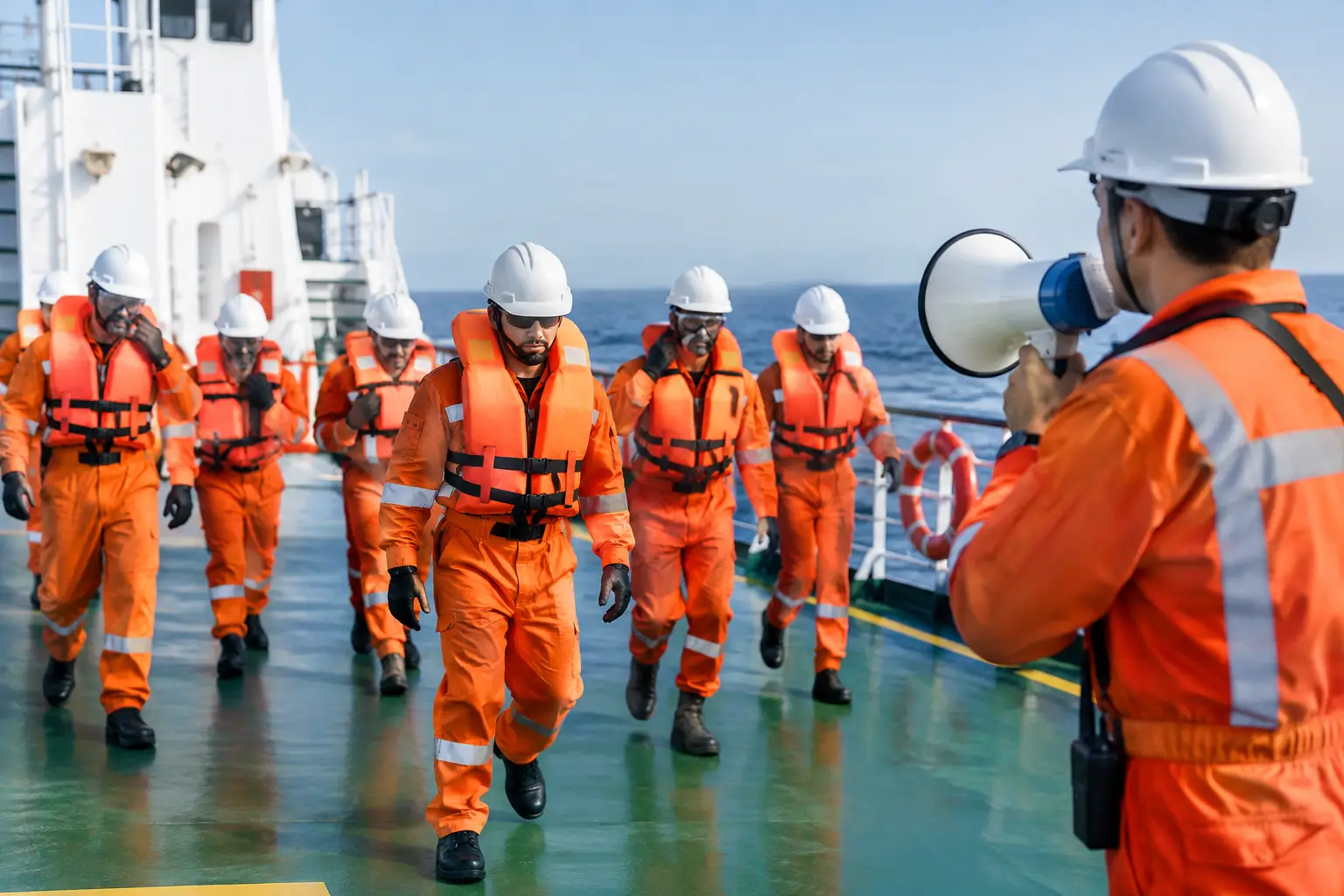
A fire alarm sounds during a night watch. A new crew member reaches the muster station but does not know who is taking the headcount. The officer on scene has the right equipment available, yet the radio channel is unclear. This is exactly why the best emergency response drills are not performed simply to complete a logbook entry. They test whether people, equipment, communication, and command decisions will work together when pressure is real.
For seafarers, drills are part of professional readiness and a core element of vessel safety management. They also support STCW competence by turning emergency procedures from something learned in a course into actions the crew can carry out onboard. A well-run drill gives every person a clear role, exposes weak points without blame, and leaves the vessel better prepared for the next voyage.
What Makes an Emergency Drill Effective?
An effective drill is realistic enough to test the crew but controlled enough to remain safe. It should be based on the vessel’s approved emergency procedures, risk assessed before it begins, and conducted under the direction of the master or designated officer. The goal is not to surprise people for its own sake. The goal is to verify that the response is organized, timely, and understood by everyone involved.
The difference between a routine drill and a useful one is usually in the detail. Instead of announcing only “fire drill,” provide a credible scenario: smoke reported near a laundry space, a suspected galley grease fire, or a fire in an engine-room workshop. This prompts the crew to consider boundaries, ventilation, communications, casualty risks, and access routes rather than repeating a memorized movement.
Drills should also reflect the vessel and its operation. A cruise ship must account for passengers and hotel departments. A cargo vessel may need to test enclosed-space rescue capability, dangerous-goods information, and port coordination. Yacht and offshore crews may have smaller teams, which makes cross-training especially important when a key person is unavailable.
The Best Emergency Response Drills to Prioritize
Every vessel follows its own safety management system, flag-state requirements, company procedures, and operational schedule. However, several drill categories deserve regular, meaningful attention because they address the most serious and likely onboard emergencies.
Fire and Smoke Response
Fire remains one of the most demanding emergencies at sea. A quality fire drill tests far more than whether a fire party can dress in protective equipment. It should confirm that the alarm is raised correctly, the bridge receives accurate information, the fire team has the right location and entry plan, and boundaries are established to prevent spread.
Use different fire locations over time. Repeating the same scenario at the same time of day can create false confidence. Consider how the response changes if the incident occurs in accommodation, galley areas, machinery spaces, storage lockers, or a vehicle deck. Test how the team confirms accountability, controls ventilation, manages communications, and prepares medical support for a possible casualty.
Abandon Ship and Lifeboat Drills
An abandon-ship drill must help crew members move from alarm recognition to orderly muster, not merely gather outside. Verify that people know their assigned muster station, understand their role on the station bill, and can report missing persons promptly. Lifejacket checks, communications, survival craft readiness, and passenger or visitor assistance should be treated as practical tasks, not formalities.
Launching and maneuvering survival craft involve real risks. These activities must follow the vessel’s procedures, maintenance status, weather limits, and risk controls. A discussion-based or partial drill may be appropriate when a full launch would introduce unnecessary danger, but it should still test the decisions and responsibilities that would matter in an actual abandonment.
Man Overboard Response
A man-overboard situation develops quickly and may involve poor visibility, cold water, heavy weather, or a vessel with limited maneuvering room. The drill should test immediate actions: raising the alarm, marking the position, maintaining visual contact, informing the bridge team, and deploying suitable recovery equipment.
Do not focus only on the maneuver. Recovery is often the harder stage. Can the crew safely bring an unconscious or injured person back onboard? Is the recovery device ready, and do the team members know how to operate it? Does the medical response begin as soon as the person is recovered? These questions turn a standard exercise into a realistic test of survival and care.
Enclosed-Space Rescue
Enclosed-space entry incidents are especially dangerous because unplanned rescuers can become casualties themselves. The best drill scenario does not reward someone for rushing in. It reinforces the correct sequence: raise the alarm, prevent further entry, assess the atmosphere with suitable equipment, ventilate where appropriate, prepare rescue equipment, and use trained personnel under controlled command.
This drill should make roles very clear. One person manages entry records and communication, another monitors atmospheric readings, another prepares recovery equipment, and a rescue team stands by with appropriate protection. If the vessel’s crew cannot safely conduct a particular rescue operation, the drill should confirm how external assistance will be requested and supported.
Medical Emergency and Casualty Evacuation
Medical drills should reflect the reality that the first responder may be a deck rating, steward, engineer, or other crew member who finds the casualty. Test how they report the location, condition, and immediate hazards. Then assess how the assigned medical team responds, how privacy is maintained, and how the bridge coordinates external medical advice or evacuation arrangements when required.
Vary the cases. A fall with suspected spinal injury, severe burn, chest pain, heat stress, or unconscious person each demands different priorities. The purpose is not to diagnose perfectly during a drill. It is to establish calm communication, safe first aid, accurate records, and a clear escalation path.
Security and Emergency Communications
Security events can overlap with safety incidents. An unauthorized person onboard, suspicious package, threatening behavior, or restricted-area breach can require coordinated action from security, bridge, hotel, deck, and shore-side teams. These drills should test reporting lines, access control, radio discipline, and the handling of passengers or nonessential personnel.
Communications deserve attention in every drill category. A message that is technically sent but unclear can delay a response. Crews should practice stating what happened, where it happened, what immediate action has been taken, and what support is needed. Closed-loop communication, where a receiver repeats critical instructions back, helps reduce misunderstanding in noisy or multilingual environments.
How to Run Drills That Build Competence
Start with a short planning brief. Define the scenario, objectives, participants, hazards, stop-work authority, and any limitations. If a drill includes equipment deployment, confirm that it is fit for use and that the activity will not create a new risk to people, the vessel, or the environment.
During the drill, assess actions rather than personalities. Time matters, but a fast response is not automatically a safe one. Look for correct alarm procedures, leadership, accountability, equipment handling, communication quality, and decisions made when information is incomplete. Assign an observer if possible so the person running the drill is not trying to control and evaluate everything at once.
The debrief is where much of the value is created. Hold it while details are fresh and invite crew members to speak honestly. Ask what worked, what caused hesitation, what equipment or information was missing, and what should change before the next drill. Record findings in line with the safety management system, assign corrective actions to named people, and follow up. A repeated observation that is never corrected is a compliance issue and a safety issue.
Avoiding Common Drill Mistakes
Predictable drills are easy to complete and easy to forget. If the crew always knows the scenario, location, and expected sequence, the exercise measures memory rather than readiness. Variation is useful, but it must remain proportionate to crew experience and operational conditions.
Another common mistake is treating the drill as the end of the process. Equipment defects, unclear station-bill assignments, language barriers, and missing training records need action after the alarm stops. If a crew member did not understand a responsibility, provide coaching and repeat the relevant part of the drill when practical.
New joiners need particular attention. Before taking part in an emergency drill, they should receive vessel-specific familiarization, including alarms, escape routes, muster duties, safety equipment locations, and reporting arrangements. This is especially relevant for crew joining during busy turnarounds or sailing soon after arrival.
Turning Practice Into Confidence
The best emergency response drills create a crew that can think clearly, communicate accurately, and act within its training when conditions are uncertain. They protect lives, support compliance, and strengthen the professional standard expected across cargo, cruise, yacht, and offshore operations.
Treat each drill as a chance to improve one real part of the vessel’s readiness. That may be a cleaner radio message, faster accountability, better equipment checks, or clearer leadership at the scene. Small corrections made consistently are what give a crew confidence when the alarm is no longer a practice alarm.
Leave a Reply