
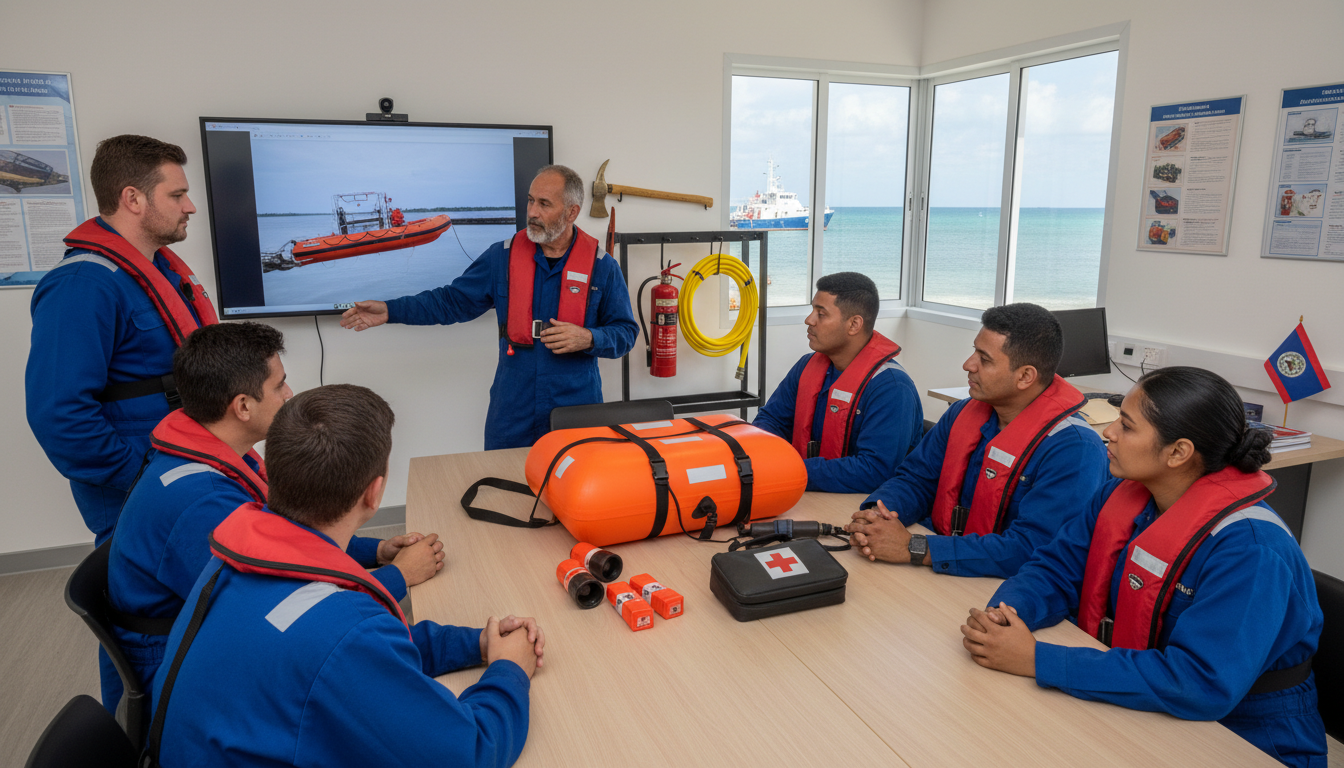
Basic safety training prepares crew to respond to emergencies and work responsibly onboard. Marine Pro Academy’s Belize four-course training bundle groups PST, FPFF, EFA and PSSR.
EFA and PSSR: people matter
Elementary First Aid emphasizes quick casualty assessment and safe initial assistance pending qualified help. Personal Safety and Social Responsibilities covers safe working practices, communication, teamwork and conduct onboard. The 2026 PSSR update also makes violence and harassment prevention a topic worth checking carefully in the course syllabus.
Before purchasing a bundle
Check whether the certificate or certificates will be issued under the relevant approval, which components require physical demonstration, whether your employer accepts the pathway, and whether previous training counts towards any refreshers. Do not assume that an entirely online learning experience automatically satisfies every flag’s practical training rules.
Explore Marine Pro Academy training
Explore the Belize-approved Basic Safety Training courses and review the specific certificate requirements before booking. Course approval, assessment and acceptance should always be checked for the individual application.
Personal Survival Techniques: preparing to respond
Personal Survival Techniques introduces the principles of surviving an emergency at sea. Learners should understand muster instructions, alarm awareness, personal protective equipment, lifejackets, survival craft and the value of controlled communication. Preparation is not simply memorizing the names of equipment: a seafarer must understand why actions are sequenced, why instructions vary with the vessel and how to avoid creating an additional emergency. Where recognized competence requires demonstrations or practical elements, confirm the assessment and approved delivery arrangements rather than assuming an online quiz replaces hands-on training.
Fire Prevention and Fire Fighting: prevention first
A large part of effective fire safety begins before flames appear. Relevant knowledge includes fire risks in accommodation spaces and workplaces, housekeeping, basic fire classifications, alarm activation and safe initial responses. Crew should distinguish raising the alarm from independently attempting to control a dangerous incident. Onboard response always follows the ship’s emergency organization and the instructions of trained personnel. Ask your provider how course learning maps to the applicable competence standard and how practical outcomes are assessed. Review Belize FPFF training if this subject is listed separately on your requirements.
Elementary First Aid: protect the casualty and yourself
The aim of foundational first-aid knowledge is to support prompt, safe assistance within the limits of training and onboard procedures. Key ideas include recognizing an emergency, requesting help, evaluating immediate danger, effective communication and basic responses while qualified medical assistance is arranged. Course participation does not turn a learner into a medical professional. Use scenarios to practise decision-making and recognize when urgent escalation is required. The Belize Elementary First Aid product describes this component and its individual training pathway.
PSSR: the everyday behaviours behind safety
Personal Safety and Social Responsibilities is often underestimated because its subject matter includes communication, teamwork and familiar workplace decisions. In reality, many operational failures involve poor handovers, fatigue, uncertainty about responsibilities or reluctance to report a hazard. PSSR should connect safe working practices with a multicultural shipboard environment. Think about how a new crew member identifies a reporting line, handles a near miss or asks for clarification when instructions are unclear. For the individual option, consult Belize PSSR.
Bundle or individual courses?
A bundle may simplify enrolment and documentation when all four subjects appear on a company’s checklist. Individual courses may be preferable if a learner has already completed part of the requirement, needs one additional module or is instructed to obtain a specific certificate. Compare total price, the certificate format, assessment arrangements and any separate practical obligations. Avoid buying the bundle solely because it seems cheaper: the correct decision is the one that meets your actual documented requirements. Explore the four-course Belize bundle only after comparing its contents to the employer’s list.
What learners should verify before enrolling
Ask who issues each certificate, which approving authority applies, what is assessed and whether any in-person component is mandatory. Verify spelling requirements for your identification, accepted payment methods and the steps for resolving certificate errors. A maritime employer may use an internal compliance checklist, so obtain confirmation before relying on a course title as proof of equivalence. If you are approaching a joining deadline, build in time for document verification rather than expecting immediate deployment clearance after the final assessment.
A realistic preparation plan for four subjects
Rather than rushing through four modules, divide the subjects into manageable sessions. Begin by reading each learning objective, then make brief notes on key concepts and reporting responsibilities. After completing the learning material, test yourself using a different scenario from the examples presented. For survival, think about muster and instruction-following; for fire prevention, hazard reporting; for first aid, recognizing when to summon help; and for PSSR, safe communication. Revisit mistakes before the final assessment. This approach is useful whether the learner studies from home, an agency office or during an approved rest period onboard.
What a certificate should communicate
A training record should identify the learner accurately and clearly state the training that was completed. Check the course designation, issuer, dates and reference information shown on your actual certificate. Some employers also request a verification route or additional supporting documentation. The course website’s description should match the resulting certificate rather than promising generic international recognition. If information is missing or inconsistent, contact the issuing provider promptly. Keeping clear records can be particularly helpful when moving between employers or joining a vessel on a short timeline.
FAQ: common basic safety questions
Do all four subjects have the same assessment method? Not necessarily, because the competences and any practical requirements differ. Can an experienced seafarer skip a subject? Only where the applicable framework and employer permit acceptable prior evidence or other approved routes. Does a four-course package include Security Awareness? Do not assume so: inspect the exact package contents. Can you enroll in only one subject? Individual Belize options are listed for learners with specific requirements, including Elementary First Aid and PSSR.
Applying basic safety knowledge onboard
Onboard competence continues to develop through familiarization, practical exercises and supervised performance. The most helpful habit is to connect each basic safety subject with one part of the ship’s actual arrangements: where to find alarms and muster information, how to communicate a hazard, what to do when a colleague needs urgent assistance, and how team members clarify responsibilities. Never substitute a general training scenario for the vessel’s approved emergency instructions. When uncertain, ask the responsible officer or supervisor before acting.
Detailed training decisions: the four components of basic safety training
PST, FPFF, EFA and PSSR cover distinct but complementary knowledge and competence. Survival preparation emphasizes alarms, muster arrangements and disciplined actions. Fire training brings attention to prevention, hazard awareness and appropriate reporting. First aid concerns safe initial assistance within the learner’s level of competence and appropriate escalation. PSSR reinforces communication, responsible conduct and teamwork. The course titles should be matched to the exact requirements of the employer; a bundle name does not by itself prove that all evidence or necessary practical assessments are included.
Practical example: the four components of basic safety training
A new passenger-vessel employee may be required to complete four basic safety subjects as well as separate passenger or security training. Before purchasing a bundle, the employee compares the individual course titles and their STCW references with the employer’s checklist. The provider clarifies which components are theoretical and how any prescribed practical competence is evaluated. After receiving certificates, the employee checks personal data, issuing details and verification information. The crewing office reviews the documents before deployment, leaving time to resolve an incomplete record.
Questions seafarers often ask: the four components of basic safety training
Is basic safety training the same as Security Awareness? No; security training has separate objectives. Does a written or online quiz always satisfy a practical performance requirement? No; the applicable approved assessment method determines how practical competence is evidenced. Should experienced crew automatically repeat every module? Requirements depend on the specific prior training, assignment and receiving criteria. Is a more expensive bundle necessarily better? No; approved fit and the actual contents matter more than price alone.
Putting training into practice: the four components of basic safety training
After completion, a crew member should relate the learning to the vessel’s procedures. During familiarization, identify how emergency alarms are communicated, where muster information is displayed and who coordinates response. Discuss uncertain reporting duties with supervisors and participate seriously in required drills. Avoid assuming that equipment arrangements are identical on different vessels. The main benefit of training is understanding hazards and responsible decisions, not simply passing multiple-choice questions or possessing a PDF certificate.
Leave a Reply