
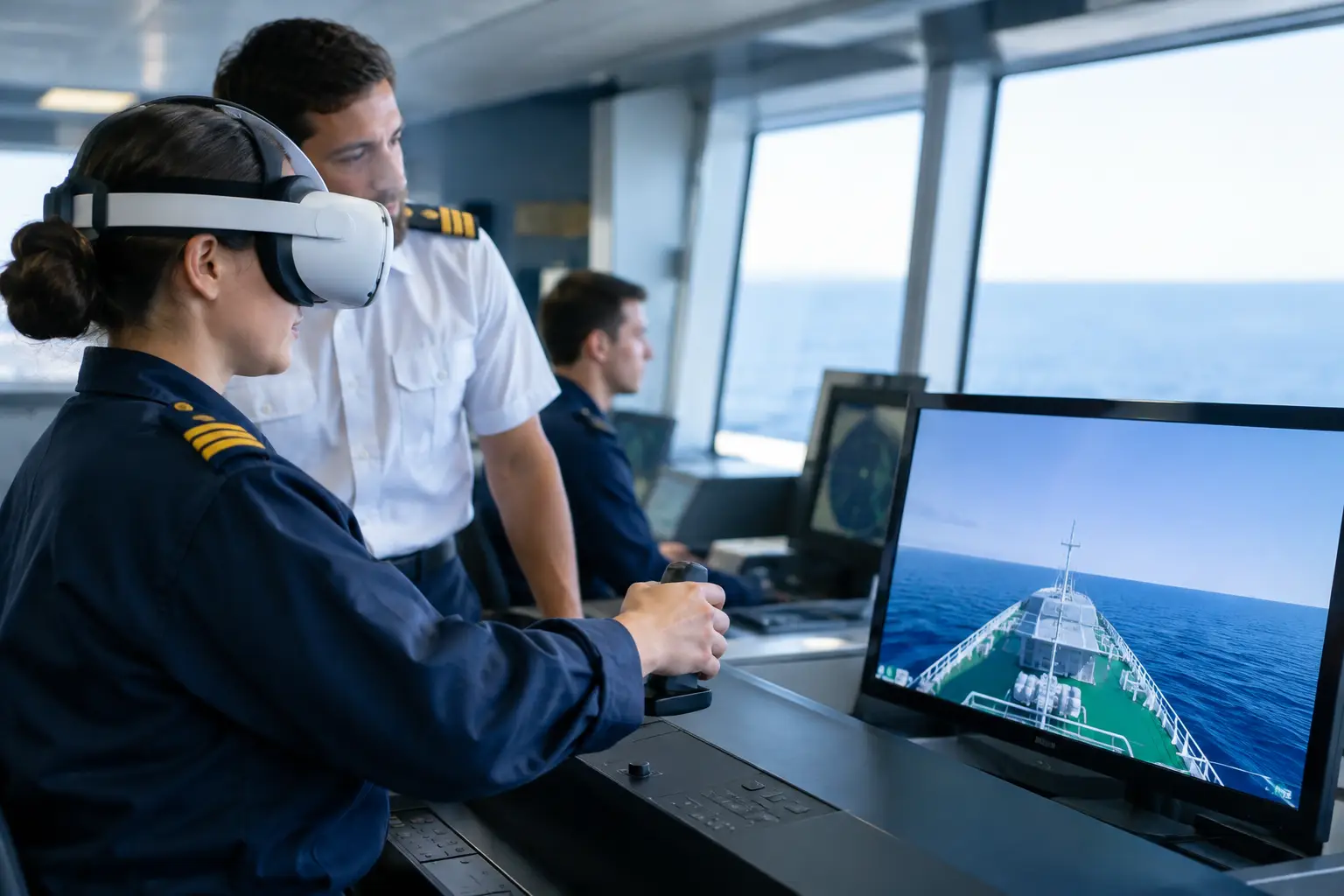
A cadet can now rehearse a bridge emergency after finishing a watch, while an engineer can receive targeted revision support before a technical assessment. That is the practical promise behind AI maritime training trends.
For seafarers, however, the real question is not whether artificial intelligence is impressive. It is whether it improves learning, supports appropriate training requirements, and helps people make better decisions when conditions are difficult.
The maritime industry has always trained for situations that should not be experienced for the first time during a real emergency: fires, abandon-ship procedures, navigation failures, machinery alarms, security incidents, medical emergencies, and increasingly, cybersecurity threats.
AI is beginning to make that preparation more responsive and individualized. Used appropriately, it can strengthen practice between formal courses and help identify areas where a learner needs additional support. Used poorly, it can create false confidence, weaken assessment integrity, or distract from the practical judgment that safe maritime operations require.
Where AI Maritime Training Trends Are Making a Difference
The most useful applications of AI in maritime training are generally not about replacing instructors or established training methods.
Instead, AI can add more practice, feedback, personalization, and visibility around the learning process.
For seafarers, this could mean more focused revision before an assessment. For instructors, it could provide better visibility into subjects that learners find difficult. For shipping companies, training data could help identify areas where additional learning or refresher training may be valuable.
Adaptive Learning for Different Experience Levels
A new deck rating, an experienced chief officer, and a hospitality crew member preparing for safety duties do not start with the same knowledge or experience.
Adaptive learning systems can potentially adjust quiz difficulty, repeat weak subjects, and recommend revision based on a learner’s previous answers.
Instead of requiring every learner to spend the same amount of time reviewing every topic, digital learning systems can direct additional attention toward areas where improvement is needed.
The value is not simply faster completion.
It is more focused preparation.
For example, if a learner repeatedly struggles with fire prevention principles or emergency procedures, additional learning could be directed toward those areas. Maritime professionals who need to strengthen their understanding of this subject can explore Basic Firefighting – STCW Course.
Likewise, officers developing their leadership and decision-making capabilities can benefit from structured professional training such as HELM – Human Element, Leadership and Management.
However, personalized learning should never mean lowering the required standard.
Learners still need to achieve the required learning outcomes for their course and, where applicable, satisfy requirements established by the relevant administration, employer, training standard, or other competent authority.
More Realistic Simulation and Scenario Practice
Simulation has long played an important role in maritime education and training.
AI can potentially make digital scenarios more responsive by changing conditions such as weather, traffic, equipment status, communications, or simulated crew behavior according to the learner’s decisions.
Instead of following one predetermined path, a bridge team could encounter a developing scenario in which situational awareness, communication, prioritization, and decision-making influence what happens next.
For engineering personnel, intelligent scenarios could simulate alarms, equipment problems, and competing operational priorities.
For cruise and hospitality teams, scenarios could explore passenger management and communication during an emergency while maintaining the focus on established safety procedures.
For security-related training, scenario-based learning can also help crew think through how they should recognize and respond to potential threats. Maritime professionals who need security training can explore STCW Security Awareness Online Course.
The advantage of digital simulation is the possibility of repeated practice without having to reproduce every scenario in a physical training environment.
The limitation is equally important.
A screen-based scenario cannot fully reproduce vessel motion, noise, fatigue, physical teamwork, environmental conditions, or the experience of operating real safety equipment.
AI-supported simulation should therefore complement appropriate practical training rather than automatically being treated as an equivalent substitute for hands-on competence.
Faster and More Specific Learning Feedback
Traditional online assessments often tell a learner only whether an answer was correct or incorrect.
AI-supported learning systems can potentially provide more detailed feedback, explain concepts, identify areas requiring revision, and generate additional practice activities.
This could be particularly valuable for international crews.
Maritime English needs to be understood accurately, yet many seafarers work professionally in a second or third language. Carefully designed digital support can help learners understand terminology and identify subjects they should discuss further with an instructor.
However, AI-generated feedback requires appropriate oversight.
Artificial intelligence can produce information that sounds convincing while being incomplete, outdated, or incorrect.
Maritime training providers therefore need reliable source material, appropriate review processes, and qualified subject-matter expertise.
AI should support maritime education — not become an uncontrolled source of safety-critical instructions.
Assessment Integrity Will Matter More, Not Less
As online maritime training becomes more flexible, training providers and employers need confidence that the person named on a certificate actually completed the relevant training and assessment.
This becomes particularly important because the same technology that can support learning may also be used inappropriately to generate assessment answers.
Depending on the course and its requirements, remote training may use different combinations of learner identification, assessment controls, question banks, instructor involvement, completion tracking, or practical demonstrations.
The appropriate method depends on the nature and purpose of the training.
A short awareness course may not require the same controls as safety-critical training involving practical competency requirements.
For seafarers, the practical lesson is straightforward:
Use AI as a learning tool, not as a shortcut through an assessment.
A certificate has value when the learner actually understands the subject and can apply that knowledge appropriately.
An automatically generated answer provides little value during an inspection, onboard drill, assessment, or genuine emergency if the person does not understand the underlying procedure.
Human Maritime Instructors Remain Essential
Maritime operations involve judgment.
A Master, officer, engineer, supervisor, or crew member may need to interpret a developing situation, communicate clearly, follow established procedures, and recognize when circumstances require escalation.
These abilities develop through a combination of education, guided practice, experience, feedback, and reflection.
AI may identify that a learner selected the wrong response during a scenario.
An experienced instructor can go further by asking why the learner made that decision, what information was missed, and how that decision could affect other people or operations.
That conversation can help transform theoretical knowledge into better operational judgment.
This is why competent maritime instructors remain important as training technology develops. Maritime professionals responsible for delivering or developing training can explore the Training Course for Instructors – STCW A-I/6.
The strongest future training models are likely to combine appropriate digital learning with instructor involvement, practical exercises, simulation, and competency assessment where required.
Convenience matters, but it should not come at the expense of demonstrated competence.
AI Can Support Leadership and Decision-Making Training
One of the most interesting areas for AI-supported learning is leadership development.
Leadership onboard is difficult to teach through theory alone.
Officers and supervisors regularly need to manage competing priorities, communicate with multicultural teams, resolve disagreements, make decisions under pressure, and balance operational requirements with safety.
Scenario-based AI tools could allow learners to explore different responses to difficult situations and consider the consequences of their decisions.
For example, a learner might be presented with a situation involving operational pressure, fatigue, communication problems, and a developing safety concern.
Instead of asking a simple multiple-choice question, a training system could allow the situation to develop according to the decisions made.
However, AI cannot determine every aspect of good leadership.
Experienced instructors, managers, and mentors remain essential because leadership involves context, emotional intelligence, communication, professional experience, and judgment.
Maritime professionals preparing for greater onboard responsibility can develop these competencies through HELM – Human Element, Leadership and Management.
AI, Data Privacy and Maritime Cyber Awareness
AI training systems may process information such as progress records, assessment results, interaction data, and other learner information.
For individual seafarers, some training information may form part of their professional development record. For companies, aggregated training data may reveal areas where additional learning or support is required.
Before using a digital platform, learners and employers should understand what information is collected, how it is used, who may access it, and what privacy and security protections apply.
There is also a wider cybersecurity issue.
Crew should be cautious about entering confidential vessel information, internal company procedures, security-sensitive information, personal documentation, or other restricted data into public AI systems.
Cybersecurity awareness is becoming increasingly important as vessels and maritime organizations become more digitally connected.
Maritime professionals can strengthen their understanding of these risks through Maritime Cyber Security Awareness 2026.
A useful principle is simple:
If information should not be shared publicly outside the company or vessel, it should not automatically be entered into a public AI tool.
AI and Maritime Security Training
AI may also create new opportunities for security-related training.
Scenario-based systems can present changing situations involving suspicious behavior, access control, communications, potential security threats, or unusual activity onboard.
Instead of memorizing procedures alone, learners may increasingly be able to practice recognizing developing situations and deciding when an issue should be reported or escalated.
However, security training must remain aligned with the applicable requirements and procedures.
AI-generated scenarios should not replace official vessel security procedures or the responsibilities established under the relevant security framework.
Seafarers requiring introductory security knowledge can explore STCW Security Awareness Online Course.
Maritime professionals with designated security responsibilities should always confirm which specific training and certification requirements apply to their role.
Can AI Replace Practical Maritime Training?
No technology automatically eliminates the need for practical maritime training.
Some competencies require practical exercises, physical equipment, instructor supervision, approved facilities, or demonstrated performance.
Firefighting is an obvious example.
Understanding fire theory online can help a learner prepare, but operating firefighting equipment, working in protective clothing, communicating within a team, and responding under realistic conditions involve physical competencies that cannot simply be replaced by an AI simulation.
The same principle applies to other safety-critical activities.
Digital learning can prepare people more effectively for practical training, reinforce knowledge afterwards, and provide additional opportunities for revision.
But the correct training route depends on the applicable requirements.
Seafarers should therefore confirm practical training, approval, assessment, and certification requirements before relying on an online course for a specific regulatory or employment purpose.
What AI Maritime Training Means for Seafarers
AI will increasingly influence how maritime professionals study, practice, and receive feedback.
It does not change the core expectation: crew must hold appropriate qualifications where required and be capable of performing their duties safely under real operating conditions.
When choosing an online maritime course or training provider, look beyond claims about new technology.
Check what the course actually covers.
Check whether it is suitable for your intended purpose.
Understand how learning is assessed.
Confirm what certificate is issued.
And make sure human support is available when clarification is required.
Technology should make maritime learning better — not simply faster.
What AI Maritime Training Means for Companies
For shipping companies, cruise operators, yacht managers, and crewing agencies, AI-supported training may create opportunities to use learning data more effectively.
Instead of viewing training only as a completed certificate, organizations may increasingly be able to identify subjects where additional refresher training or coaching would be valuable.
Recurring weaknesses in areas such as safety procedures, communication, cybersecurity, leadership, or regulatory knowledge could help training departments decide where to concentrate future learning activities.
For example, a company identifying recurring cyber-awareness weaknesses could assign additional Maritime Cyber Security Awareness Training.
Where leadership and team-management development is required, structured Human Element, Leadership and Management Training may support the company’s wider development strategy.
However, training data should be interpreted carefully.
Automated analytics cannot fully explain why an individual performed poorly or determine whether that person is competent under real operational conditions.
Experienced training professionals, managers, instructors, and assessors remain essential to interpreting results and deciding what additional support is appropriate.
The Future of AI in Maritime Training
The future of maritime training is unlikely to be simply AI versus instructors.
A more realistic direction is AI supporting instructors and learners.
Digital systems can potentially provide personalized revision, additional scenarios, faster feedback, progress tracking, and learning support.
Instructors provide context, professional experience, practical judgment, coaching, and assessment.
Practical training demonstrates whether knowledge can actually be applied.
Together, these elements can create a more flexible learning environment without losing sight of the reason maritime training exists in the first place:
Safer people, safer vessels, and better operational decisions.
Marine professionals can explore training opportunities through Marine Pro Academy’s online maritime courses.
The crew member who benefits most from AI will not necessarily be the person who uses it to finish training fastest.
It will be the person who uses technology to identify weaknesses, ask better questions, practice more effectively, and arrive onboard better prepared to contribute safely and professionally.
Explore Maritime Training with Marine Pro Academy
Marine Pro Academy provides online training across maritime safety, security, leadership, professional development, hospitality, and specialist maritime subjects.
Depending on your role and career objectives, you can explore courses including:
- Maritime Cyber Security Awareness 2026
- HELM – Human Element, Leadership and Management
- Training Course for Instructors – STCW A-I/6
- STCW Security Awareness Online Course
- Basic Firefighting – STCW Course
Explore Marine Pro Academy Online Maritime Training
Before enrolling in training required for a particular regulatory, flag, vessel, or employment purpose, confirm the applicable approval, practical training, assessment, and acceptance requirements.
Leave a Reply