
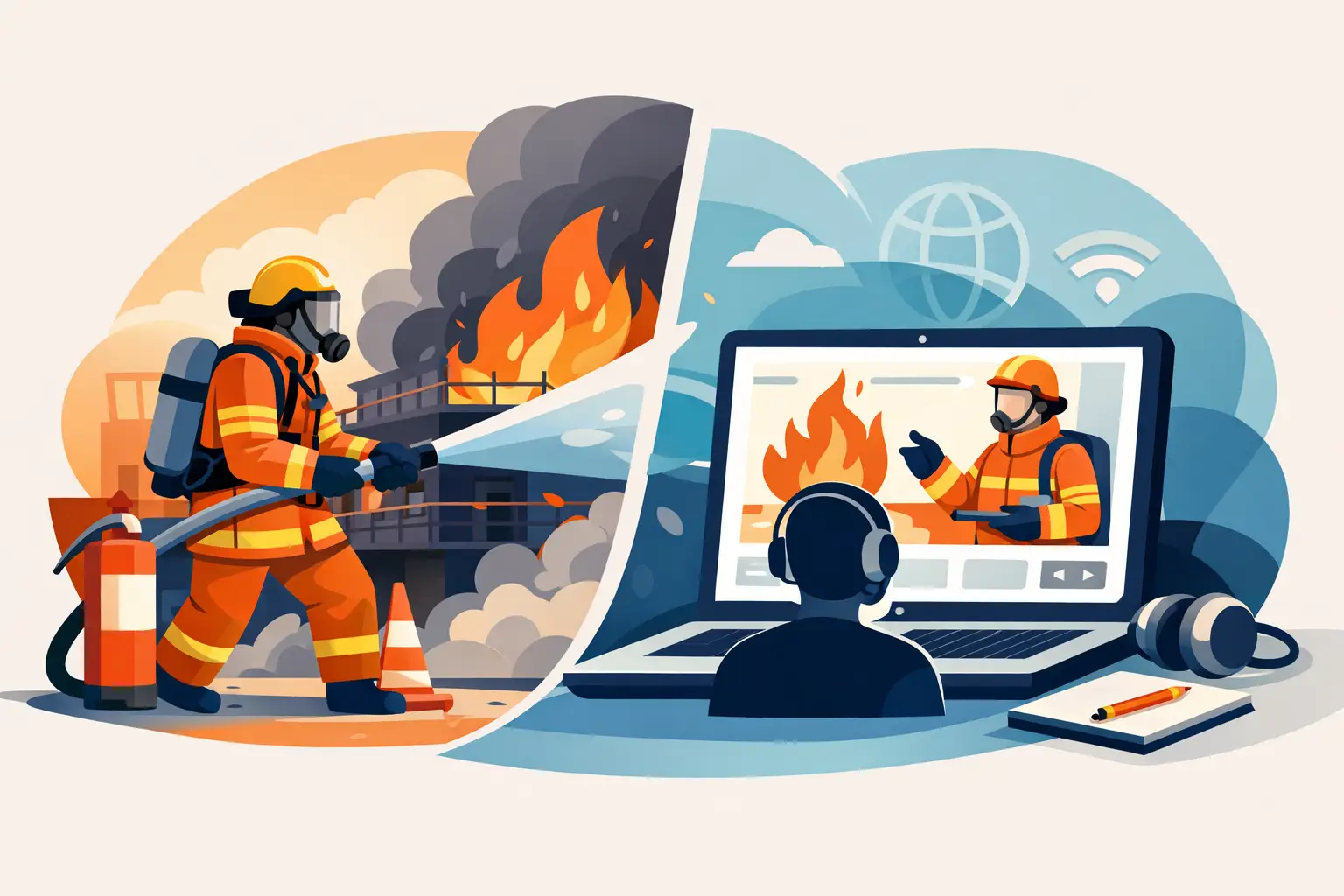
If you are trying to get hired fast or keep your documents current between contracts, the question is usually not whether you need firefighting training. You do. The real question is whether a basic firefighting STCW course online will satisfy the requirement you are facing right now.
That depends on what part of the training you need, what approval the course carries, and whether your employer or flag administration requires theory only, practical only, or a full combined certificate path. For working seafarers, that distinction matters because it can save days of travel, hotel costs, and lost income.
What a basic firefighting STCW course online actually covers
Under STCW basic safety training, fire prevention and firefighting is one of the core safety modules. It is commonly referenced under STCW Code A-VI/1 as part of the mandatory entry-level training required for many shipboard roles. In practical terms, this training is designed to make sure crew can identify fire risks, understand classes of fire, respond to alarms, use portable extinguishers correctly, and support onboard emergency procedures without creating additional danger.
When seafarers search for a basic firefighting STCW course online, they are often looking for the theory portion of that requirement. That can include instruction on the chemistry of fire, fire triangle principles, ignition sources, containment methods, fixed and portable firefighting systems, personal safety during response, and the chain of command during a shipboard emergency.
A strong online course should not feel like a generic slideshow. It should be structured around IMO-compliant learning outcomes and present shipboard scenarios that reflect actual operational conditions – machinery spaces, accommodation areas, galleys, cargo-related hazards, and alarm response under pressure. That is where quality matters.
Online firefighting training is valid in some situations and limited in others
This is where many seafarers lose time. “Online” does not always mean “complete.”
In many STCW pathways, the theory component can be delivered through an approved e-learning platform, especially when the provider is operating under a recognized administration and the course has been designed for remote delivery. That makes online training highly practical for crew members onboard, candidates in remote areas, and anyone trying to avoid unnecessary travel before joining a vessel.
But firefighting is also a hands-on competence. Depending on the approval route and certificate structure, a practical assessment or in-person drill component may still be required. If you are comparing providers, you need to confirm whether the course is theory only, theory plus simulation, or part of a blended process that leads to full compliance after a separate practical session.
That is not a weakness of online learning. It is simply the reality of safety training. Some competencies can be taught well online. Others must still be demonstrated physically.
How to evaluate an online STCW firefighting course
The first filter is approval status. If a course is not clearly presented as approved and aligned with STCW requirements, it should not be your first option. Seafarers need training that can stand up to employer review, document checks, and crewing deadlines.
The second filter is whether the provider explains the exact scope of the certificate. A legitimate course should tell you what regulation it supports, what competencies are included, whether it is fully online or blended, and what you receive after successful completion. If that information is vague, expect problems later.
The third filter is operational usability. A working seafarer does not need a complicated learning portal that only functions on one device or requires classroom-style attendance times. Self-paced access matters because shipboard schedules are not predictable. So does immediate enrollment, especially when a joining date is close.
A provider such as Marine Pro Academy is positioned around that real-world constraint. Its e-learning model is built for seafarers who need approved training access without stepping ashore for every module, and that is a meaningful advantage when compliance timelines are tight.
Why online study makes sense for active crew and new entrants
For active crew, the main value is continuity. If you are onboard and your next contract, promotion, or application depends on having your training in order, waiting for a seat at a shore-based center is not always realistic. Online delivery allows you to begin the academic portion immediately and build progress around watchstanding, port calls, and internet availability.
For first-time applicants, online study reduces the friction of entering the industry. Many job seekers need multiple STCW modules at once, not just firefighting. When theory can be completed remotely, the process becomes faster and easier to plan. You can move through required coursework from home, organize your documents, and be in a stronger position when it is time to apply for shipboard roles.
There is also a cost factor. Traditional in-person attendance often includes transport, accommodation, meals, and lost work time. Online theory does not remove every cost from the certification path, but it can reduce the overall burden substantially.
What STCW A-VI/1-2 means for firefighting training
If you see references to STCW A-VI/1-2, that points to the fire prevention and firefighting element within basic safety training. This standard is not just about putting out a fire. It is about recognizing hazards early, understanding preventive measures, and responding within the ship’s emergency organization.
That distinction matters because many shipboard fire incidents are contained or prevented through early action, proper reporting, and disciplined procedure rather than dramatic extinguishing efforts. Good training reflects that. It teaches situational awareness, not just equipment names.
An effective online course should prepare you to understand alarm systems, escape routes, basic extinguishing media, and the limits of individual action. Onboard safety depends on crew responding correctly as a team. Firefighting training is one piece of that larger emergency framework.
When online is the right choice and when it is not
If you need to begin immediately, are located far from a training center, or want to complete the theory portion before arranging any practical requirement, online is often the smartest route. It gives you speed, flexibility, and a clearer path forward.
If, however, your employer specifically requires a fully completed practical certificate before embarkation, you need to make sure the provider’s course structure matches that requirement. Some seafarers assume an online firefighting course alone will satisfy every hiring check. Sometimes it will support the process. Sometimes it will only cover the theory stage. That is why reading the course scope carefully is essential.
There is also a difference between a course that is merely convenient and one that is career-useful. The most convenient course is not the best option if it creates questions later during document review. Approval, acceptance, and clarity should come before price alone.
What to look for before you enroll
Before purchasing any basic firefighting STCW course online, confirm four things. First, check the course approval and the STCW standard it supports. Second, verify whether any practical attendance is required now or later. Third, confirm how quickly results and certificates are issued after completion. Fourth, make sure the platform is realistic for life at sea – mobile friendly, self-paced, and accessible across time zones.
These details are not minor. They affect whether you can join a vessel on time, submit documents to a crewing agency without delay, and avoid paying twice for training that did not meet the requirement.
For many seafarers, the best path is not choosing online instead of practical. It is choosing online first, so the theory is completed quickly and the remaining steps, if any, are easier to schedule.
The bottom line for seafarers
A basic firefighting STCW course online can be an efficient and legitimate way to complete the theory side of mandatory fire prevention and firefighting training, especially when delivered through an approved, IMO-compliant platform. It is particularly useful for crew already at sea, candidates in remote locations, and job seekers trying to move faster through basic safety requirements.
What matters is not the word online by itself. What matters is whether the course is approved, clearly structured, and matched to the compliance outcome you actually need. If you choose carefully, online firefighting training can remove a major barrier between you and your next contract.
When your career depends on timing, the best training option is the one that keeps you compliant without taking you off course.
Leave a Reply