
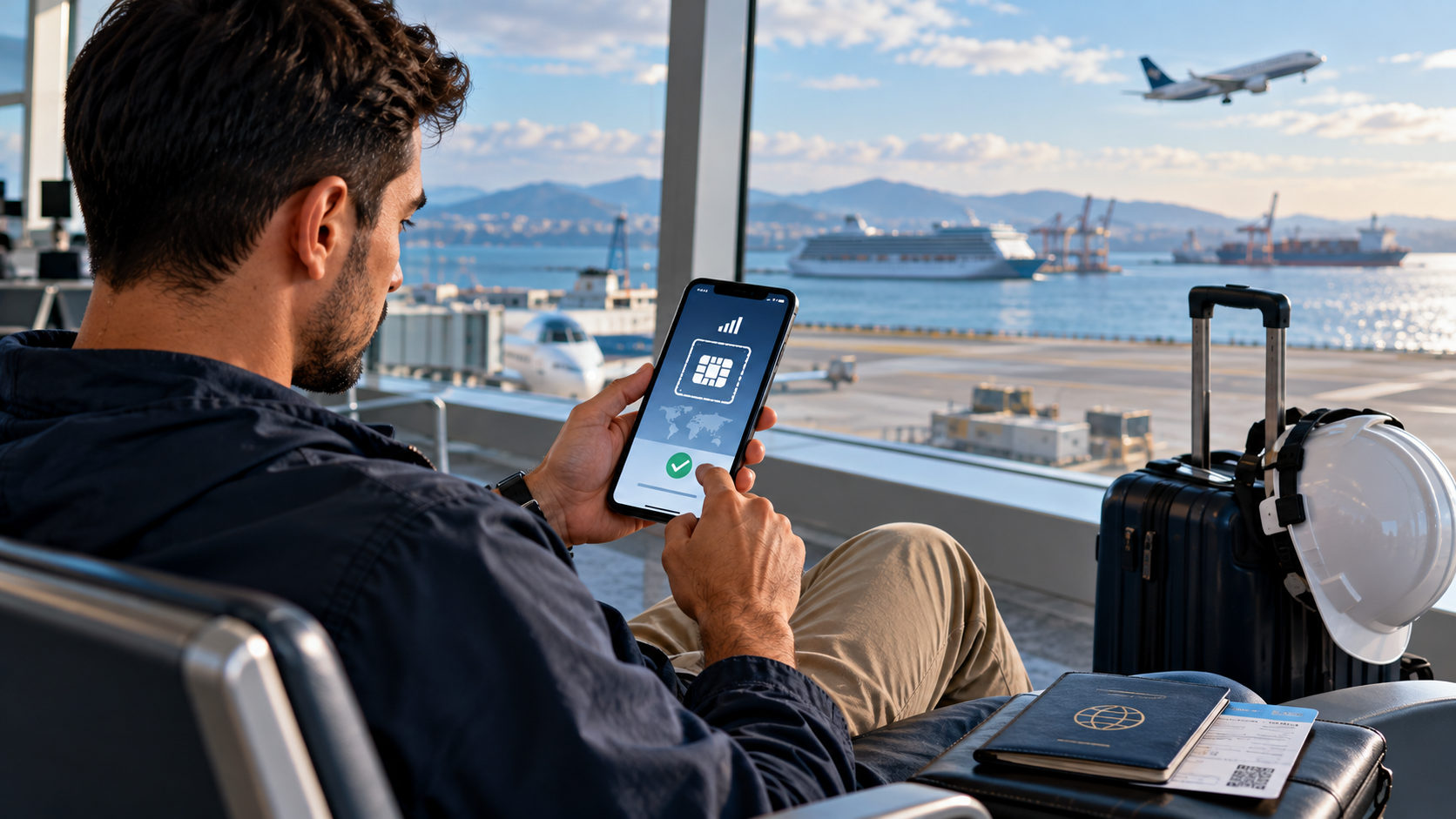
A missed crew-transfer message, an unfamiliar airport and a local SIM counter that has already closed can turn a normal joining day into a stressful one.
For seafarers asking when should crew buy eSIMs, the best answer is usually:
After the joining itinerary is confirmed, but before the travel day.
The goal is to install the eSIM while you still have reliable Wi-Fi and enough time to solve any compatibility or setup issue before reaching the airport.
The right timing depends on your route, embarkation port, transit countries, phone compatibility and how long you expect to rely on mobile data.
Buy the eSIM Once Your Travel Route Is Clear
Crew should normally choose an eSIM after flights, joining instructions and the embarkation port are confirmed.
At that point, you can check whether the plan covers:
- your departure country;
- transit countries;
- the country where you join the vessel;
- crew hotel locations;
- expected port calls; and
- any likely sign-off or onward route.
Buying too early can be inefficient.
Different eSIM plans start their validity in different ways. Some begin when they are installed, while others begin when they first connect to a supported network.
That is why crew should always check the activation terms before purchasing.
Marine Pro Academy currently offers crew eSIM plans for several important seafarer travel regions.
Install Before the Travel Day
The best time to install the eSIM is before leaving home or crew accommodation.
Do not wait until you are already at the airport.
Those are often the exact moments when you need mobile data most.
You may need to:
- receive a flight update;
- contact your crewing agent;
- locate your driver;
- check hotel directions;
- download joining instructions;
- use maps; or
- send an updated arrival time.
Trying to install an eSIM while depending on public airport Wi-Fi adds unnecessary risk.
Install the eSIM in advance and save the instructions where you can access them offline.
Activate According to the Plan Instructions
Installing and activating an eSIM are not always the same thing.
Some plans allow you to install the eSIM before travel and activate it only when you reach a supported destination.
That can be useful for seafarers because it lets you complete the technical setup early without necessarily using the plan immediately.
Before enabling the eSIM, check:
- when validity begins;
- whether data roaming should be enabled;
- which networks are supported;
- whether the plan is data-only; and
- whether your primary SIM should remain active.
Marine Pro Academy’s current FAQ recommends installing the eSIM before travel and activating it when you are ready to use data in a covered destination.
Match the Plan to Your Actual Route
The right eSIM depends more on the route than on the price.
A seafarer joining through Singapore has different connectivity needs from cruise crew joining in Miami or yacht crew moving through the Mediterranean.
Asia crew travel
For crew moving through several Asian countries, Marine Pro Academy offers the Asia Crew eSIM Data Plan – 10GB / 30 Days.
A regional plan can be useful if you transit in one country and join the vessel in another.
Caribbean crew travel
Cruise crew often move between several Caribbean destinations during a contract.
Marine Pro Academy’s Caribbean Crew eSIM plans are designed for multi-destination use across the region.
This can be more practical than trying to buy a local SIM every time the vessel reaches another port.
Europe crew travel
Crew joining through European ports can compare Marine Pro Academy’s Europe+ Crew eSIM plans.
Larger allowances can be useful for seafarers who expect longer shore stays, online learning, video calls or repeated port visits.
United States crew travel
Crew joining through U.S. ports can review the United States Crew eSIM plans.
Choose the allowance according to how long you expect to remain ashore and how much data you actually use.
When a Global eSIM Makes More Sense
A regional eSIM works well when the joining route is predictable.
But crew travel is not always predictable.
You may leave Europe, transit through the Middle East and join in Asia.
You may also sign off in a different region from where you joined.
In that situation, a Global Crew eSIM may be more practical.
A global plan is especially useful when:
- several regions are involved;
- the embarkation port may change;
- you travel internationally often;
- you want one setup for several countries; or
- your sign-off destination is uncertain.
Do Not Wait Until You Reach the Airport
Buying or installing an eSIM at the airport creates avoidable problems.
You may discover that:
- your phone is carrier-locked;
- your device does not support eSIM;
- the software needs updating;
- the QR code does not scan properly;
- airport Wi-Fi is weak; or
- the plan does not cover your next destination.
Crew travel can already be complicated enough.
Technical setup should be completed before the travel day where possible.
Check That Your Phone Supports eSIM
Before purchasing, confirm that your phone is both:
eSIM-compatible
and
carrier-unlocked
Some devices support eSIM only in certain regions or versions.
Dual-SIM support is also useful.
It can allow you to keep your normal number active for:
- banking codes;
- verification messages;
- calls;
- employer contact; and
- family communication
while assigning mobile data to the travel eSIM.
Protect Yourself From Roaming Charges
One of the biggest benefits of a travel eSIM is avoiding unexpected roaming charges.
Before departure, decide which SIM will handle mobile data.
If you do not want your primary SIM to use data abroad, turn off mobile data roaming on that line.
Then select the travel eSIM as the data line when needed.
Be particularly careful near ports and coastal areas.
Phones can sometimes connect to maritime or satellite networks.
These networks may be much more expensive and may not be included in your normal eSIM plan.
Do Not Rely on Ship Wi-Fi Alone
A crew eSIM and shipboard internet solve different problems.
An eSIM relies on terrestrial cellular networks.
That makes it useful in:
- airports;
- hotels;
- port areas;
- shore leave locations;
- crew transfers; and
- coastal areas where supported coverage is available.
It does not replace satellite internet once the vessel is offshore.
Marine Pro Academy’s guide to eSIM connectivity for seafarers explains this distinction in more detail.
For most crew, the eSIM is most valuable before boarding, during port calls and while travelling between contracts.
Buy for the Most Important Part of the Journey
Think about the moment when being offline would create the biggest problem.
Usually that is:
- during flight connections;
- immediately after landing;
- during transfer to the hotel;
- while waiting for the port agent;
- or just before vessel sign-on.
Reliable data during these stages can be more valuable than having a very large data package later.
That is why the best eSIM is not always the one with the most gigabytes.
It is the one that works where you need it.
Short-Notice Joining Requires a Simpler Decision
Some crew receive joining instructions with only 24 to 48 hours of notice.
In that situation, focus on four questions:
- Does the plan cover my route?
- Does my phone support it?
- Can I install it immediately?
- Is the validity long enough?
Do not spend too much time comparing small price differences if it increases the risk of travelling without connectivity.
The best plan is the one that works for the actual journey.
Choose the Right Data Allowance
Crew often buy too much or too little data.
For a short joining trip, a smaller plan may be enough for:
- WhatsApp;
- maps;
- email;
- airline apps;
- document access; and
- banking.
Larger allowances make more sense if you expect:
- frequent video calls;
- several weeks ashore;
- hotspot use;
- online training;
- document uploads; or
- regular port calls.
For European travel, Marine Pro Academy’s Europe+ eSIM plans offer several allowance levels.
For U.S. crew changes, the United States eSIM plans also provide several options.
Reduce Data Use Before Travel
Small settings can make your allowance last much longer.
Before departure, consider disabling:
- automatic app updates;
- automatic photo backup;
- high-quality streaming;
- background video downloads; and
- unnecessary background refresh.
Download important items before flying:
- joining instructions;
- offline maps;
- hotel details;
- certificates;
- travel documents; and
- entertainment.
Keep your mobile data available for the things that matter during crew change.
Follow Company Rules
Personal connectivity should never interfere with:
- watchkeeping;
- safety duties;
- security procedures;
- restricted areas;
- company confidentiality; or
- vessel rules.
An eSIM gives crew more flexibility.
It does not change professional responsibilities onboard.
Companies and crewing agencies can also reduce confusion by clearly telling crew whether they should arrange their own mobile connectivity and whether any cost can be reimbursed.
Day-Before-Travel eSIM Checklist
Before departure, check:
Device
- eSIM supported
- Phone carrier-unlocked
- Operating system updated
Plan
- Correct countries included
- Data allowance sufficient
- Validity period understood
- Activation trigger understood
Setup
- eSIM installed
- QR code or activation details saved offline
- Correct SIM selected for data
- Primary roaming settings checked
Travel
- Agent number saved
- Hotel details saved
- Joining instructions downloaded
- Important documents available offline
So, When Should Crew Buy eSIMs?
For most seafarers, the best time is:
after the travel route is confirmed and before the travel day.
Install the eSIM while you still have stable Wi-Fi.
Then activate it according to the plan instructions when you are ready to use data in a supported destination.
If the joining is urgent, buy as soon as the itinerary is confirmed.
Marine Pro Academy offers crew eSIM plans for regional and international travel.
The goal is simple:
Do not wait until you are standing outside an unfamiliar terminal looking for Wi-Fi.
Prepare the connection before you need it so that your next joining day starts with one less problem.
Leave a Reply