
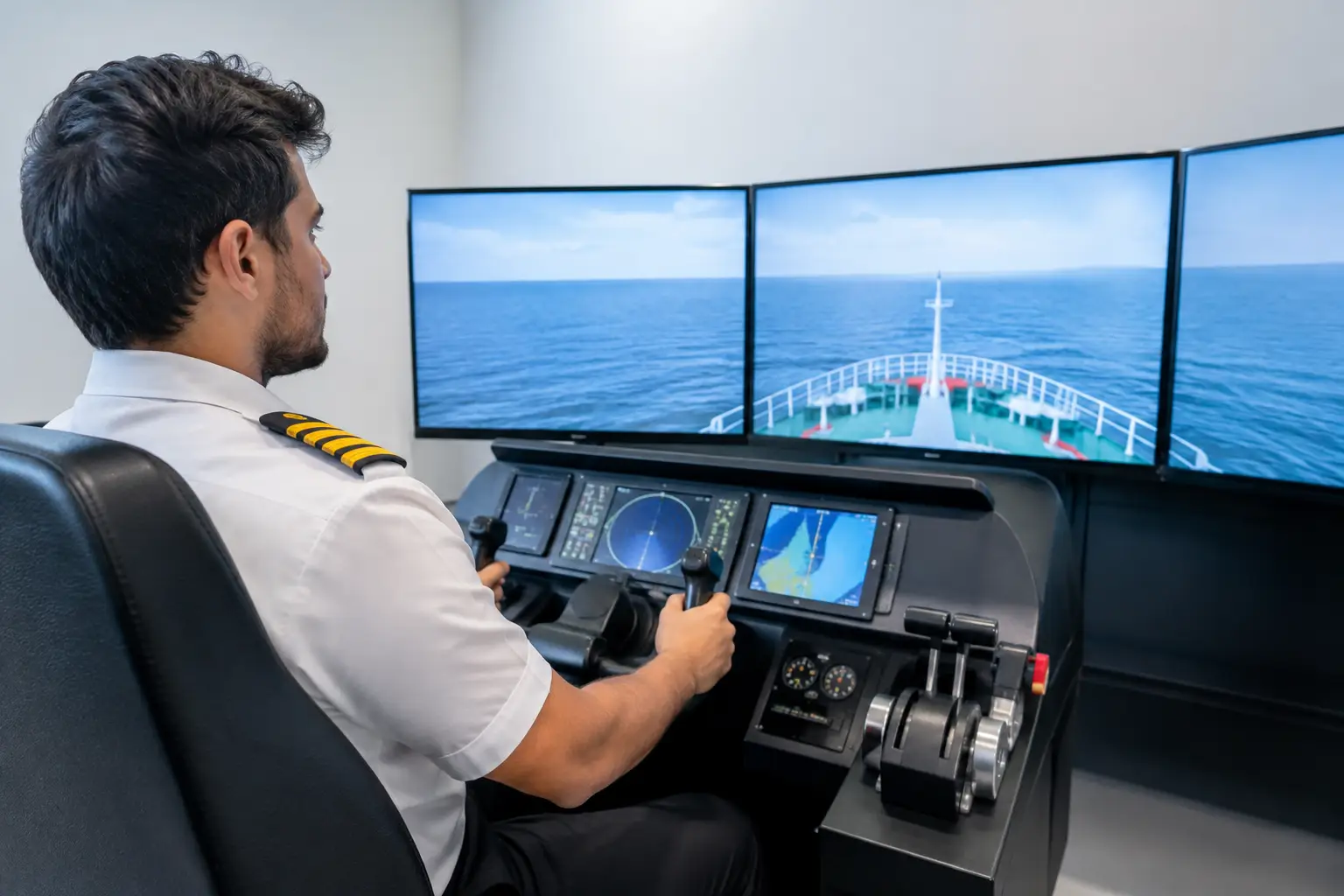
A virtual simulation learning guide can help seafarers practice decisions before they have to make them under pressure onboard.
Whether you are preparing for your first contract, refreshing knowledge between voyages, or managing training across several vessels, simulation gives learners a controlled environment where they can observe, decide, make mistakes, receive feedback, and improve without putting people, equipment, or vessel operations at risk.
For maritime professionals, this matters because knowing a procedure is not always the same as applying it correctly.
A crew member may understand a rule in a handbook but still need practice to:
- recognize a developing hazard
- prioritize actions
- communicate clearly
- follow reporting lines
- respond to alarms
- work as part of an emergency team
Well-designed virtual simulation learning helps bridge the gap between theory and the real working environment.
For new entrants, it can also form part of a broader cadet-to-seafarer training pathway before vessel-specific familiarization begins.
What Is Virtual Simulation Learning in Maritime Training?
Virtual simulation learning uses digital scenarios to recreate situations that seafarers may encounter during their work.
Depending on the training, the simulated environment could involve:
- a ship bridge
- engine room
- deck operation
- emergency station
- passenger area
- galley
- security checkpoint
- offshore worksite
Instead of simply reading information, learners are asked to make decisions.
For example, a scenario may require you to identify a hazard, choose the appropriate protective equipment, report an unsafe condition, prioritize emergency actions, or decide which person should be informed.
This creates a more active learning experience than simply watching a video or reading a manual.
Good Simulation Training Requires Decisions
The strongest maritime simulations are not just videos followed by multiple-choice questions.
They require learners to think.
A useful scenario might change according to the decision you make.
You may need to decide:
- what the immediate danger is
- whether work should stop
- who should be informed
- which procedure applies
- what equipment should be used
- what action should happen first
The feedback should then explain why the choice was appropriate or where another decision could create additional risk.
This is where simulation becomes valuable.
The learner is not simply memorizing the correct answer.
They are practicing professional judgment.
Why Virtual Simulation Can Help Seafarers
Maritime work involves situations that are difficult to recreate repeatedly in real life.
You cannot create an actual fire every time someone needs refresher training.
You cannot create a real security breach simply to test reporting decisions.
You cannot deliberately place passengers in danger to practice crowd control.
Simulation creates a controlled environment where those decisions can be explored safely.
It can also allow learners to repeat scenarios until the underlying reasoning becomes clearer.
That makes simulation particularly useful for:
- hazard recognition
- emergency decision-making
- communication
- security awareness
- passenger management
- leadership
- familiarization
- safe working practices
Simulation Helps Connect Theory With Real Work
Traditional e-learning is effective for delivering information.
Simulation can go one step further by asking the learner to apply that information.
Imagine learning about a fire response.
A normal lesson may explain:
- fire classes
- alarm procedures
- extinguishing methods
- communication requirements
A simulation could instead present smoke coming from a particular area and ask you to decide what to do first.
Do you investigate?
Raise the alarm?
Contact another department?
Use an extinguisher?
Evacuate the area?
The purpose is not simply to test memory.
It is to make the learner evaluate the situation.
Virtual Simulation Does Not Replace Every Practical Requirement
This distinction is essential.
Simulation can be an excellent preparation tool, but not every maritime competence can be demonstrated virtually.
Skills involving:
- firefighting equipment
- survival craft
- first aid procedures
- physical rescue techniques
- machinery operation
- practical emergency exercises
may still require supervised physical training or assessment depending on the specific course and approval.
Marine Pro Academy’s guide Is Online STCW Accepted? explains why online delivery can be accepted in certain circumstances, but approval, assessment method, issuing authority, and intended use all matter.
The correct question is therefore not:
“Can this be learned online?”
It is:
“Does this approved training route satisfy the requirement I need?”
Where Virtual Simulation Works Best
Simulation is particularly effective when the learning objective involves judgment rather than purely physical performance.
Emergency Response Awareness
A learner can be placed into a simulated emergency and asked to recognize:
- alarms
- hazards
- communication priorities
- evacuation decisions
- escalation procedures
This helps prepare crew for the logic behind emergency procedures before they participate in vessel drills.
Security Awareness
Simulation can present situations involving:
- suspicious behavior
- restricted areas
- unattended objects
- access-control problems
- unusual activity
The learner can practice identifying what needs to be reported and through which channel.
Passenger and Crowd Management
Cruise and ferry personnel may benefit from scenarios involving passengers who are:
- confused
- frightened
- separated from their group
- moving toward the wrong area
Simulation allows learners to practice communication and decision-making before dealing with real passengers under pressure.
Leadership and Teamwork
Senior or aspiring crew can use scenarios involving:
- poor communication
- conflicting priorities
- unsafe decisions
- fatigue
- interpersonal problems
These situations help learners think about how leadership decisions affect the wider team.
Simulation Can Support Fire Safety Training
Fire response is a good example of where virtual and practical learning can complement each other.
A digital simulation can help a learner practice decisions such as:
- recognizing the fire type
- identifying the correct alarm
- selecting an appropriate extinguishing method
- understanding escape routes
- communicating with the emergency team
But practical competence may still require direct interaction with real equipment.
Marine Pro Academy’s STCW Basic Training preparation course includes safety, survival, firefighting, and first-aid learning designed to help seafarers understand the principles before practical application.
The purpose of simulation should therefore be preparation and reinforcement where physical demonstration remains necessary.
Simulation Can Help New Seafarers Before Their First Contract
New crew often understand maritime terminology before they understand what it feels like to work inside the system.
Words such as:
- muster
- chain of command
- emergency station
- risk assessment
- PPE
- familiarization
can feel abstract until they are placed into a realistic situation.
Simulation gives new seafarers context.
A scenario can show why clear communication matters, why an unsafe shortcut creates risk, or why reporting an unusual condition early can prevent a larger incident.
This can make subsequent onboard familiarization easier because the learner already understands the logic behind the procedure.
Marine Pro Academy’s Cadet to Seafarer Training Path explains how training, documentation, safety preparation, and sea-service planning fit together for people entering the industry.
Virtual Simulation Versus Vessel Familiarization
Simulation and onboard familiarization should not be confused.
A simulation provides a controlled learning environment.
Vessel familiarization teaches you the actual arrangements onboard the ship you have joined.
That includes details such as:
- your real muster station
- actual emergency exits
- firefighting equipment locations
- lifeboat or liferaft arrangements
- onboard reporting lines
- vessel-specific procedures
A digital simulation cannot tell you exactly where the nearest emergency escape is on a vessel it was not designed around.
Use simulation to develop the thinking.
Use onboard familiarization to apply that thinking to the actual vessel.
How to Choose a Virtual Simulation Course
Before enrolling, begin with the outcome you need.
Ask yourself:
Why am I completing this training?
The answer may be:
- formal certification
- refresher learning
- company induction
- professional development
- preparation for practical training
- confidence before joining
These are different objectives.
A course designed for awareness does not automatically satisfy a formal certification requirement.
Check the Approval and Intended Use
If the simulation forms part of a certificate program, verify:
- approving administration
- provider authorization
- certificate issued
- STCW reference if applicable
- assessment method
- identity verification
- practical requirements
Do not rely only on the course title.
Two courses can have similar names while serving completely different compliance purposes.
Marine Pro Academy’s article on whether online STCW is accepted explains the importance of checking the actual approval and employment pathway before purchasing training.
Look for Realistic Decision Points
Good simulation should require more than obvious answers.
The learner should need to observe what is happening and make a reasonable professional decision.
Useful scenarios include uncertainty.
For example, the learner may receive:
- incomplete information
- several possible hazards
- competing priorities
- time pressure
That reflects real work more closely than questions where one answer is immediately obvious.
Look for Useful Feedback
Feedback is one of the most important parts of simulation-based learning.
Being told “incorrect” is not enough.
Good feedback should explain:
- what was missed
- why another action was safer
- which procedure applied
- what communication was required
- what consequence the wrong decision could create
That helps the learner improve on the second attempt.
Repeat Scenarios When Possible
One advantage of virtual simulation is repeatability.
In real operations, you may experience a situation once.
In simulation, you can repeat it.
That gives you the opportunity to compare your first instinct with the recommended process.
If the platform allows multiple attempts, use them.
The goal is not simply to achieve a passing score.
It is to understand why your decision changed.
Use Three Questions During a Simulation
A simple approach can help you think through almost any maritime scenario.
Ask:
1. What is happening?
Identify the actual situation.
2. What is the immediate risk?
Consider who or what could be harmed.
3. Who needs to know?
Identify the correct reporting or escalation route.
These three questions work across:
- deck
- engine
- hotel
- security
- offshore
- passenger operations
They keep attention on observation, risk, and communication.
Connect the Simulation to Your Vessel
After completing a scenario, ask how the lesson would apply onboard your vessel.
Consider:
- reporting lines
- procedures
- muster arrangements
- equipment
- work areas
- emergency responsibilities
If you are unsure how the simulated procedure applies onboard, ask your supervisor, safety officer, or relevant department head.
Do not guess.
Simulation provides a foundation.
Vessel procedures provide the operational answer.
Connectivity Matters for Virtual Training
Virtual simulation often requires reliable connectivity.
Courses may need internet access for:
- scenario loading
- videos
- progress tracking
- assessments
- account verification
- certificate generation
Seafarers who plan to study while travelling should prepare for this.
Marine Pro Academy’s guide to maritime connectivity for seafarers explains why mobile data can support training, document access, joining instructions, and communication during international crew travel.
If you expect to complete training while moving between countries, a global crew eSIM can also help provide mobile access where supported terrestrial networks are available.
Remember that eSIM connectivity does not replace vessel satellite internet once you are outside normal cellular range.
Do Not Depend on the Final Day
Virtual courses provide flexibility.
That does not mean they should be left until the last moment.
Technical issues can happen.
A platform may require:
- identity verification
- additional assessments
- certificate processing
- instructor review
- reliable internet
Start early enough that a technical problem does not become a joining problem.
Virtual Simulation for Crew Managers
Simulation is also valuable from the company side.
Shipping companies and crewing agencies often manage personnel who:
- live in different countries
- join at different ports
- follow different rotations
- have different experience levels
A standardized virtual scenario can provide the same core learning experience before embarkation.
For example, an organization could assign training covering:
- company safety culture
- cyber awareness
- security
- passenger management
- environmental responsibilities
- communication
This helps establish a shared baseline before vessel-specific familiarization.
Use Simulation as Part of a Wider Training System
Simulation should not become another checkbox.
The strongest approach combines several forms of learning.
For example:
Before joining:
Complete digital theory and simulation.
During induction:
Discuss key decisions and procedures.
Onboard:
Complete vessel familiarization.
During operation:
Participate in drills and supervised practice.
After incidents or near misses:
Use lessons learned to reinforce training.
This creates continuity between digital learning and real vessel operations.
Simulation Can Help Identify Training Gaps
Digital scenarios can also show where a learner struggles.
If someone repeatedly makes errors involving:
- communication
- hazard recognition
- emergency priorities
- equipment selection
that information can help identify where additional coaching may be useful.
For companies managing large numbers of crew, this can make training more targeted rather than treating every learner exactly the same.
What Crew Managers Should Check in a Platform
Companies evaluating virtual training should look beyond visual design.
Important considerations include:
- course approval
- learner tracking
- completion records
- assessment reporting
- certificate management
- language options
- data protection
- technical support
- mobile compatibility
Marine Pro Academy’s B2B Maritime Solutions support shipping companies, crewing agencies, yacht operators, offshore firms, and maritime schools with structured training, certification, documentation, and compliance workflows.
Digital learning can become particularly useful when companies need to train multiple crew members across different locations.
Questions to Ask Before Starting Virtual Simulation Training
Before enrolling, ask:
Will this course satisfy a formal requirement or is it professional development?
Does it provide an assessment?
Will I receive a certificate or completion record?
Is practical attendance still required?
Is the course accepted by my employer or intended administration?
Can I complete it on my device?
Do I have enough time before joining?
These questions protect both your training budget and your deployment schedule.
Virtual Learning Should Prepare You for Reality
Simulation cannot reproduce every aspect of shipboard life.
It cannot perfectly recreate:
- vessel movement
- heat
- noise
- smoke
- equipment weight
- physical fatigue
- human pressure
But that is not its purpose.
Its value is giving seafarers another opportunity to practice thinking.
When designed properly, simulation can help crew arrive onboard better prepared to:
- recognize hazards
- prioritize actions
- communicate clearly
- follow procedures
- understand consequences
The physical vessel then provides the environment where that knowledge becomes operational experience.
Final Thoughts
Virtual simulation learning is becoming an increasingly useful part of maritime training.
It gives seafarers a safe environment to practice decisions, repeat scenarios, receive feedback, and connect theory with real working situations.
For new crew, it can make maritime procedures easier to understand before their first vessel.
For experienced seafarers, it can support refresher learning and professional development.
For companies, simulation can provide consistent pre-joining training across internationally distributed crews.
But its role must remain clear.
Virtual simulation is powerful when used for the right learning objective.
It should complement practical training, drills, supervised assessment, and vessel-specific familiarization rather than replace them where physical competence is required.
Marine Pro Academy supports maritime professionals through online STCW training, structured career preparation, connectivity guidance, and B2B crew-training solutions.
The goal is not to replace the vessel with a screen.
It is to help seafarers step onboard better prepared for the decisions they will eventually need to make in the real environment.
Leave a Reply