
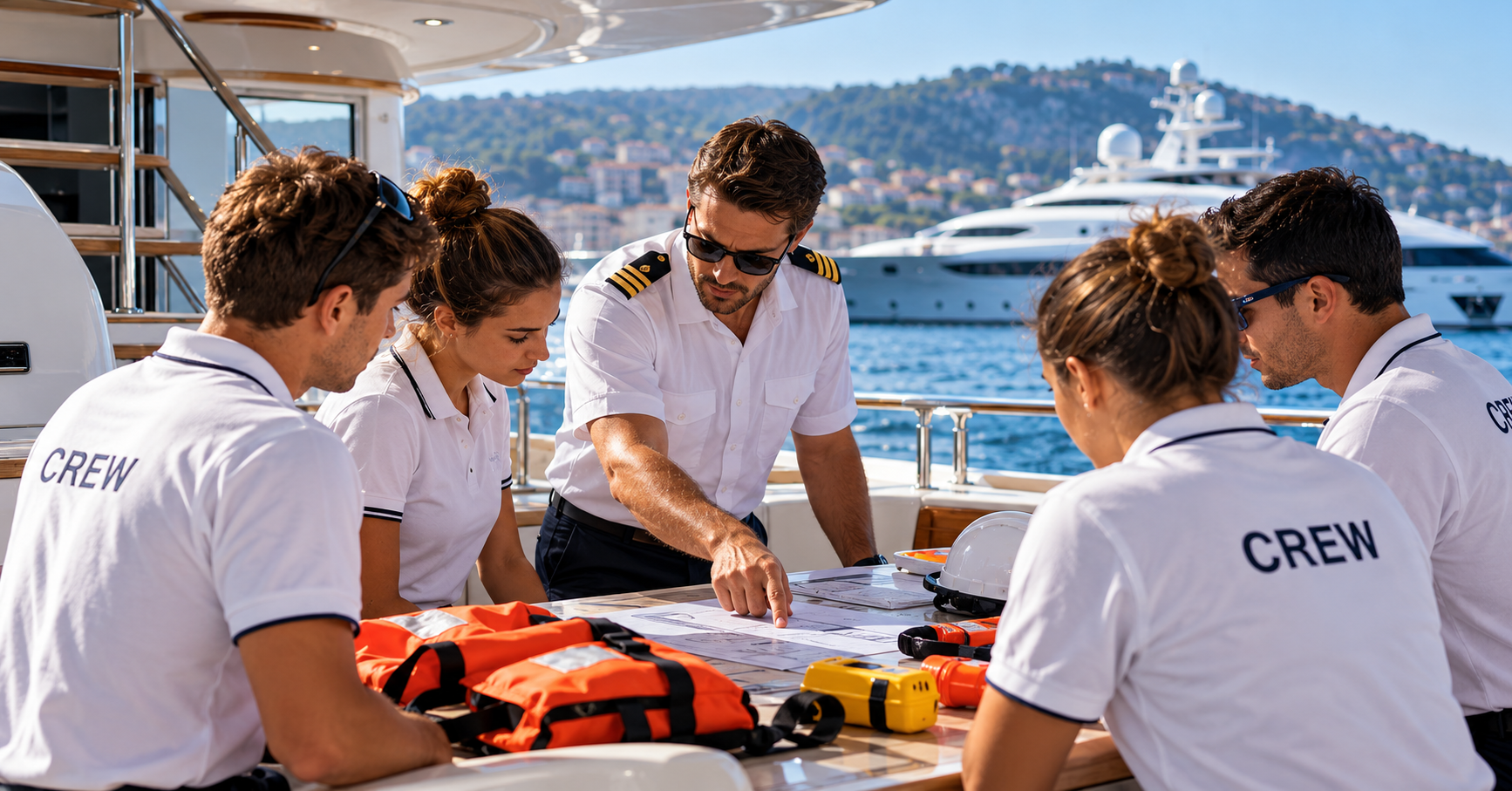
Moving from hospitality, deck work or shore-based service into a yacht job? This guide shows how to match STCW training to your actual role, avoid buying certificates you do not need and check whether a course will be accepted before you pay for it.
Why Yacht Crew Training Is Not One Fixed Package
STCW training for yacht crew is often presented online as a single shopping list. In practice, the right certificates depend on whether the yacht is commercially operated, its flag, size, trading area and applicable code, your duties and the employer’s requirements. A steward, deckhand, engineer and officer share basic safety needs but hold different role-specific qualifications. The smartest starting point is the yacht’s training matrix and the flag’s rules, not a generic bundle.
Start With the Yacht, Not the Course Catalogue
Ask the recruiter or captain for the yacht’s flag, commercial or private status, size and the exact position offered. Ask for a written list of required certificates and accepted issuing administrations. If the answer is simply “get STCW”, ask for more detail: STCW is a convention and training framework, not the name of one universal certificate.
The Four Core Basic Safety Courses
STCW Basic Training (Regulation VI/1, section A-VI/1) is made up of four courses: Personal Survival Techniques (PST), Fire Prevention and Fire Fighting (FPFF), Elementary First Aid (EFA) and Personal Safety and Social Responsibilities (PSSR). Marine Pro Academy offers the four courses as a Basic Safety Training bundle with Liberia, Panama or Belize approval. Before purchasing, confirm that the yacht’s flag and employer accept the issuing approval and delivery format.
Personal Survival Techniques (PST)
PST covers survival at sea, abandoning ship and life-saving appliances. Yacht arrangements differ, so the course does not replace yacht-specific drills or familiarisation. See Marine Pro Academy’s Personal Survival Techniques course, and check whether the flag requires an approved practical element.
Fire Prevention and Fire Fighting (FPFF)
Yachts combine technical spaces, guest accommodation, galleys and electrical equipment in a compact space, so fire prevention matters in every department. Basic FPFF is not the same as Advanced Fire Fighting. Marine Pro Academy offers Fire Prevention and Fire Fighting training and a practical FPFF course (ABS approved). Confirm what practical evidence your flag and employer require.
Elementary First Aid (EFA)
EFA teaches immediate first response. It does not replace Medical First Aid or Medical Care where an officer or designated person needs them. See Elementary First Aid and, if your role requires it, Medical First Aid.
Personal Safety and Social Responsibilities (PSSR)
PSSR covers safe working practices, communication, fatigue and conduct on board, which matter on yachts where small teams live and work closely together. It also reflects the 2026 STCW amendments on preventing violence and harassment. See Marine Pro Academy’s updated Liberia PSSR course and our PSSR training guide.
Security Awareness or Designated Security Duties?
Where maritime security requirements apply, security training depends on your duties. Crew without designated security duties generally need Security Awareness (A-VI/6-1). Crew assigned duties under the Ship Security Plan need Designated Security Duties (A-VI/6-2). Marine Pro Academy offers Security Awareness approved by Liberia, Panama, Belize or Cyprus (EU), and Designated Security Duties approved by Liberia, Panama, Belize or Cyprus (EU). Ask the yacht which one matches your role before buying both.
Whether security requirements apply depends on the yacht’s status, size, voyages and flag, and an employer may ask for more than the legal minimum. The IMO’s maritime security model courses explain why awareness, designated duties and ship security officer training are separate.
Deckhands, Stewards, Engineers and Officers: Different Pathways
- Deckhands: basic safety, security, onboard familiarisation and deck task training.
- Interior crew: the same safety foundation, plus service, galley or housekeeping training where relevant.
- Engineers: appropriate technical qualifications and machinery familiarisation.
- Officers: Certificates of Competency and additional courses beyond basic training.
A short course alone does not qualify anyone for watchkeeping, tender command or engineering duties.
Online Learning vs Practical Training
Online study works well for theory and for courses approved for online delivery, but it is not automatically accepted for every competence. Some administrations, such as the UK MCA, do not accept online courses where the STCW Code requires face-to-face practical training. Other flags have their own rules. Before paying, ask the employer in writing whether the exact certificate, issuing approval and format will be accepted, especially for survival and firefighting.
How to Check a Certificate Before You Join
Check that your name matches your passport, and check the course title, STCW reference, issuer, issue date, certificate number and verification method. Marine Pro Academy certificates include a QR code and can be checked through our certificate verification page. Our online certificate validity guide explains other common checks.
Common Training Purchases That Go Wrong
- Buying a large bundle without a role-specific list.
- Confusing Security Awareness with Designated Security Duties.
- Assuming every flag accepts every foreign-issued or online certificate.
- Overlooking practical training or refresher requirements.
- Believing one STCW course covers tender operations, watchkeeping or engineering.
Example: A First-Time Yacht Steward
A hospitality professional is offered an interior role on a commercial yacht. The recruiter asks for basic safety, security awareness and a medical certificate. Instead of buying a seven-course package, the candidate asks for the exact courses, accepted approval and any practical attendance, and confirms DSD is not needed. The result is a precise shopping list and no wasted money.
Pre-Enrolment Checklist
- Write down the yacht’s flag and commercial status.
- Get the exact position and certificate list.
- Check whether you have designated security duties.
- Match each requirement to a course page.
- Confirm the flag and employer accept the issuing approval and format.
- Check if practical training is required.
- Make sure your passport details match your documents.
Allow time for certificates: Marine Pro Academy issues flag-approved STCW certificates within 48 hours of completion and receipt of all documents, so finish your training a few days before your deadline.
Recommended Courses for This Topic
Online and self-paced. Choose the flag approval your employer or vessel requires.
- STCW Basic Training (4 courses): Liberia | Panama | Belize
- Basic Training + Security (6 courses): Liberia | Panama
- Security Awareness: Liberia | Panama | Belize | Cyprus
- Designated Security Duties: Liberia | Panama | Belize | Cyprus
- Survival craft & rescue boats: PSCRB Liberia | PSCRB Panama | Fast Rescue Boats (Panama) | Free-fall Lifeboats
- Browse: STCW Bundles | Safety & Security
Frequently Asked Questions
Do yacht stewards need STCW?
Many commercial yacht roles require STCW basic safety training, but the exact list depends on the yacht and employer.
Is Security Awareness always enough?
Not if you have designated security duties under the Ship Security Plan.
Can all yacht STCW courses be completed online?
Not always. Practical competence and flag recognition may require attendance.
Will a Liberia or Panama certificate be accepted on a UK-flagged yacht?
Acceptance is not automatic. Ask the employer or the MCA to confirm for the exact course.
Start Your Yacht Crew Training
Choose training based on the job you have been offered, not the biggest package advertised. Once your employer confirms the list, compare the Liberia Basic Safety bundle, other STCW course bundles or the Panama-approved STCW courses. New to the industry? Read our STCW basic training guide for new seafarers.
Leave a Reply