
If your joining date is close and your employer needs proof of STCW compliance, the wrong training setup can cost you a contract. The STCW basic safety training bundle, 6 courses is built for seafarers who need the core certificates in one place, without losing weeks to classroom scheduling, travel, and repeated admin.
For new entrants, this bundle is often the fastest route to becoming job-ready. For active crew, it can be the most practical way to close training gaps before sign-on, promotion, or transfer. What matters is not just finishing courses, but finishing the right ones under approved, internationally recognized standards that employers actually accept.
What the STCW basic safety training bundle, 6 courses usually includes
At its core, a six-course bundle is designed to cover the safety and security training that seafarers commonly need before joining an international vessel. The exact package can vary by provider and approval route, but it typically combines the four Basic Safety Training subjects under STCW A-VI/1 with two security-related modules that strengthen employability across cruise, merchant, offshore, and mixed-fleet operations.
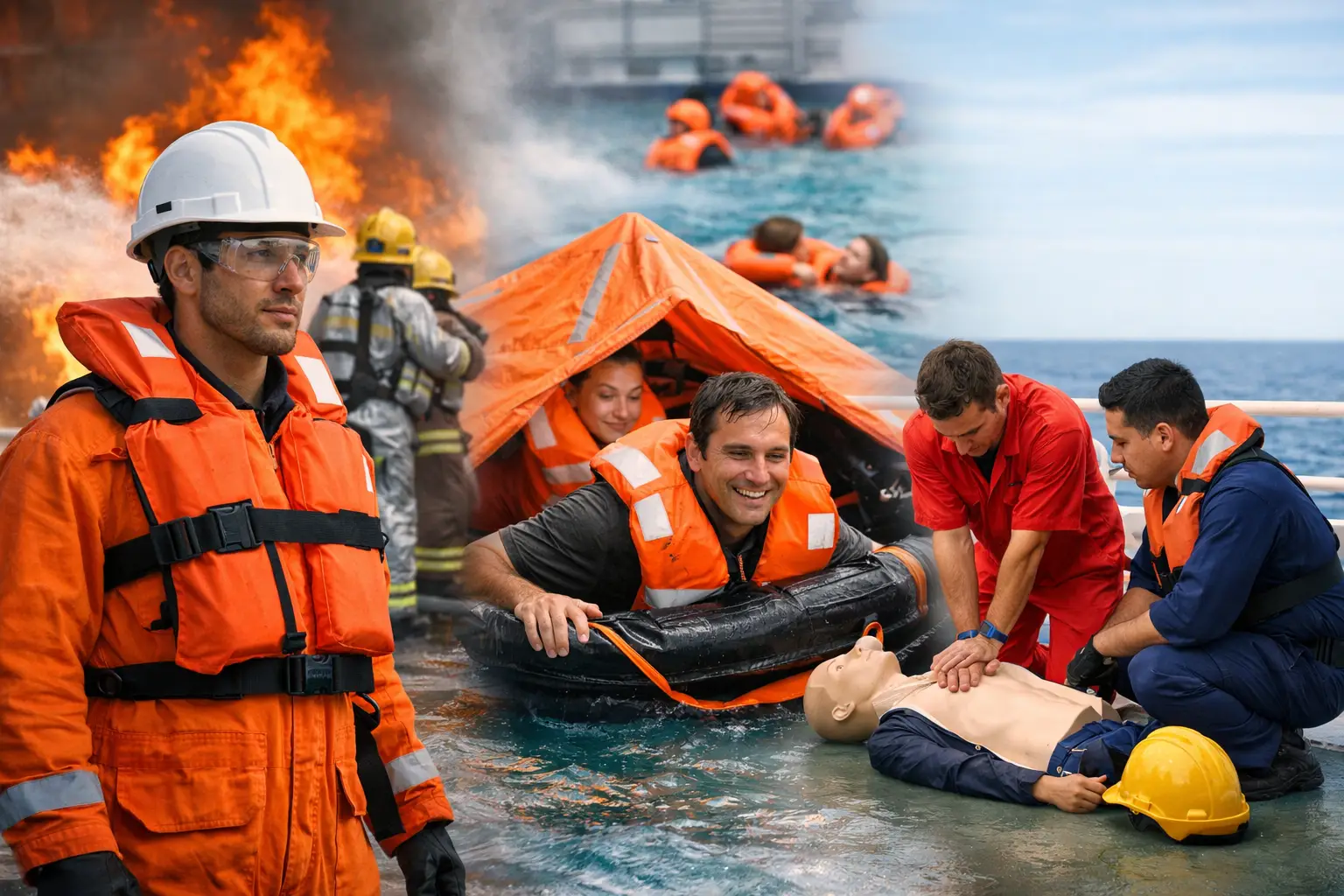
The first four are the foundation. Personal Survival Techniques covers abandonment, survival craft awareness, and immediate actions in an emergency at sea. Fire Prevention and Fire Fighting focuses on fire classes, onboard hazards, containment, and response procedures. Elementary First Aid addresses basic casualty assessment and initial care. Personal Safety and Social Responsibilities deals with safe working practices, pollution prevention awareness, fatigue, communication, and shipboard conduct.
The additional two courses are often Security Awareness and Designated Security Duties, depending on the bundle structure. That matters because many employers do not just want crew with baseline safety training. They want candidates who can step onboard already aligned with ISPS-related security requirements and onboard procedures.
Why a 6-course bundle makes operational sense
Buying six modules separately may appear manageable at first, but in practice it creates friction. Different enrollments, different certificate timelines, separate records, and a higher chance that one missing course delays your application. A bundle reduces that risk by organizing your compliance path as one purchase and one study track.
For working seafarers, the bigger advantage is scheduling. Shipboard life does not leave much room for commuting to a center, waiting for class dates, or repeating theory sessions in person when all you need is recognized training completed quickly. A self-paced online format works because it lets you study around watchkeeping, port calls, relief periods, and unstable internet windows. You move when your schedule allows, not when a classroom opens.
There is also a cost-control angle. Bundled pricing is usually more efficient than purchasing each course one by one, especially when you factor in travel, accommodation, and missed work time associated with traditional attendance-based training. For many seafarers, that difference is not minor. It is the reason training gets done now instead of postponed until the next contract cycle.
Who should take the STCW basic safety training bundle, 6 courses
This bundle is a strong fit for first-time seafarers applying to cruise ships, cargo vessels, ferries, offshore units, and support fleets. If you need the baseline certificates that open the door to employment, a six-course package gives structure and speed.
It also suits experienced crew whose documentation is incomplete for a new employer or flag requirement. Sometimes a mariner already holds part of the BST pathway but needs to add security modules to match a role. In that case, the bundle can still make sense if the pricing and approval route are better than rebuilding a course plan one certificate at a time.
That said, it depends on your current record. If you already hold valid A-VI/1 certificates and only need one security course, a full bundle may be unnecessary. The right decision is the one that closes your compliance gap without paying for training you do not need.
Approval and acceptance matter more than course count
A common mistake is assuming that any online package labeled STCW is enough. It is not enough if the course approvals are unclear, the standards are vague, or the issuing pathway does not align with employer expectations. Seafarers should always look at whether the training is delivered under recognized maritime standards and whether the provider clearly states the approval basis and compliance framework.
That is where the difference between marketing and operational value becomes obvious. A six-course bundle only helps your career if the certificates are credible when reviewed by recruiters, crewing departments, and maritime employers. Approval status, IMO compliance, and international acceptance are what turn a training bundle into something useful in the real hiring process.
Marine Pro Academy positions these programs around that exact requirement: approved STCW training, internationally recognized certification, and study access that works onboard or at home. For seafarers balancing deadlines and deployment schedules, that model removes a major barrier.
Online learning is not just convenience
For maritime training, convenience is often described too lightly. In reality, access is a compliance issue. Many seafarers are deployed far from approved centers, live between contracts, or work in regions where course availability is limited. If theory training can be completed online through a structured e-learning platform with simulation support, the seafarer has a realistic path to staying employable.
That matters especially for international crew. A cadet in one country, a cruise applicant in another, and an offshore worker joining from a third location all face the same basic problem: they need recognized training before reporting to duty. A digital model compresses that delay.
There is a trade-off, of course. Some learners perform better in a physical classroom and prefer direct instructor interaction in real time. Others need a study format they can pause and resume between shifts. Neither approach is universally better. The practical question is which format helps you complete approved training correctly and on time.
What to check before you enroll
Before paying for any STCW basic safety training bundle, 6 courses, verify the course lineup and confirm that it matches your employment target. Cruise operations, cargo fleets, offshore support, and security-sensitive roles may prioritize different combinations. Do not assume every six-course package is identical.
You should also confirm certificate issuance timelines. Fast completion loses value if documentation takes too long to process when your joining date is near. Look for a provider that is clear about how quickly certificates are issued after successful completion.
Finally, check whether the learning format is built for seafarers rather than general online students. That means mobile-friendly access, self-paced progression, practical scenario framing, and support that understands maritime documentation and employer deadlines. A polished website alone does not guarantee that.
How the bundle supports employability
Recruiters rarely spend extra time interpreting partial compliance. If a candidate has a complete, recognizable training package ready for review, that candidate is easier to process and easier to place. That does not guarantee a contract, but it improves readiness at the exact point where many applicants lose time.
For new seafarers, the six-course bundle helps convert intention into eligibility. For experienced crew, it supports continuity – less scrambling before embarkation, fewer last-minute training gaps, and a cleaner path to meeting employer onboarding requirements.
It also supports broader career mobility. A seafarer who completes a well-structured safety and security bundle is better positioned to apply across vessel types instead of being restricted by missing baseline certificates. In a competitive labor market, flexibility has real value.
The real value of a bundled route
The STCW basic safety training bundle, 6 courses is not just a discount package. At its best, it is a compliance tool. It brings together core safety subjects and security training in a format that respects how seafarers actually live and work – on rotation, across borders, and often under tight deadlines.
If you choose the right provider, the result is simple: less wasted time, fewer administrative delays, and a stronger position when the next job opportunity opens. When your career depends on being ready before the gangway goes down, practical training access is not a minor benefit. It is part of staying at sea.
Leave a Reply