
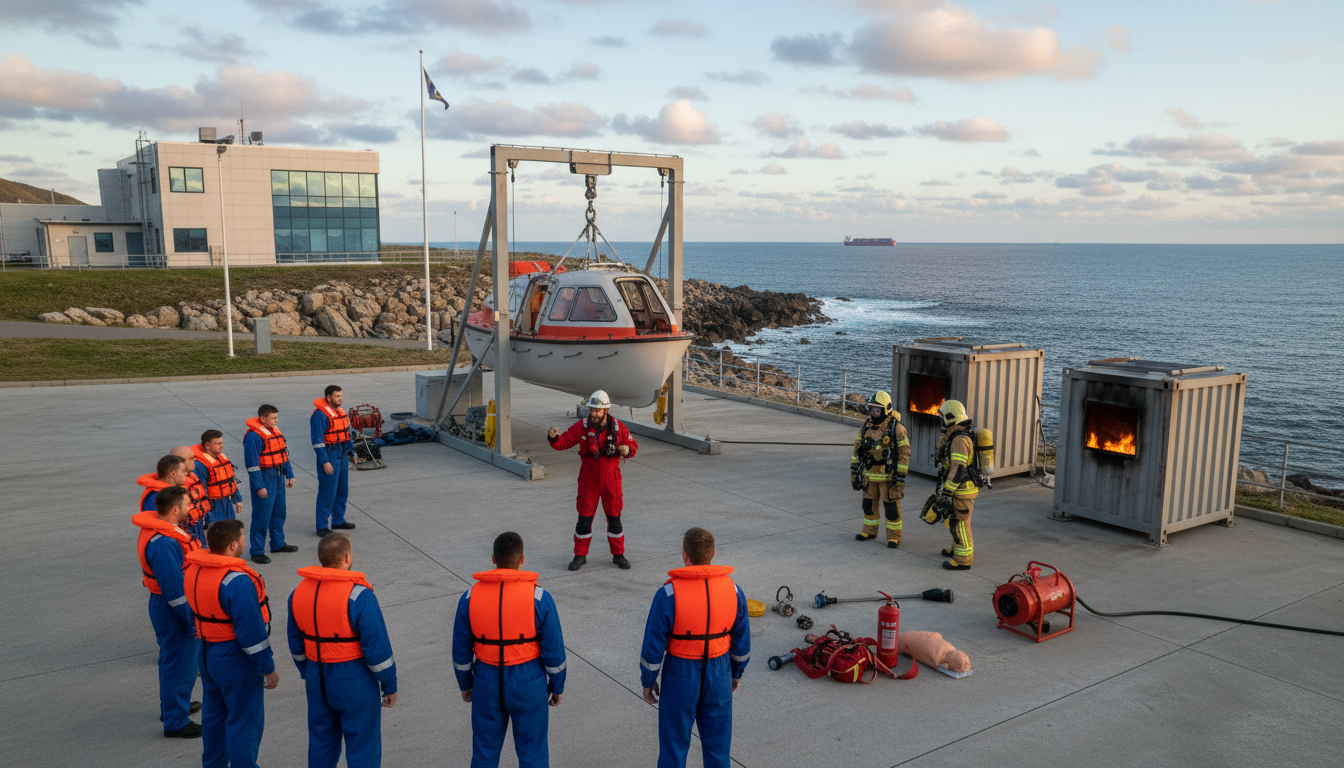
Survival and firefighting are among the most important emergency competencies taught to seafarers. Personal Survival Techniques (PST) and Fire Prevention and Fire Fighting (FPFF) are separate but complementary subjects, and good preparation means more than reading a course outline. This guide covers what to check before booking, how to study each subject, and how to connect theory to onboard practice.
Check Requirements Before Booking
A preparation plan should first establish whether you need initial training, a refresher or other evidence of competence. Ask the training provider which practical demonstrations are mandatory, whether theoretical learning may take place remotely, how assessment is supervised and when certificates are issued. An online theoretical module can help you understand alarms, risk recognition and decision-making, but it should not be represented as a substitute for a required hands-on assessment. Your employer or administration should confirm acceptance of the intended certificate before you rely on it for joining a vessel.
Get Documents and Logistics Ready
Check your name against your passport and confirm whether the provider needs previous certificates, identity verification or documentation of practical work. Make sure you can access the learning platform and have reliable connectivity for assessments. Allow extra time for verification, any practical component and certificate checking before your joining date. Keep copies of correspondence, receipts and training records. If your employer specifies an accepted training centre or administration, obtain confirmation before paying.
Survival Techniques: Make Decisions Under Pressure
Review muster signals, lifejackets, immersion protection, survival craft arrangements and sea-survival priorities. Focus on why correct sequencing matters: raise the alarm, locate the assigned muster station, follow orders, use equipment correctly and avoid actions that place other crew in danger. Think through what a crew member should do when an alarm sounds, how to avoid confusion at the muster station and why staying calm matters. General course examples are not substitutes for vessel-specific procedures. The Belize PST course outlines the related training subjects.
Fire Prevention: Recognize the Changing Risk
Fire safety begins with hazard awareness: ignition sources, housekeeping, electrical risks, safe storage, work permits and prompt reporting of abnormal conditions. Study fire classes, alarms, basic fire behaviour and communication with the response team, and understand why a small incident can escalate rapidly in enclosed shipboard spaces. A developing fire can exceed a person’s safe response capability quickly, so no seafarer should attempt dangerous intervention outside their training, authority or the vessel’s emergency procedures.
The Belize Fire Prevention and Fire Fighting course can support theoretical preparation, but applicable practical training and demonstrated competence must still be completed.
Don’t Overlook First Aid and Teamwork
Emergencies often require coordination across multiple departments. Knowledge of Elementary First Aid and PSSR supports calmer reporting, casualty assistance and team communication.
When a Bundle Makes Sense
If your requirement includes PST, FPFF, Elementary First Aid and PSSR, a four-course Basic Safety Training bundle may provide a convenient way to cover all four subjects. Marine Pro Academy offers it with Belize, Liberia or Panama approval, and as a 6-course bundle with security training (Liberia or Panama). However, a bundle does not automatically satisfy every role’s documentation requirements. Compare the programme’s individual components, issuing arrangements and practical assessment method against the employer’s checklist. If only one subject is missing, a single-course option may be more appropriate and less expensive. If you only need PST and FPFF, see the PST and FPFF 2-course bundle (Liberia).
Use Scenarios Rather Than Memorizing Answers
A useful way to prepare is to describe what you would notice, communicate and do first in an emergency. Imagine being in an unfamiliar crew area when you hear the general emergency alarm, or noticing signs of smoke or overheating near equipment during a routine shift. Training should help you recognize the concern, report it promptly and follow the vessel’s approved emergency procedure within the boundaries of your role. The point is not to invent a universal response, but to identify where you need to consult the vessel’s instructions, a supervisor or course guidance. Explain why an action is appropriate, not just which multiple-choice answer looks familiar.
Sample Study Schedule Before Training
- Session 1: Read the learning objectives and make a short glossary of unfamiliar terms.
- Session 2: Focus on survival-related alarm awareness and following instructions.
- Session 3: Review fire prevention and hazard reporting.
- Session 4: Work through decision scenarios and note any uncertainty for clarification.
Adjust the sequence to the training provider’s actual syllabus and your personal schedule. A plan makes it easier to retain information, but it cannot replace approved practical demonstrations where these are required.
Mistakes Learners Should Avoid
- Studying only to pass a multiple-choice assessment without understanding why a decision is safe.
- Confusing a general training example with the vessel’s actual emergency plan.
- Postponing identity checks or course acceptance questions until after payment.
- Assuming every remotely accessible course fulfils all practical requirements.
A careful review of the PST and FPFF listings can help reveal which details to clarify.
After Training: Link Theory to Onboard Familiarization
When you receive the certificate, inspect the identity details, title, competence reference and any verification or renewal information. Save the record securely and submit it to your crewing department in time for validation.
Once aboard, pay particular attention to emergency organization, designated muster points, communications and local safe working procedures. Ask questions during familiarization and take part in required drills. Emergency equipment and arrangements can differ between vessels, even within the same fleet. Training gives you conceptual preparation, while vessel-specific practice helps you apply that knowledge in the correct context. If anything conflicts with your understanding, seek guidance from authorized personnel rather than relying on an old course example.
Survival and Fire Safety Preparation Checklist
- Confirm whether you need initial or refresher training.
- Confirm employer and administration acceptance before paying.
- Ask how practical competence is assessed.
- Organize identification details and previous records.
- Study with scenarios, not just answer memorization.
- Check the certificate details after completion.
- Learn vessel-specific muster arrangements and join required drills.
Recommended Courses for This Topic
Online and self-paced. Choose the flag approval your employer or vessel requires.
- Personal Survival Techniques: Liberia | Panama | Belize
- Fire Prevention & Fire Fighting: Liberia | Panama | Belize | Practical (ABS)
- Survival craft & rescue boats: PSCRB Liberia | PSCRB Panama | Fast Rescue Boats (Panama) | Free-fall Lifeboats
- STCW Basic Training (4 courses): Liberia | Panama | Belize
- Browse: STCW Belize | STCW Bundles
Frequently Asked Questions
Should a first-time seafarer complete both PST and FPFF?
Follow the relevant employer and regulatory training matrix, which commonly lists both among basic safety subjects. Completing one does not cover the other.
Is passing an online test enough for every learning outcome?
No. Practical competences, especially in firefighting, may require additional approved assessment.
Is fire prevention only about using extinguishers?
No. Prevention, reporting and safe conduct are just as important.
Can onboard drills replace initial training?
Do not assume so. Drills and certificated training serve different purposes and are subject to separate requirements.
Explore Marine Pro Academy Training
Explore the Basic Safety Training courses approved by Belize, Liberia and Panama, and review the specific certificate requirements before booking. Course approval, assessment and acceptance should always be checked for the individual application.
Leave a Reply