
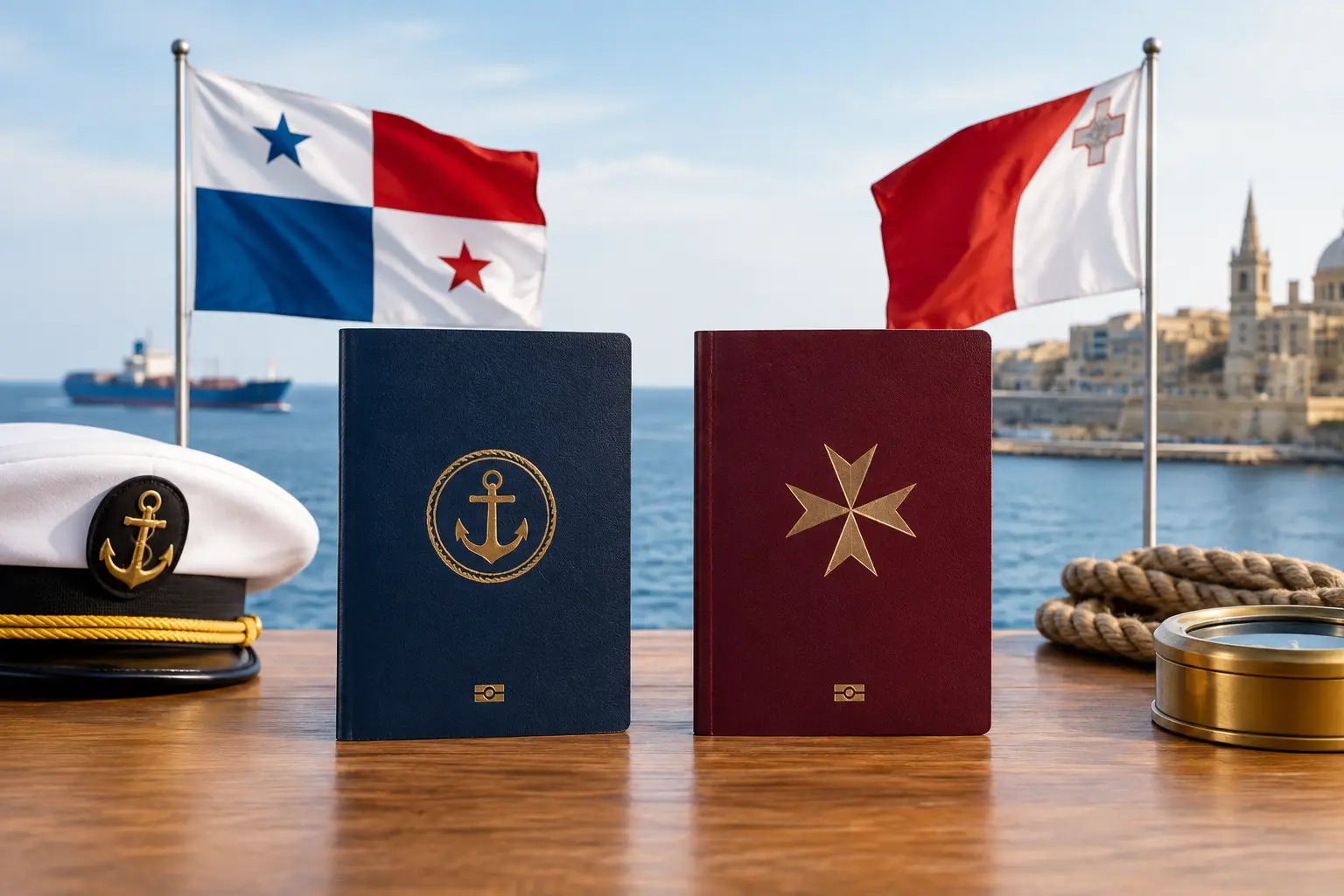
A Seaman Book is often one of the first documents a crew member is asked about before joining a vessel. But choosing between a Panama Seaman Book vs Malta Seaman Book is not simply a question of which application appears faster or easier.
The right choice depends on the vessel’s flag, your position, your employer’s requirements, your eligibility, and the documentation requested for your next assignment.
For crew preparing for cargo, cruise, yacht, or offshore employment, the practical priority is obtaining the right document for the intended job. A Seaman Book may be legitimate and professionally useful while still not being the document requested by a particular employer or vessel operator.
Understanding the differences before applying can help you avoid unnecessary costs, duplicate applications, and last-minute documentation problems before embarkation.
What Does a Seaman Book Actually Do?
A Seaman Book—also referred to as a Seafarer’s Record Book, discharge book, or similar terminology depending on the issuing administration—is an important maritime document used in connection with a seafarer’s professional service.
It can record information relating to sea service, vessel assignments, rank or capacity, and periods of employment.
However, a Seaman Book should not be confused with a Certificate of Competency, STCW training certificate, passport, medical certificate, visa, or flag-state endorsement. Depending on the position and vessel, a seafarer may require several of these documents before joining.
A valid Seaman Book also does not automatically authorize someone to work aboard every vessel.
The vessel’s flag administration, employer’s crewing procedures, position requirements, and immigration rules may all affect the documentation required for a particular assignment.
Think of the Seaman Book as one part of your complete maritime documentation file rather than a universal work authorization.
Panama Seaman Book vs Malta: What Is the Main Difference?
Panama and Malta are both established international ship registries, but the correct Seaman Book should be determined by your circumstances rather than simply by the popularity of the issuing country.
A Panama Seaman Book may be relevant for eligible maritime professionals requiring Panama documentation, particularly when working within a Panama-related vessel or employment process.
Marine Pro Academy currently provides Panama Seaman Book application support for eligible applicants. Depending on the application and position, documentation may include a valid passport, appropriate medical documentation, required STCW training, security training, and employment or hiring documentation.
A Malta Seaman Book, officially referred to by Transport Malta as a Maltese Seaman’s Record Book, has specific eligibility requirements.
Transport Malta states that the Record Book is available to seafarers who are engaged or will be engaged on ships registered under Malta’s Merchant Shipping Act, as well as Maltese nationals and holders of Maltese Certificates of Competency. Applications require the relevant supporting documentation.
If your circumstances meet those requirements, you can also review Marine Pro Academy’s Malta Seaman Book application support.
Neither option should automatically be considered “better.”
The more useful question is:
Which document am I eligible for, and which document does my employer or vessel require?
Start With the Vessel, Not the Application Form
One of the easiest mistakes to make is applying for a Seaman Book before confirming what the employer actually requires.
If your job offer, joining instructions, crew manager, or recruitment agency specifies a particular flag-state document, start there before paying for another option.
This becomes particularly important for seafarers moving between sectors.
A yacht crew member may face different documentation requirements from an engine rating joining a bulk carrier. A cruise ship employee may need company-specific medical, security, visa, and onboarding documentation in addition to maritime certificates and a Seaman Book.
Offshore employment can introduce another set of client, vessel, training, and travel requirements.
Before choosing Panama or Malta, ask your employer or crewing agent:
Which Seaman Book or Record Book do you require for this vessel?
Is a particular flag-state document mandatory before joining?
What employment evidence or joining documentation do I need before applying?
Getting those answers before submitting an application can prevent you from obtaining a perfectly valid document that is not suitable for the position you are about to take.
Eligibility Is More Important Than Popularity
Seafarers sometimes hear that a particular Seaman Book is “easy to get” or “accepted everywhere.”
Those statements should be treated cautiously.
Eligibility and documentation requirements depend on the issuing administration and can include factors such as employment, vessel connection, qualifications, medical fitness, STCW training, identity documents, and position.
For Malta in particular, there is a clearly defined eligibility connection. Transport Malta states that its Seaman’s Record Book is available to seafarers engaged or due to be engaged on Maltese-registered ships, Maltese nationals, and holders of Maltese Certificates of Competency.
That means a seafarer should not choose Malta simply because Malta is an established European maritime administration.
The applicant must first determine whether they meet the applicable requirements.
For Panama, applicants should likewise verify the requirements applicable to their position and intended application before proceeding.
Marine Pro Academy’s Seaman Book services can assist with reviewing documentation and identifying the appropriate application route, subject to the eligibility requirements and decisions of the relevant issuing authority.
Prepare Your Documents Before Applying
Whichever route you take, document quality matters.
Names, dates of birth, passport details, certificate information, and other personal details should be consistent throughout your application.
If your passport uses one spelling of your name while a training certificate uses another, resolve the discrepancy before applying where possible.
Your supporting documents should also be clear, complete, current, and readable.
Depending on the application, these may include your passport, photographs, medical certificate, STCW certificates, security training, employment evidence, sea-service records, and other role-specific documentation.
A passport approaching expiry, an unsuitable medical certificate, missing employment evidence, or incomplete training documentation can slow down an otherwise straightforward application.
Preparing the entire crew documentation file before submission is generally better than responding to missing-document requests one at a time.
Panama vs Malta: What About Recognition?
Recognition should not be reduced to which country’s name appears on the cover.
The practical question is whether the document was properly issued, remains valid, and satisfies the requirements applicable to your vessel and employment.
Panama operates one of the world’s major ship registries, so Panama maritime documentation is frequently encountered throughout international shipping.
Malta is also an important maritime flag, with its Seaman’s Record Book connected to Malta’s regulatory framework and qualifying seafarers.
But familiarity within the maritime industry should not be interpreted as automatic acceptance for every job.
A shipping company may have its own crew-document matrix specifying required Seaman Books, flag endorsements, medical standards, visas, and training.
For this reason, written guidance from your employer, crewing agency, vessel operator, or relevant authority is more useful than informal recommendations based on another seafarer’s experience.
What About Processing Time and Cost?
Processing time matters when your joining date is approaching, but it should not determine the decision by itself.
A fast application has little value if you later discover that your employer requires different documentation.
Allow sufficient time for document collection, review, application processing, issuance, and delivery where applicable.
Problems can occur when photographs do not meet requirements, scans are incomplete, certificates are unsuitable, information is inconsistent, or employment evidence is missing.
Cost should also be considered beyond the initial application.
Depending on the document and service, there may be application charges, document preparation costs, delivery charges, renewal costs, or replacement expenses if the document is lost.
Before paying, understand what is included in the service and what additional requirements may apply.
How Marine Pro Academy Can Assist
Marine Pro Academy provides Seaman Book application support for eligible maritime professionals seeking documentation for Panama, Malta, Liberia, and the Netherlands.
The process starts with determining which documentation is appropriate and reviewing the applicant’s supporting information.
Marine Pro Academy can assist with application preparation and document review, but final eligibility, processing, issuance, and approval remain subject to the requirements and decisions of the relevant maritime authority.
That distinction is important.
No documentation provider should promise approval before the issuing authority has reviewed an applicant’s circumstances and supporting documents.
Panama Seaman Book or Malta: How Should You Choose?
If you have a confirmed vessel assignment, start with the flag of the vessel and the requirements provided by your employer or crewing agency.
If your employment circumstances require Panama documentation and you satisfy the applicable requirements, the Panama route may be appropriate.
If you are eligible for a Maltese Seaman’s Record Book under Transport Malta’s requirements—for example, through qualifying service on a Malta-registered vessel—the Malta route may be appropriate.
If you do not yet have a vessel assignment, avoid choosing solely because one option appears more popular, faster, or easier.
Instead, maintain the documents that are broadly important throughout your maritime career: a valid passport, appropriate STCW certificates, valid medical documentation, accurate sea-service records, and organized copies of your professional credentials.
You can also compare the broader options in Marine Pro Academy’s guide to the best Seaman Book options for international crew.
Choose the Seaman Book That Fits the Job
The Panama Seaman Book vs Malta decision does not have one answer for every seafarer.
Both are associated with major maritime administrations, but the appropriate choice depends on eligibility, vessel, employer, position, and intended use.
Start with the job rather than the document.
Confirm what your employer requires. Check whether you meet the issuing authority’s eligibility requirements. Prepare complete and accurate documentation. Then submit the application that matches your actual employment circumstances.
The right Seaman Book is not simply the one that can be obtained fastest. It is the one you are eligible to receive and that meets the requirements of the maritime employment for which you need it.
Leave a Reply