
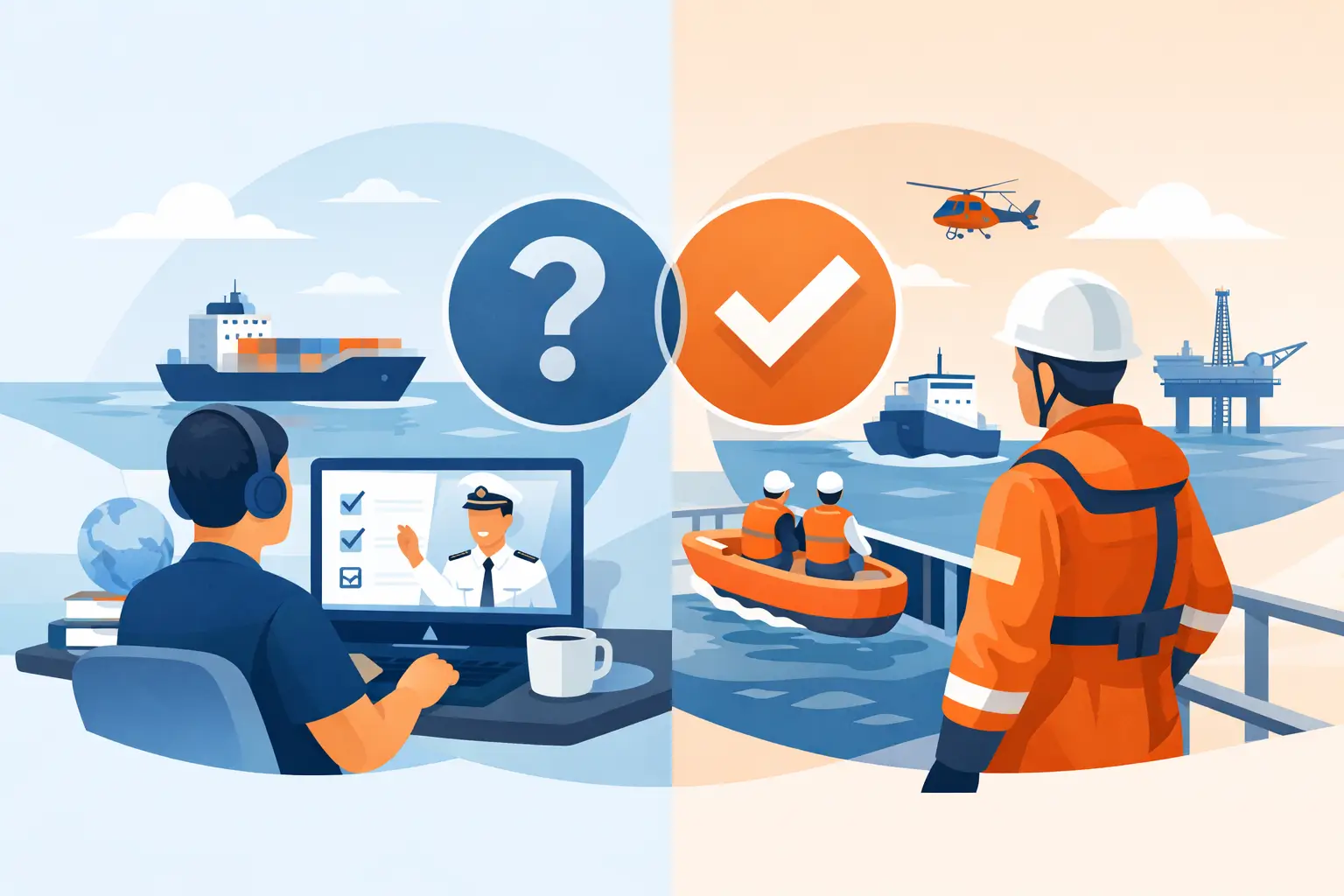
A missed joining date can come down to one thing – your certificates are not ready. For seafarers working against crew changes, contract deadlines, and employer screening, that is not a small issue. It is why interest in online STCW basic safety training has grown so quickly among new entrants, active crew, and returning mariners who need approved training without losing weeks to travel and classroom schedules.
The real question is not whether online learning exists in maritime training. It does. The better question is whether it fits STCW requirements, employer expectations, and shipboard reality. In many cases, it does – if you choose the right provider and understand which parts can be completed online, which approvals matter, and where the limits are.
What online STCW basic safety training actually covers
STCW Basic Safety Training is not one single topic. It is a group of mandatory safety subjects required for many seafarers under the STCW Convention. Depending on the training pathway and flag requirements, the package commonly includes Personal Survival Techniques, Fire Prevention and Fire Fighting, Elementary First Aid, and Personal Safety and Social Responsibilities under the A-VI/1 framework. Some seafarers also need related security training such as Security Awareness under A-VI/6-1, depending on role and vessel assignment.
When people search for online STCW basic safety training, they are often looking for a faster way to complete the theory components of these subjects. That distinction matters. The online model is strongest when it delivers approved theoretical instruction through e-learning and virtual simulation, allowing students to study from home or onboard, then move efficiently through any required next steps.
For working crew, this changes the logistics completely. Instead of waiting for a seat at a shore-based center during leave, you can begin immediately, progress at your own pace, and keep your compliance timeline moving.
Why seafarers are choosing online delivery
Traditional classroom attendance creates friction that most seafarers know well. You may be offshore, mid-contract, or in a port with no practical access to a training center. Even if a center is available, travel costs, visa issues, hotel costs, and lost workdays can make a short course unnecessarily expensive.
Online delivery removes much of that burden. A properly structured e-learning course lets you study when your schedule allows – after watch, during leave, or between assignments. That flexibility is especially valuable for cruise ship crew, merchant mariners, offshore workers, and yacht crew who operate on rotating schedules and cannot easily commit to fixed class dates.
There is also a career advantage. Job seekers often need proof that they have started or completed required training before they can move forward in recruitment. Fast access to approved modules shortens the gap between application and employability.
When online STCW basic safety training makes sense
For a first-time entrant to the industry, online study is often the fastest way to begin meeting mandatory training requirements. If you are applying for entry-level shipboard positions, completing the theoretical parts early can help you avoid delays once an employer asks for documents.
For active seafarers, the benefit is different. You already know the pressure of expiry dates, joining instructions, and manning office requests. Online access helps you complete what can be done remotely without interrupting contract cycles more than necessary.
For experienced crew upgrading their profile, it also makes sense as part of a broader compliance plan. Many seafarers do not only need basic safety modules. They may also need security courses, crowd management, crisis management, or ship security training. Having those available through one online platform reduces admin time and keeps records organized.
What to check before you enroll
Not all maritime e-learning is equal. The biggest mistake seafarers make is assuming that any online course with maritime branding will be accepted by employers or flag administrations. Approval status matters first.
Look closely at whether the provider states that the course is flag-approved and IMO-compliant, and whether the certification is positioned for international acceptance by major cruise lines and shipping companies. If that information is vague, treat it as a warning sign. Maritime compliance is not an area where unclear wording helps you.
You should also check how the course is delivered. A serious program should explain the learning format, assessment process, certificate issuance timeline, and whether virtual simulation is included. Good online training is not just a PDF and a quiz. It should be structured to build understanding of emergencies, shipboard procedures, and personal responsibilities in a way that reflects real vessel operations.
Student support matters too. Seafarers often enroll while traveling, working odd hours, or dealing with weak internet access. A provider that understands shipboard constraints will usually make enrollment, study access, and documentation straightforward.
The trade-offs you should understand
Online training is efficient, but that does not mean every seafarer should think of it as a complete replacement for all forms of practical instruction. Safety training is tied to real emergency response. Depending on the module, your route to full compliance may involve both online theory and additional practical elements.
That is not a weakness of the online model. It is simply the reality of maritime safety standards. What online learning does exceptionally well is remove delays in the theory portion, reduce travel dependency, and let you start immediately from almost anywhere.
There is also a learning-style trade-off. Some students perform better in a classroom with direct instructor interaction. Others do far better studying independently because they can pause, repeat, and complete modules around work obligations. If you are disciplined and need flexibility, online training usually gives you an advantage. If you struggle with self-paced study, you need to be realistic about your habits before enrolling.
How online training supports employability
Employers are not impressed by convenience alone. They care about whether your documents are current, recognized, and aligned with the role you are applying for. That is why the value of online STCW basic safety training is really about speed to compliance, not speed for its own sake.
If your training provider can issue accepted certification quickly and clearly, you are in a stronger position to apply for jobs, complete onboarding, and meet joining deadlines. That is especially relevant in sectors with fast hiring cycles, such as cruise, offshore support, and international merchant shipping.
For new seafarers, this can be the difference between being ready when an opportunity appears and missing it because your paperwork is incomplete. For experienced crew, it can be the difference between a smooth rejoining process and a delayed contract.
A practical way to choose the right provider
Start with the end use. Ask yourself who will review your certificate – a cruise recruiter, a manning agency, a vessel operator, or a flag-related compliance team. Then choose training built for that level of scrutiny.
Next, look for a provider that offers more than a single course. In practice, seafarers often need a bundle of training and documentation services, not a one-off certificate. If your provider can support STCW modules, security courses, and seaman book or endorsement services in one place, you reduce paperwork, save time, and avoid dealing with multiple vendors.
This is where a specialized maritime platform such as Marine Pro Academy stands out. The value is not only that courses are delivered online. It is that the training is structured around actual seafarer constraints – immediate access, self-paced study, approved course pathways, and certification designed for international employment.
Is it the right move for you?
If your priority is flexibility, fast enrollment, and maintaining compliance without unnecessary travel, online STCW basic safety training is often the practical choice. If you need a fully managed path from training to broader maritime documentation, it becomes even more useful.
The main thing is to approach it like a professional requirement, not a shortcut. Verify approval. Match the course to your role. Make sure the provider understands international maritime hiring standards. Then start as early as possible, because in this industry, being ready on time is part of being employable.
A good training decision does more than tick a box. It keeps your career moving when the next contract, vessel, or opportunity appears.
Leave a Reply