
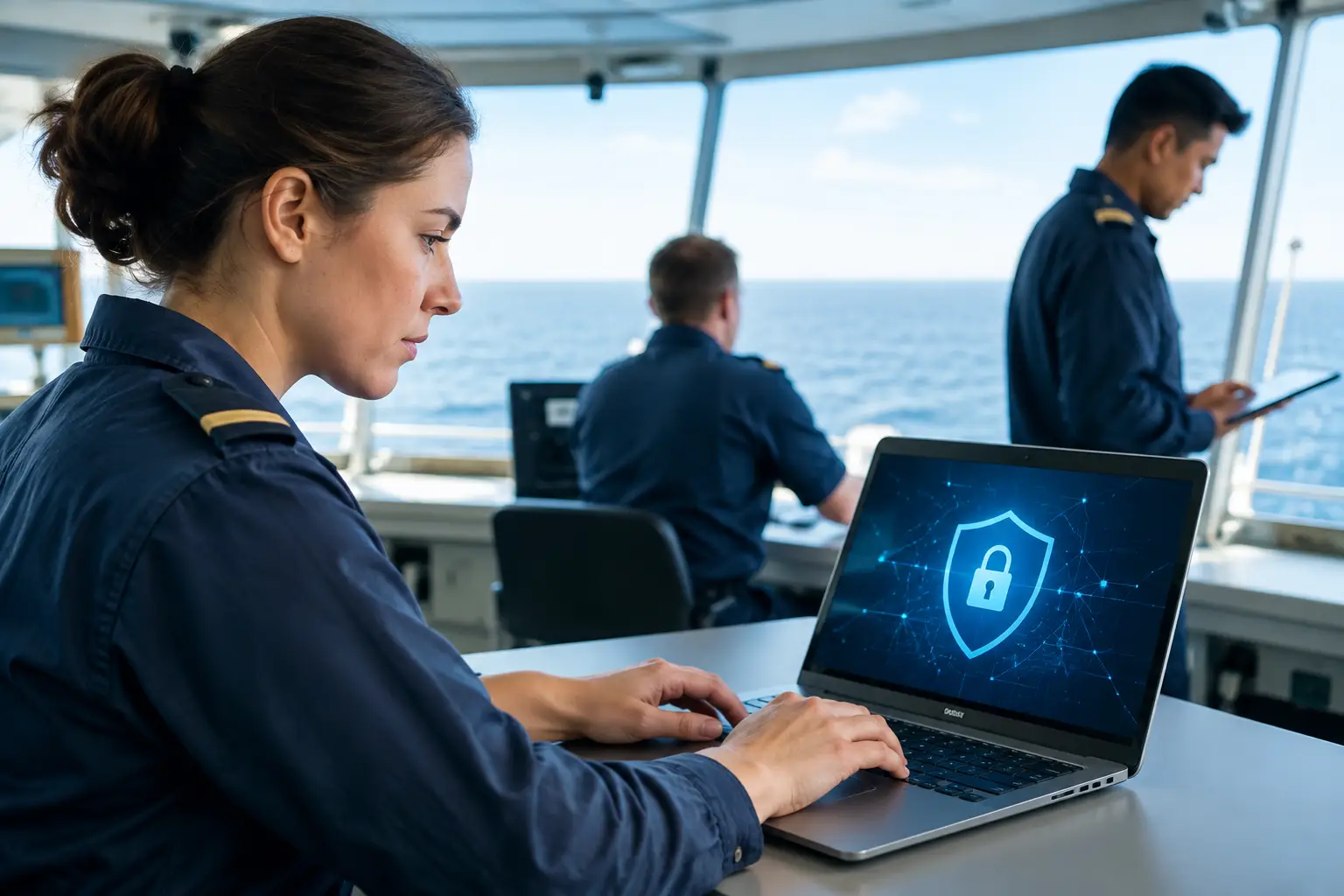
A suspicious email can arrive while a vessel is alongside, during a crew change, or halfway through an ocean passage.
Maritime cybersecurity training gives crew members the practical judgment to recognize suspicious activity, protect shipboard systems, and report concerns before a minor mistake develops into a safety, security, operational, or commercial incident.
For seafarers, cyber awareness is no longer something that belongs only to an IT department.
Navigation, engine monitoring, cargo operations, access control, crew administration, communications, maintenance systems, and ship-to-shore information exchange increasingly depend on digital technology.
That creates major operational benefits, but it also means that everyone onboard has a role to play in protecting the vessel.
The International Maritime Organization continues to strengthen its approach to maritime cyber-risk management. Its revised Guidelines on Maritime Cyber Risk Management address identifying, protecting against, detecting, responding to, and recovering from cyber incidents, while emphasizing appropriate cybersecurity awareness across an organization.
Why Cybersecurity Is Now a Shipboard Skill
A modern vessel may rely on electronic navigation systems, integrated bridge equipment, planned maintenance software, satellite communications, cargo systems, administrative networks, crew welfare systems, and numerous connected devices.
These systems do not all carry the same level of risk and are not necessarily connected in the same way.
However, one compromised user account, infected removable device, weak password, or poorly handled email can create consequences far beyond the original device.
Cyber incidents onboard may involve:
- phishing emails;
- fraudulent payment requests;
- malicious attachments;
- fake login pages;
- compromised passwords;
- unauthorized USB devices;
- infected laptops or mobile devices;
- social engineering;
- lost or stolen devices; and
- unauthorized access to company systems.
A phishing email, for example, may appear to come from a port agent, superintendent, supplier, crewing company, payroll department, or even another crew member.
The message may ask the recipient to open an attachment, confirm credentials, make an urgent payment, or change bank details.
The consequences depend on what is compromised.
A crew email account may expose personal or commercial information. An administrative system could become unavailable. A cyber incident involving operational technology may affect monitoring, communications, or other vessel functions.
Not every cyber event becomes an emergency.
But identifying suspicious activity early gives the crew and company a much better opportunity to contain it.
Crew members who want dedicated maritime cyber training can review Marine Pro Academy’s Cyber Security Awareness Training, which focuses specifically on cyber risks, system vulnerabilities, risk assessment, preventative measures, and response to cyber incidents.
What Maritime Cybersecurity Training Should Cover
Effective training should not simply take a generic office cybersecurity presentation and replace the photographs with ships.
Seafarers operate in a very different environment.
Connectivity can be limited. People work in shifts. Systems may have different access restrictions. Crew may be moving between personal devices, company equipment, and operational technology while working under significant time pressure.
Good maritime cybersecurity training should therefore focus on decisions that crew members genuinely face onboard.
Recognizing Cyber Threats in Real Shipboard Situations
Crew should understand common warning signs.
These may include:
- an unexpected request to change payment details;
- unusual urgency;
- an attachment that was not expected;
- a slightly altered email address;
- an unfamiliar login page;
- an unexpected password-reset request;
- requests for confidential vessel information; or
- instructions that bypass normal company procedures.
The goal is not to turn every crew member into a cybersecurity specialist.
The goal is to develop a simple professional habit:
Pause. Verify. Report.
Crew should also understand that seeing a familiar name does not automatically make a message trustworthy.
Attackers can impersonate a superintendent, master, crewing agency, chandlery, port authority, supplier, manager, or colleague.
A fraudulent message may appear convincing because information about vessels, personnel, companies, schedules, and ports may already be publicly available.
When an unusual request arrives, verification through an approved contact method is often the safest response.
Safe Use of Onboard Systems and Devices
Cybersecurity procedures only work when they fit everyday vessel operations.
Training should cover practical subjects including:
- strong passwords;
- multi-factor authentication where available;
- screen locking;
- user access;
- approved software;
- removable media;
- USB devices;
- mobile-device security;
- personal devices;
- company devices;
- system updates; and
- safe handling of confidential information.
Crew should also understand the difference between convenience and good cyber practice.
Sharing a login may save time during a busy watch, but it reduces accountability and may expose systems to unauthorized access.
Connecting a personal USB drive may appear harmless, but removable media can introduce malicious software.
Installing unauthorized software can create vulnerabilities even when the software itself appears legitimate.
Crew therefore need clear company procedures and a clear route for asking questions when they are unsure.
Reporting a Cybersecurity Incident Onboard
Good maritime cybersecurity training should explain what happens when something goes wrong.
Crew need to know what to do if they:
- click a suspicious link;
- enter a password into an unexpected page;
- open a suspicious attachment;
- lose a company device;
- discover an unauthorized USB device;
- notice unusual system behaviour; or
- receive a suspicious financial request.
The exact first action depends on company procedures and the system involved.
In general, crew should avoid continuing to interact with suspicious content, preserve useful information where possible, and report the issue promptly through the vessel’s established reporting structure.
They should not attempt unauthorized technical repairs, delete potential evidence, or reconnect affected equipment simply to test whether the problem has disappeared.
Fast and calm reporting is a professional response.
The current IMO Guidelines on Maritime Cyber Risk Management specifically include detection, response, recovery, incident reporting, and cybersecurity training within an organization’s wider cyber-risk-management process.
IMO Cyber Risk Management and Shipboard Training
Cybersecurity is now part of the broader maritime safety and risk-management environment.
IMO Resolution MSC.428(98) encouraged companies to ensure that cyber risks are appropriately addressed in existing safety management systems.
IMO’s current MSC-FAL.1/Circ.3/Rev.3 Guidelines on Maritime Cyber Risk Management, issued in April 2025, provide an updated framework covering cyber-risk identification, protection, detection, response, and recovery.
The guidance also emphasizes the importance of cybersecurity awareness being appropriate to employees’ roles and responsibilities.
For shipping companies, this means cyber training should not exist only as an isolated online certificate.
It should connect with:
- company procedures;
- the Safety Management System;
- access controls;
- incident-reporting processes;
- onboard responsibilities;
- drills or scenario discussions where appropriate; and
- recovery procedures.
Marine Pro Academy also provides broader maritime security training for personnel who require STCW Security Awareness under section A-VI/6-1.
Cybersecurity awareness and STCW security training address different areas, but both contribute to a stronger security culture onboard.
Training Records Matter, but Competence Matters More
Training records are important because they demonstrate that personnel have received instruction.
But a certificate alone does not protect a vessel.
The strongest cybersecurity programs connect training with everyday behaviour.
A crew member who has completed training should know how to recognize suspicious activity, protect credentials, follow device procedures, and report concerns correctly.
This is particularly important because different people onboard may have very different levels of system access.
A master, deck officer, engineer, electro-technical officer, rating, hotel employee, IT officer, and shoreside coordinator may all require cyber awareness.
However, the systems they use and the consequences of their decisions can differ considerably.
A general awareness course can establish a common foundation.
More targeted instruction may then be appropriate for personnel responsible for critical operational, technical, or administrative systems.
For companies looking to combine traditional maritime security training with cyber awareness, Marine Pro Academy also offers an STCW Security Training Bundle including Cyber Security Awareness.
How Crew Can Apply Cybersecurity Training Immediately
The value of a cybersecurity course becomes visible when a crew member faces an ordinary decision after the training is complete.
Before opening an attachment, ask:
Was I expecting this file?
Before entering a password:
Is this really the normal login page?
Before sending vessel information:
Is the recipient authorized to receive it?
Before connecting removable media:
Is this device permitted under company procedures?
Before acting on an urgent request:
Can I verify this instruction using a known contact method?
These simple questions can prevent many avoidable incidents.
Phishing Is Often a Human Decision Problem
One of the most common cyber risks begins with communication rather than technology.
A message may appear to come from someone senior in the company and request immediate action.
It may mention a real vessel, port, supplier, crew member, or travel arrangement.
The attacker wants the recipient to react quickly rather than think carefully.
That is why effective training teaches verification rather than fear.
If a message claims to come from a manager and requests an unusual payment or confidential information, contact the person using a known number or approved communication channel rather than relying solely on the message itself.
If a password prompt appears unexpectedly, avoid entering credentials until the source has been verified.
If something feels unusual, reporting it early is generally safer than hoping it is harmless.
Cybersecurity Between Contracts
Cybersecurity habits should not stop when a seafarer signs off a vessel.
Crew frequently manage:
- travel arrangements;
- certificates;
- payroll;
- visas;
- seaman books;
- training;
- medical documents;
- employment contracts; and
- joining instructions
while moving between vessels and countries.
These situations can attract fraudulent messages because crew members may be expecting urgent information and working from personal phones, hotel Wi-Fi, airport networks, or unfamiliar connections.
Good practices include:
- keeping devices updated;
- using secure connections;
- avoiding unnecessary use of public Wi-Fi for sensitive activity;
- using strong passwords;
- enabling multi-factor authentication;
- protecting personal documentation; and
- verifying unusual employment or payment requests.
Seafarers who frequently complete training remotely can also review our guide explaining how online maritime training supports career development.
Choosing the Right Maritime Cybersecurity Course
Online training can be particularly useful for seafarers because working schedules rarely match traditional classroom timetables.
Before enrolling in a cybersecurity course, check whether the training is specifically relevant to maritime operations.
A useful course should address areas such as:
- cyber threats and threat actors;
- phishing and social engineering;
- passwords and authentication;
- device security;
- removable media;
- vulnerabilities;
- cyber-risk assessment;
- reporting;
- response to cyber incidents; and
- maritime operational considerations.
Marine Pro Academy’s Cyber Security Awareness Training is designed for maritime personnel and covers cyber threats, vulnerabilities, cyber-risk assessment, procedural and technical controls, and effective incident response.
The course is intended for operational and management-level crew and currently includes an ABS certificate.
As with any maritime training used for a specific company, flag-state, contractual, or regulatory requirement, seafarers should confirm acceptance with the relevant employer or administration before enrolling.
Crew who are unsure about remote maritime training more generally can also read our guide on whether virtual maritime courses are accepted.
Cybersecurity Is a Professional Shipboard Habit
Cybersecurity does not mean distrusting every email or avoiding useful technology.
It means applying the same discipline to digital systems that seafarers already apply to other safety-sensitive areas of shipboard work.
Follow procedures.
Protect access.
Verify unusual requests.
Report suspicious activity.
Do not improvise when a critical system may be involved.
For new seafarers, these habits create a strong foundation from the first contract.
For experienced crew, cybersecurity training provides an opportunity to keep pace with the increasingly connected systems that shape modern maritime operations.
A few minutes spent checking a message, reporting unusual behaviour, or following the approved process can protect personal information, colleagues, company systems, vessel operations, and ultimately the safety and security of everyone onboard.
Leave a Reply