
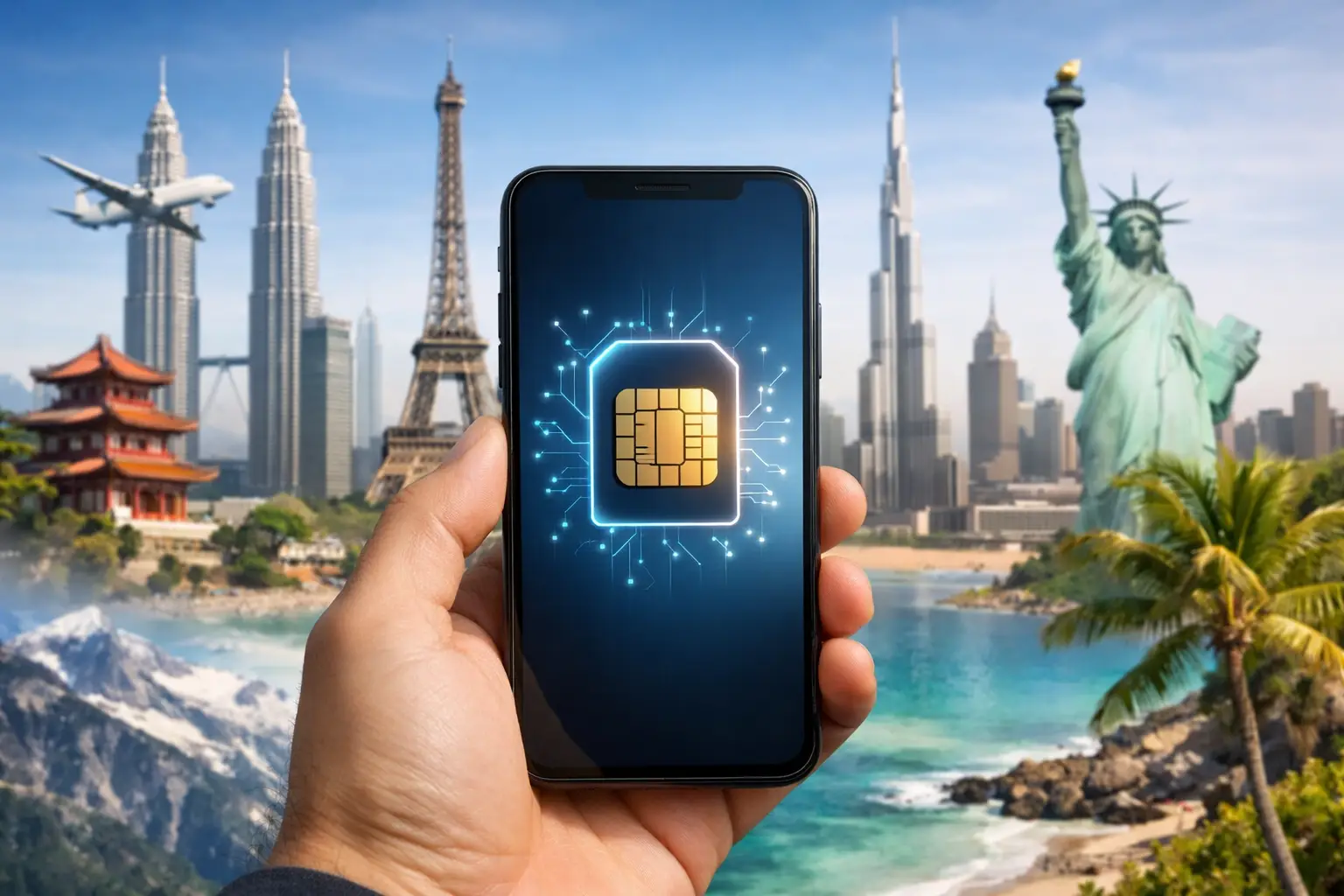
A missed message from crewing, a delayed document upload, or an expired verification code can create problems before you even reach the vessel. Searches for eSIMS Asia , Global, Europe ,Carribean ,Europe, North America, United Arab Emirates United States plans usually come from seafarers who need one practical answer: which data option will work across the ports, airports, hotels, and transit points in their next contract cycle?
The right eSIM is not always the plan with the largest data allowance. It is the plan that matches your itinerary, device, activation timing, and real communication needs between contracts.
eSIMs for Asia, Europe, the UAE, and the Americas
An eSIM is a digital SIM profile installed directly on a compatible phone. Instead of buying and replacing physical SIM cards at each destination, you purchase a regional or global data plan, install it through a QR code or provider instructions, and activate it when needed.
For maritime professionals, this matters because travel often involves multiple jurisdictions in a short period. A crew member may fly through the United Arab Emirates, join a vessel in Europe, call home from the Caribbean, and finish a contract through North America. Managing a separate local SIM for every stop is time-consuming, and it can leave you without data when you need access to crew instructions, travel documents, banking, or training records.
A regional eSIM generally offers better value when your travel is concentrated in one area. An Asia plan can suit embarkation routes through Singapore, Japan, South Korea, Thailand, or the Philippines. A Europe plan can be a practical choice for frequent movement between European ports and airports. A North America plan may cover the United States, Canada, and Mexico, while a Caribbean plan is useful for crew joining cruise itineraries in the region.
A global eSIM is better suited to multi-region travel. The trade-off is usually cost: global coverage is convenient, but the price per gigabyte may be higher than a single-region plan. Check the supported countries before purchase. “Global” does not always mean every country, every territory, or identical network access in every port.
Choose Coverage Based on Your Actual Route
Start with the countries where you will be on land, not only the vessel’s advertised itinerary. Your data needs are often highest at airports, crew hotels, immigration points, and during transfer days. Include your departure country, transit locations, joining port, likely shore-leave destinations, and the country where you expect to disembark.
For example, a seafarer transiting Dubai before joining a Mediterranean contract should confirm that the selected plan includes the United Arab Emirates and the relevant European countries. A plan that works only after arrival may not help when you need a driver contact, boarding pass, or last-minute update during transit.
If you regularly work one region, a regional eSIM is often the most efficient option. If your contracts shift between cruise, merchant, and offshore assignments, a global plan can reduce the need to install and manage multiple profiles. Some crew members keep both: one lower-cost regional plan for a planned contract and one small global plan for emergency connectivity during unexpected travel changes.
Check These Details Before You Buy
Coverage labels alone are not enough. Before installing an eSIM, verify these operational details:
- Your phone must be carrier-unlocked and eSIM-compatible. Some devices support multiple eSIM profiles but allow only one or two to be active at the same time.
- Confirm whether the plan starts when you install it or only when it first connects to a supported network. Install early if permitted, but avoid activating too soon before departure.
- Review the data allowance and validity period. A 10 GB plan valid for 30 days may be more useful than a larger plan that expires before your return flight.
- Check whether the plan is data-only. Data-only eSIMs generally do not provide a local phone number for standard calls or SMS, although messaging and calling apps can work through mobile data.
- Review hotspot permissions if you need to connect a laptop for training, document submissions, or travel administration.
Keep your primary physical SIM active only if you understand your home carrier’s roaming charges. For many seafarers, the safest setup is to use the eSIM for mobile data while disabling data roaming on the primary SIM. This lets you retain access to your usual number for essential messages, subject to your carrier’s terms.
Plan Data for Crew Life, Not Vacation Use
Data use varies sharply. Messaging, email, crew portal access, and document uploads use relatively little data. Video calls, social media feeds, cloud backups, and software updates can consume a plan quickly.
For a short joining trip, 3 GB to 5 GB may be enough if you use Wi-Fi whenever it is available and limit video streaming. For a month of travel and port access, 10 GB to 20 GB provides more margin. If you need to complete online STCW study, participate in virtual sessions, or upload certification documents, choose a larger allowance and use reliable Wi-Fi for heavier tasks whenever possible.
Disable automatic app updates, photo backups, and high-quality video playback before traveling. Download offline maps, travel documents, course materials, and entertainment while connected to Wi-Fi. These small steps preserve data for the moments when mobile connectivity is necessary.
Install Before You Need It
Do not wait until you land in an unfamiliar airport with limited Wi-Fi. Purchase and install the eSIM while you have a stable connection, then save the QR code, activation instructions, and support details offline. Name the profile clearly, such as “Europe Contract” or “Global Transit,” so you do not select the wrong line when changing settings.
Before departure, confirm that mobile data is assigned to the eSIM, data roaming is enabled for that eSIM if required by the provider, and your primary line is not using expensive roaming data. Once you arrive, restart the phone if the network does not connect automatically, then manually select a listed local network if necessary.
Marine Pro Academy’s connectivity solutions are designed around this reality: seafarers need access that supports travel, compliance tasks, training progress, and communication without adding another administrative burden. Choose the plan for the route you are actually traveling, install it before departure, and keep your critical documents available offline for every stage of the journey.
Leave a Reply