
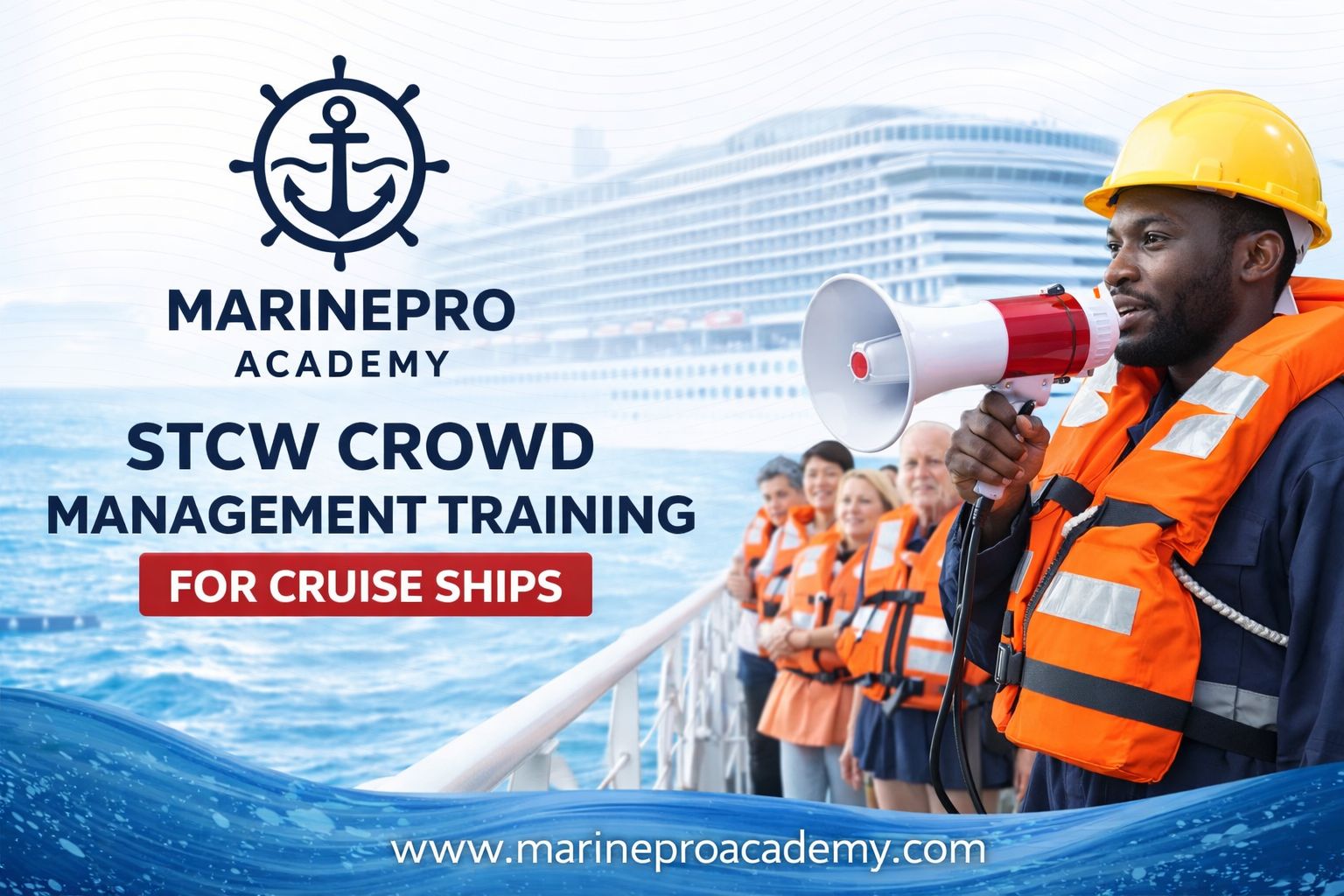
A full passenger muster is where weak training shows up fast. Noise rises, instructions get repeated, people move in the wrong direction, and a routine safety process can turn disorganized in seconds. That is exactly why crowd management training cruise ships crew complete is not a box-ticking exercise. It is a required operational skill that affects passenger safety, onboard compliance, and your employability.
For crew members working on ferries, ro-pax vessels, and cruise ships, crowd management is tied directly to STCW requirements for personnel who assist passengers in emergency situations. Cruise operators do not just want certificates on file. They want crew who understand movement control, human behavior under stress, clear communication, and how to support order when large groups need direction quickly.
What crowd management training on cruise ships actually covers
This training is built for one reality – passenger vessels carry people who are not part of the ship’s command structure. In an emergency, guests may panic, freeze, misunderstand instructions, or move toward familiar spaces instead of safe assembly points. Crew must know how to respond before confusion spreads.
A compliant crowd management course usually focuses on how passengers react in emergencies, how to communicate instructions clearly, how to guide movement through corridors and stairwells, and how to reduce fear without creating false reassurance. It also addresses assisting vulnerable passengers, controlling flow at embarkation stations, and maintaining order when information is incomplete or conditions are changing.
That matters on cruise ships because crowd control is rarely just about volume. It is about mixed demographics, language barriers, mobility issues, family separation, and the fact that passengers often look first to the nearest uniformed crew member, not necessarily the person with formal command responsibility.

Why cruise lines take crowd management training seriously
On a cargo vessel, emergency response is crew-centered. On a cruise ship, it is public-facing from the first minute. That changes the standard completely.
A cruise line has to protect passengers, maintain compliance with international training requirements, and reduce operational risk across departments. Hotel crew, housekeeping staff, food and beverage personnel, entertainment teams, and guest service teams may all have emergency support duties depending on the vessel’s muster list. In practice, that means crowd management competence is not limited to deck officers or security teams.
This is also why hiring managers often look beyond the certificate name. They want to know whether your training is approved, aligned with IMO standards, and accepted by major cruise operators. A low-cost course with unclear approval status can create delays later when you are trying to join a vessel or complete pre-employment checks.
Who needs crowd management training cruise ships require
It depends on your role, the type of passenger vessel, and the duties assigned to you in the muster list. In general, crew members designated to assist passengers in emergency situations need this training. That often includes hospitality staff, cabin stewards, restaurant personnel, retail staff, and other hotel department crew, not only marine department personnel.
Some seafarers also need additional crisis management or human behavior training, especially if they carry responsibility for passenger safety during emergencies beyond basic assistance and direction. The exact training path depends on your assigned functions onboard and the flag-state or company requirements connected to your vessel.
If you are applying for your first cruise ship contract, it is worth checking the vacancy wording carefully. Some employers require the certificate before embarkation. Others allow completion during onboarding, but that can narrow your options and slow deployment. If you already hold a valid certificate, you are simply easier to process.
The compliance side – where this fits under STCW
Crowd management training on passenger ships sits within the broader STCW framework for safety familiarization and emergency preparedness. The goal is straightforward: crew who may need to control or assist passengers must be trained before they are expected to perform those duties.
For seafarers, the practical takeaway is simple. Approval status matters. The course should be delivered by a recognized provider and aligned with applicable international requirements for passenger ship personnel. If your documents are reviewed by a cruise line, crewing agency, or flag administration, they need to stand up without questions.
That is one reason online access has become more valuable. Working crew do not always have the option to attend a shore-based training center between contracts. If the theory component can be completed through an approved e-learning platform, it reduces downtime and keeps your file moving.
Online crowd management training for cruise ships – what to expect
For many seafarers, online delivery is not a convenience feature. It is the only practical way to finish required training while managing rotation schedules, travel, and limited time ashore.
A good online course should be structured around actual shipboard duties, not generic passenger service language. You should expect modules on emergency organization, verbal and non-verbal control techniques, passenger flow, stress behavior, and coordination during musters or evacuations. The strongest programs also use scenario-based learning so you are not just memorizing definitions. You are applying decisions in a cruise ship context.
There is a trade-off here. Online training gives speed and flexibility, but quality varies between providers. If the platform is poorly organized or the course is too theoretical, you may finish with a certificate yet still feel underprepared for real onboard pressure. That is why provider credibility matters as much as price.
Marine Pro Academy addresses that gap with IMO-compliant, flag-approved online maritime training built for active seafarers who need to study from home or onboard. The model is practical – enroll securely, start immediately, study at your own pace, and keep your certification path moving without unnecessary shore-based delays.
How this training helps your cruise ship career
The most obvious benefit is compliance. Without the right training, you may not be eligible for certain passenger vessel roles. But from a hiring standpoint, crowd management certification also signals something else – readiness for the realities of cruise operations.
Cruise lines manage large volumes of guests, multinational crews, and strict safety oversight. When your certifications are already in place, you become a lower-friction hire. Recruiters and manning departments can process your application faster, especially when certificates come from recognized providers and match role requirements clearly.
This matters even more for entry-level applicants. If you are competing for your first cruise contract, approved crowd management training can help separate you from candidates who still need additional courses after selection. For experienced crew, it supports contract continuity and role mobility. If you want to move into positions with greater passenger responsibility, missing certifications can become a bottleneck.
Choosing the right course provider
Not every course labeled for passenger ship safety meets the same standard. Before you enroll, check whether the training is approved, whether it is aligned with current IMO and STCW requirements, and whether certificates are accepted by international employers. Those are the first filters.
After that, look at the operational side. Can you start immediately? Is the platform accessible on limited shipboard internet? Are materials self-paced? Is certificate issuance fast once you complete the course? For working seafarers, those details are not minor. They affect whether training actually gets finished before your joining date.
Price matters, but it should be weighed against acceptance and speed. A cheap course that causes document rejection, delays your embarkation, or forces you to retrain is more expensive in the long run.
When to take crowd management training
The best time is before you need it urgently. If you are targeting cruise ship or ferry work, complete the training early enough that your certificate is ready during recruitment. Waiting until a job offer arrives can create pressure, especially if the employer has a tight joining window.
If you are already serving in passenger vessel operations, review your certificate validity and company requirements before your next contract cycle. Some crew only discover a missing course during document review, medical clearance, or final deployment checks. By then, timing becomes harder.
The smarter approach is to treat crowd management the same way you treat the rest of your compliance file – current, approved, and ready to present at any time.
Passenger operations leave little room for uncertainty when an alarm sounds. The crew members who make the biggest difference are usually the ones who were trained before the pressure started, not after. If cruise ships are part of your career path, crowd management is one of the qualifications worth putting in place now, while you still control the timeline.

Leave a Reply