
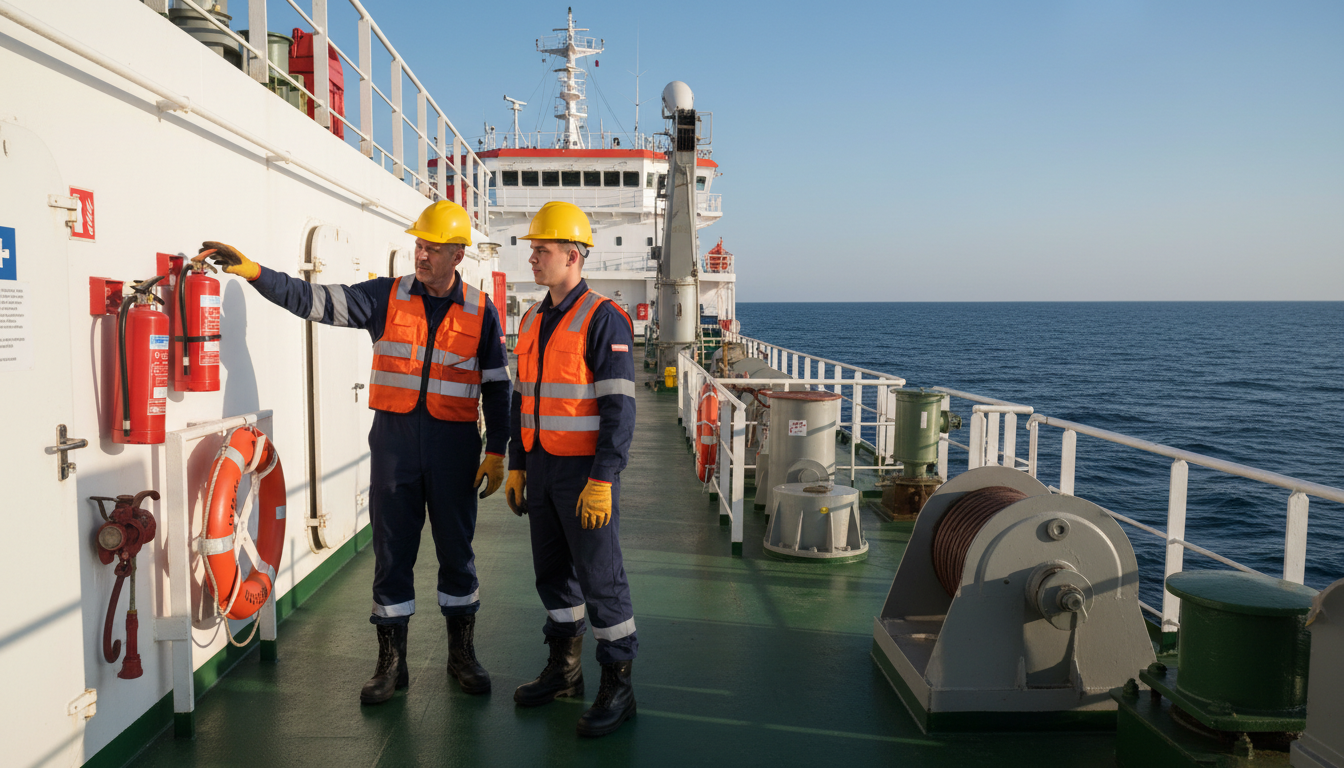
Crew familiarization and STCW certification serve different purposes and should not be treated as interchangeable. STCW training provides internationally defined competence requirements, while familiarization helps a crew member understand the specific vessel, equipment, procedures and emergency arrangements they are joining.
A seafarer can hold valid certificates and still need substantial vessel-specific familiarization before being ready to perform independently.
What STCW Certification Shows
STCW certificates can provide evidence that the seafarer completed approved training or demonstrated a defined competence under the applicable administration.
Marine Pro Academy offers a range of STCW training options covering safety, security and specialist topics.
What Crew Familiarization Covers
- Emergency alarms and stations.
- Escape routes.
- Safety equipment.
- Work areas.
- Company procedures.
- Reporting lines.
- Vessel-specific systems.
- Duties in emergencies.
Why Familiarization Cannot Be Replaced by a Certificate
Two vessels can operate under the same regulatory framework while having different layouts, equipment and company procedures. A portable certificate cannot teach the exact route to a muster station or the location of a vessel’s emergency equipment.
Why Certificates Still Matter
Familiarization also cannot replace required STCW training. A short onboard briefing is not a substitute for an approved course where formal training is required.
Use Both Layers Together
The strongest onboarding process verifies portable certificates before travel, then completes vessel-specific familiarization after joining.
Marine Pro Academy’s STCW Certificate Verification Before Joining explains what can be checked before deployment.
Example: Security Training
A crew member may hold Security Awareness training but still needs to learn the vessel’s access-control arrangements, restricted areas and reporting channels.
Example: Fire Safety
A crew member may have completed Fire Prevention and Fire Fighting training but must still learn the location and arrangement of firefighting equipment on the actual vessel.
Example: Passenger Operations
A person trained in crowd management still needs to understand the ship’s muster stations, passenger routes and emergency organization.
Marine Pro Academy provides Crowd Management training for applicable passenger-vessel roles.
Record Familiarization Separately
The training matrix should show STCW certificates, company courses and familiarization as separate items. Combining them into one “complete” status reduces visibility.
Use a Role-Based Familiarization Checklist
- Safety and emergency arrangements.
- Work-area equipment.
- Operational procedures.
- Communication channels.
- Environmental responsibilities.
- Security responsibilities.
- Company-specific expectations.
Supervisors Should Confirm Understanding
Do not rely only on signatures. Ask crew to show locations, explain actions or walk through a scenario where appropriate.
New Joiners Need Time to Absorb Information
Too much information in the first few hours can reduce retention. Prioritize immediate safety information first, then continue role-specific familiarization over the early days of the assignment.
Use E-Learning Before Joining
Pre-joining digital learning can reduce the amount of theory that has to be introduced onboard. Marine Pro Academy’s maritime e-learning can support this preparation.
Crew Familiarization vs STCW Certification: Quick Comparison
- STCW certificate: portable evidence of defined training or competence.
- Familiarization: vessel- and company-specific preparation.
- STCW: may require approved course and assessment.
- Familiarization: delivered according to vessel/company procedures.
- Both: important for deployment readiness.
Build a Complete Readiness Picture
Marine Pro Academy’s Crew Training Matrix for Maritime Companies can help crewing teams track these layers clearly.
The safest approach is not to ask whether a seafarer is “trained.” Ask which formal competencies they hold, what vessel-specific familiarization has been completed and what still needs verification before independent work.
Why Companies Need Both Records
STCW certification and familiarization should be visible as separate evidence. A certificate shows that a defined training requirement has been completed; a familiarization record shows that the crew member has been introduced to the actual vessel, equipment and company procedures.
What to Confirm During Familiarization
- Emergency alarms and muster duties.
- Escape routes and safety equipment.
- Workstation and equipment controls.
- Communication channels.
- Environmental and security procedures.
- Who to contact when unsure.
Avoid Information Overload
New joiners often receive too much information in the first hours onboard. Prioritize immediate safety and emergency information first, then continue role-specific familiarization in a structured sequence.
Use Demonstration Where It Matters
Where practical understanding is important, ask the seafarer to show the route, identify the equipment or explain the next action. A signature alone does not prove understanding.
Companies can combine pre-joining e-learning with onboard familiarization to reduce theory load after embarkation.
Example: A New Officer Joining a Different Vessel Type
An officer may hold valid STCW certificates and significant sea time but still be new to the vessel’s layout, equipment and company procedures. Their formal qualifications remain important, yet they do not remove the need to learn emergency stations, alarm systems, work permits, reporting lines and equipment-specific controls.
The company can reduce overload by completing suitable theory before joining and reserving onboard time for vessel-specific information. This also gives the supervisor a clearer picture of what the new joiner already understands.
Common Familiarization Mistakes
- Using the same checklist for every role.
- Trying to complete all information in the first hour.
- Relying only on signatures.
- Failing to demonstrate critical equipment.
- Assuming experienced crew need no familiarization.
When Is Familiarization Complete?
Completion should follow the company’s procedure and reflect whether the person has received the required information and, where appropriate, demonstrated understanding. It should not be treated as a paperwork exercise completed automatically at embarkation.
Frequently Asked Questions About Familiarization
Does an experienced seafarer still need familiarization?
Yes. Experience and certificates do not provide knowledge of the specific vessel, company procedures and equipment arrangement.
Can familiarization be completed online?
Some company information may be introduced before joining, but vessel-specific locations, equipment and procedures normally still require onboard familiarization.
Should familiarization appear in the training matrix?
Yes, but it should be tracked separately from portable STCW certificates so the company can see both types of readiness evidence.
Use Familiarization to Confirm Readiness
The goal of familiarization is not to repeat everything a qualified seafarer already knows. It is to close the gap between portable competence and the actual vessel. A good process should leave the person able to locate critical equipment, explain emergency duties, understand reporting lines and safely begin role-specific work under the company’s procedures.
Leave a Reply