
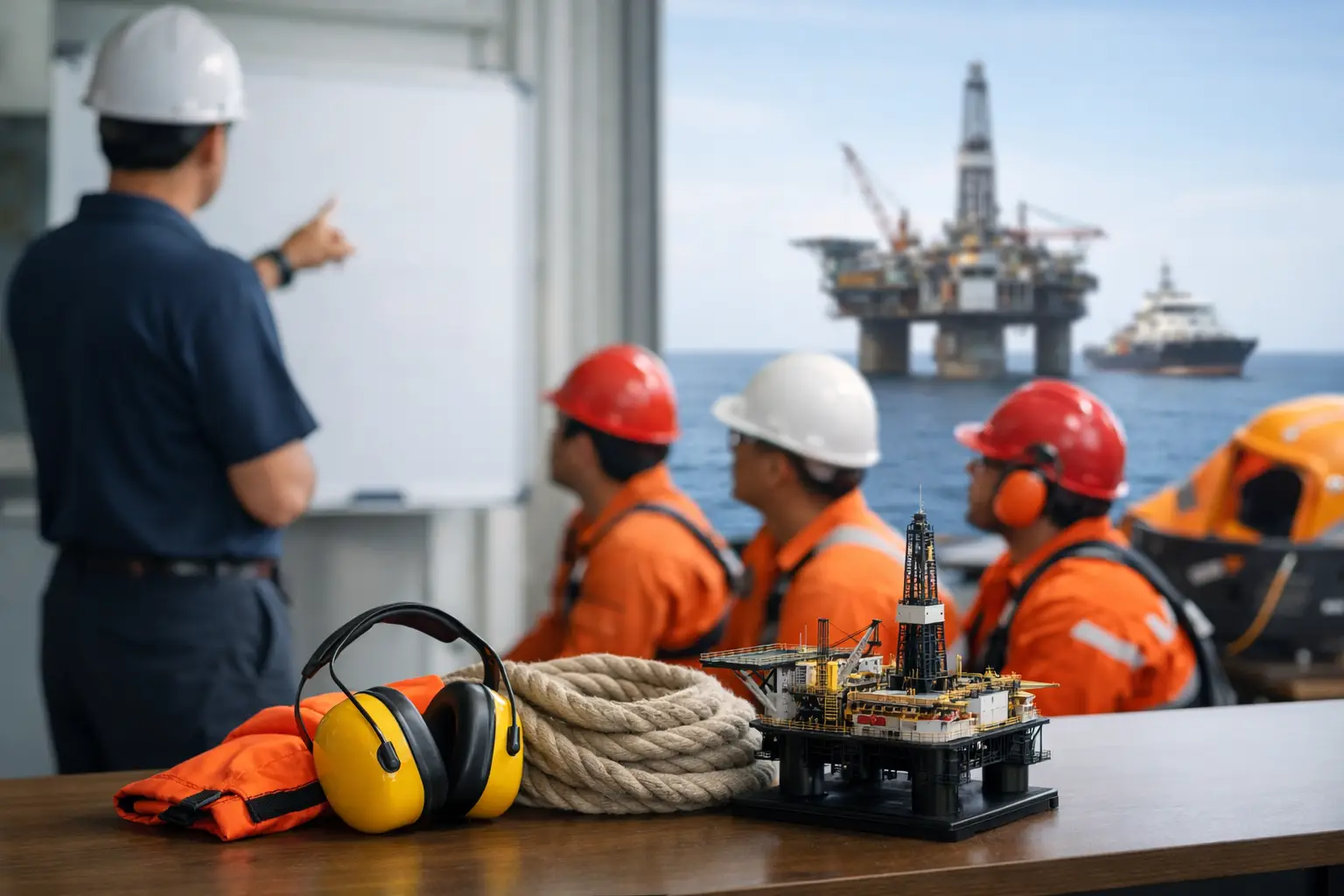
A missed course date can mean a missed crew change, delayed mobilization, or a contract offered to someone whose documents are already in order. The best courses for offshore crew are not simply the most popular certificates. They are the courses that match your role, vessel or installation, employer requirements, flag requirements, and the hazards you will actually face offshore.
For offshore personnel, training is a readiness system. Your certificates must be valid, correctly issued, and available when the crewing office asks for them. Start with the required safety foundation, then add the offshore-specific and role-specific qualifications that make you deployable without last-minute gaps.
Start With the Requirements of Your Offshore Assignment
“Offshore crew” covers very different jobs. A deckhand on a supply vessel, an engine rating on an offshore support vessel, a crane operator on a construction project, and a wind technician may all work offshore, yet their training pathways are not the same.
Before enrolling, confirm four points with the employer, crewing agent, or project coordinator: the vessel or installation type, your assigned position, the operating area, and the certificate standards they accept. This matters because STCW certification may be central for seagoing crew, while oil and gas or offshore wind projects often require additional industry programs.
Do not assume a certificate is interchangeable because the course title sounds similar. Check the issuing authority, approval status, practical assessment requirements, certificate validity, and whether a refresher is due before joining. A course that is valid in general may still fail to meet a specific client or project matrix.
Best Courses for Offshore Crew: The Core Safety Pathway
STCW Basic Safety Training
For crew serving on merchant ships and many offshore support vessels, STCW Basic Safety Training is the starting point. It generally covers personal survival techniques, fire prevention and firefighting, elementary first aid, and personal safety and social responsibilities.
This is foundational training, not a box to check and forget. Offshore operations can involve heavy weather, transfers by boat or helicopter, restricted movement on deck, and long distances from shore-based emergency support. The principles learned in basic safety training support everyday decisions, from wearing the correct personal protective equipment to responding effectively during an alarm.
Choose training aligned with the STCW Convention and accepted by the flag and employer connected to your assignment. Liberia- and Panama-approved pathways can be especially relevant when those flags apply, but approval must always match the vessel’s requirements.
Security Awareness or Designated Security Duties
Security training is frequently required for seafarers working aboard vessels subject to the ISPS Code. The appropriate course depends on whether you have only security awareness responsibilities or have designated security duties in your role.
Personnel with designated duties may be expected to take part in security-related tasks, such as monitoring access points, supporting restricted-area controls, or reporting suspicious activity. The right certificate depends on your assigned responsibilities, not your job title alone. Ask for the vessel’s crew matrix if there is any uncertainty.
Proficiency in Survival Craft and Rescue Boats
For officers and ratings assigned to muster, launch, command, or assist with survival craft, proficiency in survival craft and rescue boats may be required. This training goes beyond personal survival. It addresses the organization and operation of lifeboats, rescue boats, survival equipment, and emergency procedures.
It is particularly valuable for crew with emergency team duties. However, it is not automatically required for every offshore worker, so confirm the assignment before paying for a course that may not be included in your role matrix.
Advanced Firefighting and Medical Care Training
Advanced firefighting is commonly required for personnel who lead or take an active role in vessel fire response. It focuses on command, tactics, communications, breathing apparatus management, and controlling a fire emergency under pressure.
Medical first aid or medical care qualifications may also be needed for designated personnel. The correct level depends on your role, vessel manning, and onboard medical arrangements. If you are not assigned medical responsibilities, basic first aid within STCW Basic Safety Training may be sufficient. If you are, a higher-level medical course can be essential to your deployment clearance.
Offshore-Specific Courses That Often Determine Mobilization
STCW is not always enough for an offshore project. Oil and gas, subsea construction, and offshore wind operations can add strict client requirements based on transfer methods, worksite hazards, and emergency response plans.
BOSIET, FOET, and Helicopter Escape Training
For oil and gas assignments, Basic Offshore Safety Induction and Emergency Training, commonly known as BOSIET, is often requested for new personnel. It typically introduces offshore hazards, emergency response, sea survival, firefighting, first aid, and helicopter escape procedures.
For experienced workers renewing their qualifications, Further Offshore Emergency Training, or FOET, may be the applicable route. Validity periods and refresher rules vary by standard and employer, so review your current certificate before booking. Do not wait until your mobilization date is confirmed. Practical sessions can have limited availability, particularly in major crew-change locations.
Helicopter underwater escape training is a critical consideration where helicopter transport is part of the job. This is practical, safety-sensitive training. If your operator requires it, make sure the course includes the exact module and recognition standard specified in the project documentation.
Offshore Wind Safety Training
Offshore wind crew may need Global Wind Organisation training, especially for technician, maintenance, installation, and support roles. Basic Safety Training can include modules such as first aid, manual handling, fire awareness, working at height, and sea survival.
Wind assignments may also require advanced rescue, lifting, electrical safety, or blade repair qualifications. A marine certificate alone does not necessarily qualify a worker to enter a turbine or perform a task at height. Treat vessel access and worksite authorization as separate requirements.
H2S, Confined Space, and Work-at-Height Training
Hydrogen sulfide awareness or escape training can be required in oil and gas environments where H2S exposure is a known risk. Confined-space entry, gas testing, breathing apparatus, lifting operations, and work-at-height training are also common depending on the work scope.
These courses are highly job-specific. A deck crew member assigned only to vessel operations may not need the same package as a maintenance technician entering enclosed spaces or working on elevated structures. Obtain the project competency matrix before building your training plan.
Build Your Course Plan Around Role, Validity, and Timing
The fastest path is not enrolling in every course available. It is organizing the right courses in the right order. Start with your non-negotiable STCW and security requirements, then schedule offshore survival and project-specific practical training. Finally, add role-based competencies required for the work you will perform.
Keep a simple certificate tracker with the certificate name, issue date, expiration date, issuing organization, approval status, and a clear digital copy. Include your passport, seafarer medical certificate, seaman’s book where applicable, and any employer-required forms in the same secure document system. A valid course certificate is only useful if you can provide it quickly when asked.
Timing matters. Some courses can be completed online or through digital learning components, while others require hands-on practical assessment. Online study can reduce time away from work and allow you to prepare between contracts, but it does not replace an in-person exercise where the standard requires demonstrated physical competence.
Marine Pro Academy supports seafarers with IMO-compliant, flag-approved STCW training delivered through a digital learning system, helping crew progress without adding unnecessary travel or administrative friction. For any course, verify the delivery method and recognition before enrollment.
Choose Training That Holds Up Under Review
Price matters, especially when you are paying before a contract begins, but the cheapest course can become expensive if a crewing office rejects the certificate. Select providers based on approval, course scope, assessment quality, certificate issuance process, and support when documentation is needed quickly.
Look closely at the certificate details. Your name should match your travel and identity documents exactly. The course title, completion date, certificate number, approval information, and provider details should be clear and verifiable. Correcting a name error during a tight mobilization window is avoidable pressure.
It is also wise to ask whether a course is accepted by your intended employer before you enroll. Approval status and international standards provide a strong compliance foundation, but the final decision may rest with the vessel operator, charterer, project client, or flag administration.
Stay Ready Between Contracts
Offshore careers move quickly. A recruiter may call with a short-notice opening, and the difference between being considered and being passed over may be a current certificate, a complete document package, and the ability to respond immediately.
Review your training record before your next contract ends, not after your next job offer arrives. Renew what is approaching expiry, close known competency gaps, and keep your documents accessible wherever travel takes you. When the right offshore position becomes available, readiness gives you options.
Leave a Reply